Lugalbanda
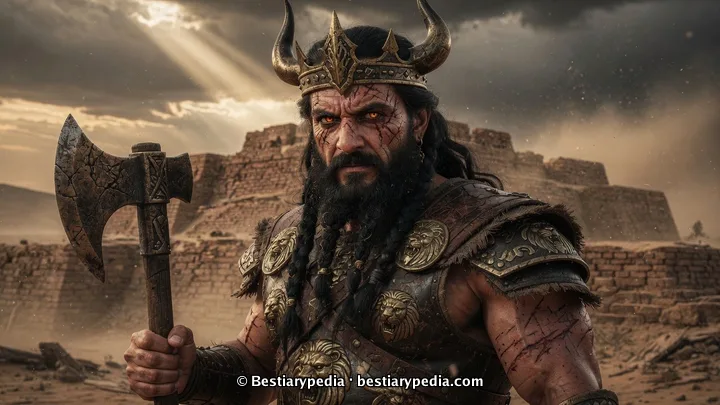
Lugalbanda, shepherd king of Uruk in Sumerian epics
Curated byBestiarypediaCreated onUpdated on
 Mesopotamia(Iraq)
Family Tree

Mythical and Historical Origins of Lugalbanda
Lugalbanda appears in the ancient Sumerian king lists as the second ruler of the First Dynasty of Uruk, succeeding his brother Meshkiangasher, who ruled 324 years according to tradition, and preceding Dumuzi the Fisherman, considered the father of Gilgamesh in some versions. His Sumerian name, lugal banda, translates literally as 'shepherd king' or 'young king', evoking a humble origin from pastoral labors to royalty, a recurring motif in Mesopotamian mythology that emphasizes ascent by divine favor. Although his historical existence remains debated among scholars, with possible roots in the Early Dynastic period (ca. 2900-2350 B.C.), the epics composed during the Third Dynasty of Ur (ca. 2100-2000 B.C.) immortalize him as leader of an ambitious military expedition toward Aratta, a mythical city in the remote eastern mountains, tentatively identified with regions in present-day Iran or the Pamir. These narratives, inscribed on cuneiform tablets found in Nippur, Abu Salabikh, and other sites, present him not only as a warrior king but as a pious hero, capable of invoking the gods in moments of crisis, setting precedents for the Gilgamesh cycle.
The Journey to the Mountains and Encounter with Anzu
In the epic 'Lugalbanda in the Mountain Cave' and its sequel 'Lugalbanda and the Anzû Bird', the shepherd king leads his seven brothers on a grueling march from Uruk to Aratta, crossing scorching deserts and scaling snow-capped peaks in search of lapis lazuli and precious metals for Inanna's temples. Exhausted by the trek, Lugalbanda falls ill with a mysterious ailment that leaves him prostrate in a remote cave, while his brothers continue without him, fearing his imminent death. Alone in the darkness, he offers fervent prayers to the great gods: Utu the sun in the morning, Nanna the moon at night, and finally Inanna, promising sacrifices if they grant him recovery. Miraculously, he awakens healthy and vigorous at dawn, with superhuman strength. In the second part, hungry in the heights, he prays again and is favored by Anzu, the mythical bird with a lion's body and eagle's wings, guardian of the tablets of destiny. Moved, Anzu grants him divine speed, allowing him to run like the wind and return swiftly to Uruk to lead the victory against Aratta.
Heroic Legacy and Connection to Gilgamesh
Lugalbanda's legacy transcends his individual epics to integrate into the vast Mesopotamian epic cycle, particularly as the direct progenitor of Gilgamesh, the Sumerian hero archetype, in king lists such as the Weld-Blundell and the Babylonian of Berosus. This filiation establishes a divine-human dynastic line in Uruk, where shepherd kings like him legitimize their authority through supernatural feats and divine favors, a pattern influencing later narratives like the Epic of Gilgamesh, where echoes of his journey and gifts of speed are perceived in the deeds of Uruk's king. His filial piety toward the gods, especially the pact with Anzu granting prophetic vision and cosmic agility, positions him as the ideal king model: humble, resilient, and blessed. In later Mesopotamian iconography, though scarce, references to lion-birds and flying heroes evoke his myth, while in Akkadian and Babylonian oral tradition he merges with figures like Etana, the king who ascends to heaven on an eagle. Thus, Lugalbanda embodies the transition from mythical to historical kingship, an eternal bridge between mortals and the divine in Sumerian culture.
Also known as
Relics
🏺 Bow of Lugalbanda
🏺 Feather of Anzu
Symbology
Element
Mountain
Number
7
Color
Blue
Animals
Anzu the mythical bird, Shepherd Sheep
Sigils:
🏷️ Traits
Powers
Weaknesses
Behavioral
Resistances
🗺️In the Atlas
Travel the beings’ world of origin and the cosmos of their dimensions.
📜 Mythologies
Mesopotamian mythology developed in the region situated between the Tigris and Euphrates rivers, in the territory that today corresponds to Iraq and bordering areas, and spans an extensive period that begins with Sumerian civilization around the fourth millennium BCE and continues through the Akkadian, Babylonian and Assyrian cultures until the Hellenistic era. Its tales were transmitted on clay tablets written in Sumerian and Akkadian, and reflect a worldview in which the gods controlled the forces of nature and human destiny, while kings acted as intermediaries between the divine world and society.
Sources
Lugalbanda in the Mountain Cave
Electronic Text Corpus of Sumerian Literature (ETCSL) · 2006
Sumerian text ETCSL 1.8.2.1 narrates Lugalbanda's illness and miraculous recovery during the Aratta expedition, preserved on cuneiform tablets from the 3rd millennium B.C.
Lugalbanda and the Anzû Bird
Electronic Text Corpus of Sumerian Literature (ETCSL) · 2006
Sumerian text ETCSL 1.8.2.2 describes Anzu's favor to Lugalbanda, granting him divine speed to return victorious to Uruk.
Sumerian King List
Anonymous (Sumerian tradition) · 2100 BCE
Sumerian document (c. 2100 BC) listing royal dynasties from before the Flood, mixing historical rulers with mythical reigns lasting thousands of years. A key bridge between history and myth in Mesopotamia.
Frequently asked questions
What position does Lugalbanda hold in the Sumerian king lists and how does he relate to the dynasty of Uruk?
Lugalbanda appears as the second ruler of the First Dynasty of Uruk in the ancient Sumerian king lists. He succeeds his brother Meshkiangasher and precedes Dumuzi the Fisherman. His name translates literally as 'shepherd king' and evokes a humble origin raised by divine favor.
What powers does Lugalbanda receive from Anzu and how does he use them in the expedition to Aratta?
Anzu grants Lugalbanda the power of divine speed after being favored by his prayers. This gift allows him to run like the wind and return swiftly to Uruk. With that speed he leads the military victory against Aratta.
What genealogical link unites Lugalbanda with Gilgamesh according to Mesopotamian traditions?
Lugalbanda is regarded as the direct progenitor of Gilgamesh in king lists such as the Weld-Blundell and the Babylonian of Berosus. This filiation establishes a divine-human dynastic line in Uruk. His example of piety and feats influences later narratives of the Gilgamesh cycle.
What iconographic and symbolic elements are associated with Lugalbanda in Mesopotamian tradition?
Tradition associates Lugalbanda with lion-birds like Anzu, snow-capped mountains and the number seven. These symbols evoke his journey to Aratta, endurance at altitude and the pact with the guardian of the tablets of destiny. Later references to flying heroes recall his myth.
🔖Cite this entry▾
If you cite this article in an academic, journalistic or editorial publication, use any of these formats:
Bestiarypedia. (2026, July 15). Lugalbanda. Bestiarypedia. https://bestiarypedia.com/en/beings/lugalbanda
Free citation with attribution and canonical link for editorial, academic or journalistic use. Full commercial reuse or creation of derivative products requires prior agreement.