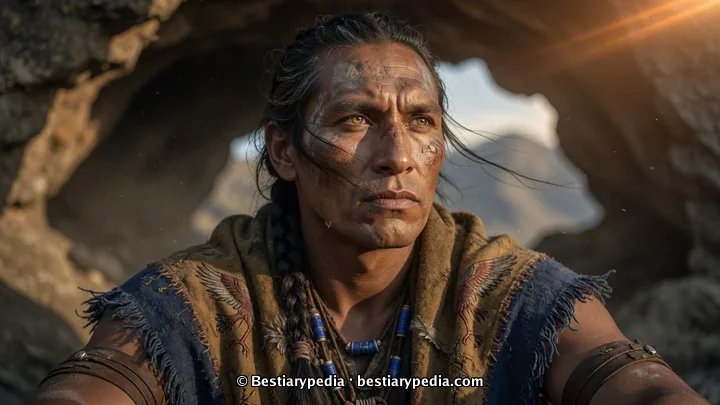
Gilgamesh
Gilgamesh, the semidivine king of Uruk and seeker of immortality
Curated byBestiarypediaCreated onUpdated on
 Mesopotamia(Iraq)
Family Tree


Mythical Origins of Gilgamesh
Gilgamesh, the semidivine king of Uruk in the ancient Mesopotamian epic, is described as the son of King Lugalbanda and the goddess Ninsun, making him two-thirds god and one-third man. In the Sumerian King List, he is recorded as a historical-mythical ruler who reigned for 126 years, symbol of absolute royal power. In the epic, he is presented as a hero who initially suffers from tyranny, builds the massive walls of Uruk that testify to his greatness, and is called to be tamed through the creation of Enkidu. These origins symbolize the tension between divine and human, where Gilgamesh embodies the royal ambition that challenges divine boundaries, derived from older Sumerian traditions like the myth of Gilgamesh, Enkidu, and Enki.
Enkidu and the Adventures
Enkidu, the strong wild man, was created from clay by the goddess Aruru to confront Gilgamesh's tyranny, but they became loyal friends after an initial struggle. Together, they traveled to the Cedar Forest, where they defeated its monstrous guardian Humbaba with the help of Shamash, the sun god, in an adventure showcasing their combat prowess and challenge to natural forces. Then they slew the Heavenly Bull sent by the goddess Ishtar after rejecting her advances, incurring the gods' wrath and leading to Enkidu's punishment by death, symbol of divine consequences for human hubris.
The Quest for Immortality
After Enkidu's death, Gilgamesh left Uruk seeking immortality, crossing dark mountain regions where he faced lions and scorpion-men, then desert and oceans with Urshanabi the ferryman until reaching Utnapishtim, the flood survivor. Utnapishtim recounted the divine flood story and revealed the youth plant at the sea bottom, stolen by a snake during Gilgamesh's return, shattering his hope for eternal life and accepting death as human fate.
Legacy and Cultural Impact
Gilgamesh is the oldest known literary hero, with the epic discovered in Ashurbanipal's library (7th c. BCE), influencing world literature as a symbol of human ambition, friendship, and acceptance of death. The walls of Uruk he built are glorified in the epic as an eternal monument. In modern culture, he inspired novels, films, and artworks, and is seen as the origin of flood myths like Noah's story, with Utnapishtim's poem paralleling the Bible.
Also known as
Relics
🏺 Gilgamesh Axe
Gilgamesh's massive axe used in heroic battles against monsters and gods, symbol of his superhuman strength.
🏺 Cedar Gates from Humbaba's Forest
Giant gates carved from cedar trees felled by Gilgamesh and Enkidu, a monument in Uruk.
Symbology
Element
Earth and Water
Number
11
Color
Black and Gold
Animals
Royal Lion, Heavenly Bull
Sigils:
🏷️ Traits
Powers
Weaknesses
Behavioral
Resistances
🗺️In the Atlas
Travel the beings’ world of origin and the cosmos of their dimensions.
📜 Mythologies
Mesopotamian mythology developed in the region situated between the Tigris and Euphrates rivers, in the territory that today corresponds to Iraq and bordering areas, and spans an extensive period that begins with Sumerian civilization around the fourth millennium BCE and continues through the Akkadian, Babylonian and Assyrian cultures until the Hellenistic era. Its tales were transmitted on clay tablets written in Sumerian and Akkadian, and reflect a worldview in which the gods controlled the forces of nature and human destiny, while kings acted as intermediaries between the divine world and society.
Sources
Epic of Gilgamesh
Sin-leqi-unninni (editor) · c. 2100–1200 BCE
The great Mesopotamian epic (2nd millennium BCE), preserved on cuneiform tablets. It recounts the deeds of King Gilgamesh and Enkidu, his quest for immortality and a primeval flood, and is an essential source of Sumerian and Babylonian gods and demons.
Sumerian King List
Anonymous (Sumerian tradition) · 2100 BCE
Sumerian document (c. 2100 BC) listing royal dynasties from before the Flood, mixing historical rulers with mythical reigns lasting thousands of years. A key bridge between history and myth in Mesopotamia.
Frequently asked questions
What does the Sumerian King List record about Gilgamesh's reign?
The Sumerian King List records Gilgamesh as a historical-mythical ruler who reigned for 126 years. This duration symbolizes absolute royal power. His origins present him as son of King Lugalbanda and goddess Ninsun.
What relationship unites Gilgamesh with Enkidu in the epic?
Enkidu was created from clay by the goddess Aruru to confront Gilgamesh's tyranny. After an initial fight they became loyal friends. Together they defeated Humbaba and the Heavenly Bull sent by Ishtar.
What do the walls of Uruk symbolize in the Gilgamesh tradition?
Gilgamesh built the massive walls of Uruk that testify to his greatness. These structures are glorified in the epic as an eternal monument. They represent royal power and the hero's enduring legacy.
What role does Utnapishtim play in Gilgamesh's quest for immortality?
Utnapishtim, the flood survivor, recounted the divine flood story and revealed the youth plant. This plant was stolen by a snake during Gilgamesh's return. The encounter led the hero to accept death as human fate.
🔖Cite this entry▾
If you cite this article in an academic, journalistic or editorial publication, use any of these formats:
Bestiarypedia. (2026, July 14). Gilgamesh. Bestiarypedia. https://bestiarypedia.com/en/beings/gilgamesh
Free citation with attribution and canonical link for editorial, academic or journalistic use. Full commercial reuse or creation of derivative products requires prior agreement.