Uranus
Uranus, the primordial sky, husband of Gaia and father of the Titans
Curated byBestiarypediaCreated onUpdated on
 Ancient Greece(Greece)
Family Tree

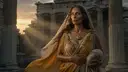
Mythical Origins of Uranus
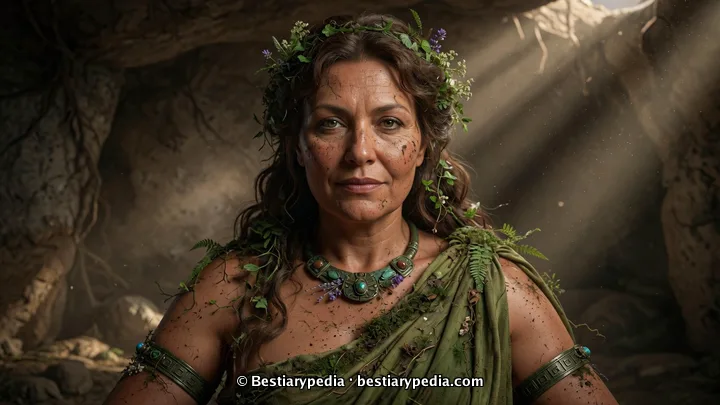
Uranus is the starry sky understood as body and as person. Unlike other primordial powers, he does not arise from Chaos: Hesiod's Theogony says that Gaia engendered him alone, without mediating union, and made him equal to herself in extension so that he would cover her completely and serve as a safe dwelling for the gods. Son of the Earth before her husband, he embodies the vault that stretches over the world and delimits it. His name, ouranós, is the current Greek word for sky, and his image is literal: an immense body extended over Gaia, so close to her that there is no space between them. The Romans called him Caelus. Other traditions, such as the Titanomachy attributed to Eumelus, gave him Ether as father, but the Hesiodic version is the one that prevailed.
Union with Gaia and Offspring
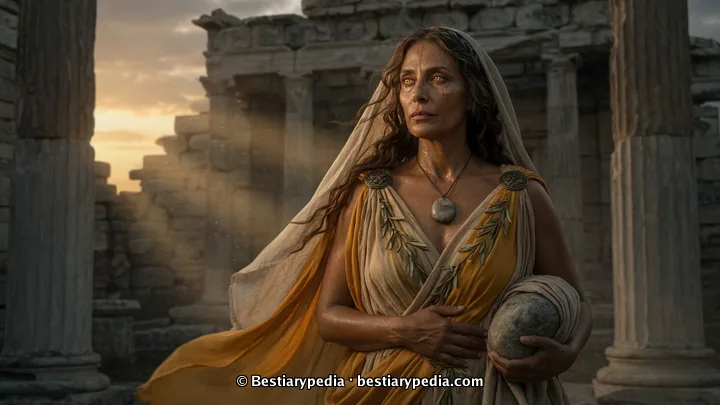
Uranus unites with his mother and begets the first divine generation: the twelve Titans, the three one-eyed Cyclopes (Brontes, Steropes and Arges) and the three Hecatonchires of a hundred arms and fifty heads (Cottus, Briareus and Gyges). But he abhors his children and does not allow them to be born into the light: he pushes them back into Gaia's womb as they appear, and he takes pleasure in that work of his. The reason is fear, because he knows that one of them will overthrow him. The result is a clogged cosmos: the children cannot come out and the Earth cannot give birth. That blockage, and not a power dispute, is what sets in motion all subsequent Greek mythology.
The Castration and Its Legacy
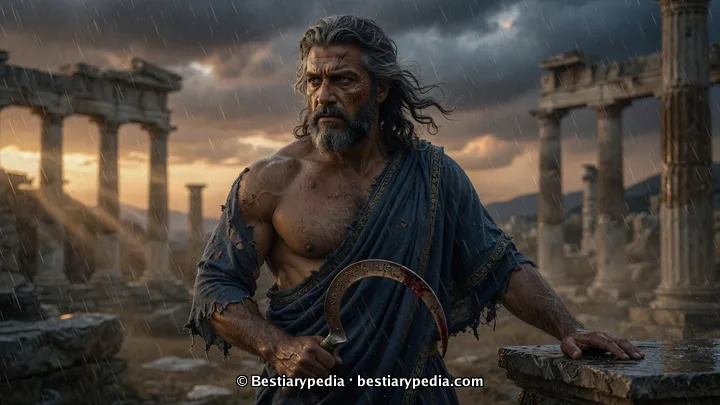
Gaia forges an adamant sickle and asks her children to avenge her; only Cronus accepts. Ambushed by his mother, he cuts off his father's genitals at the moment he stretches over her and throws them behind him. From the blood that soaks the earth are born the Erinyes, the Giants and the Meliae nymphs; from the foam formed by the remains in the sea arises Aphrodite, who lands in Cyprus. Finally separated sky and earth, the space where the world fits remains. Wounded, Uranus gives his children the name Titans, those who forced, and prophesies punishment to them: Cronus will be dethroned by his own son, just as he was. That prophecy is the engine of the divine succession, and it is fulfilled when Zeus overthrows his father.
Also known as
Relics
🏺 Cronus' Sickle
🏺 Sky Vault
Symbology
Element
Sky
Number
1
Color
Sky Blue
Animals
Celestial Eagle, Sky Falcon
Sigils:
🏷️ Traits
Powers
Weaknesses
Behavioral
Resistances
🗺️In the Atlas
Travel the beings’ world of origin and the cosmos of their dimensions.
📜 Mythologies
Greek mythology developed in Ancient Greece from the Late Bronze Age and reached its most elaborate form during the archaic and classical periods, between the 8th and 4th centuries BCE. It emerged among the Hellenic peoples who inhabited the Greek peninsula, the Aegean islands and the coasts of Asia Minor, and was transmitted mainly through the oral poetry of Homer and Hesiod, as well as local traditions collected in sanctuaries and festivals. Its worldview presents a universe ordered by a hierarchy of divinities that intervene in human and natural affairs, with Olympus as the dwelling of the principal gods and Hades as the destination of the deceased. The central deities include the twelve Olympians, headed by Zeus, god of the sky and sovereign, together with Hera, Poseidon, Athena, Apollo, Artemis, Aphrodite, Ares, Hephaestus, Hermes, Demeter and Dionysus. Before them, the Titans, among whom Cronus and Rhea stand out, ruled the cosmos until they were deposed by the Olympians in the Titanomachy. Other important entities are the Muses, the nymphs, the Cyclopes and the Moirai, who embody cosmic forces and destinies. This tradition exerted a lasting influence on the literature, art and thought of Rome, the European Renaissance and subsequent Western culture, supplying motifs, characters and narrative structures that have endured in philosophy, astronomy and the arts to the present day.
Sources
Theogony
Hesiod · -700
Poem by Hesiod detailing the origin of Greek gods and Titans.
Library of Apollodorus
Apolodoro · 2nd century AD
Apollodorus's Library (2nd century AD) is a mythological compendium summarizing Greek myths, including Uranus's lineage, children with Gaia, and castration.
Orphic Hymns
Orphic Tradition · 3rd cent. BC - 2nd cent. AD
The Orphic Hymns (3rd c. BCE - 2nd c. CE) invoke Gaia as nurturing mother and cosmos establisher, highlighting her fertility, role in earth oracles, and mediation in divine conflicts.
Frequently asked questions
From where is Urano born?
From Gea alone. It is a nuance that is often confused: from Chaos arise Gea, Tartarus and Eros, but Uranus is not among them. Hesiod says that the Earth begot him without mediating union and made him equal to herself in size, so that he would cover her completely.
Why was he locking up his own children?
Out of fear: he knew that one of them would overthrow him. As the titans, the cyclopes and the hecatonchires were being born, he pushed them back into the bosom of Gea without letting them come out to the light. The result was a clogged cosmos, where the Earth could not give birth and nothing new came to exist.
What happened when Cronos castrated him?
When the sky finally separated from the earth, the space where the world fits remained. From the spilled blood were born the Erinyes, the Giants and the Meliae; from the remains fallen into the sea, the foam from which Aphrodite emerged facing Cyprus. Wounded, Uranus called his sons Titans, «those who forced», and announced to them that they would pay for it.
Does it have anything to do with the planet Uranus?
The planet bears its name, but it was discovered in 1781, millennia after the myth. It is the only planet in the solar system with a Greek name instead of Latin: the others use the Roman form (Jupiter, Mars, Venus), while this one was given Uranus and not Caelus, its equivalent in Rome.
🔖Cite this entry▾
If you cite this article in an academic, journalistic or editorial publication, use any of these formats:
Bestiarypedia. (2026, July 20). Uranus. Bestiarypedia. https://bestiarypedia.com/en/beings/uranus
Free citation with attribution and canonical link for editorial, academic or journalistic use. Full commercial reuse or creation of derivative products requires prior agreement.