Ryūjin
Ryūjin, sovereign kami of the seas in Shintō mythology
Curated byBestiarypediaUpdated on
 Japan(Japan)
⇄ Cultural variants (1)
Origins in Shintō mythology
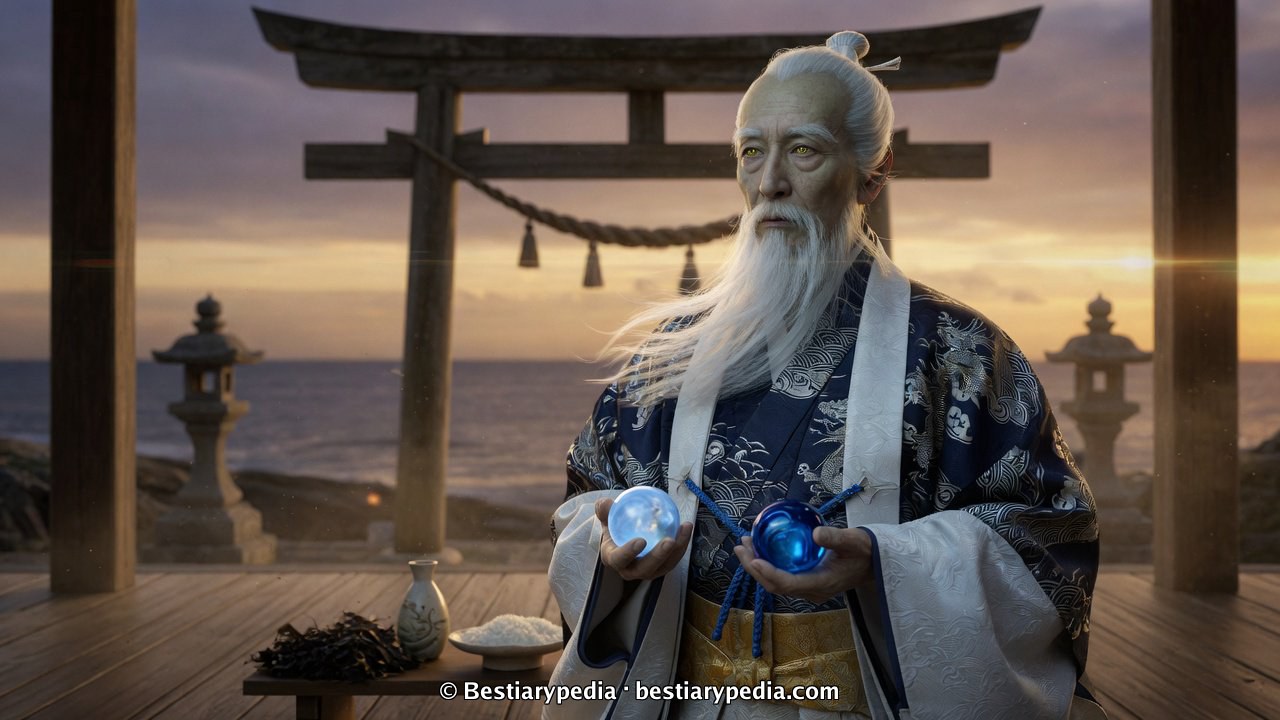
Ryūjin also called Watatsumi or Ōwatatsumi no Kami is the sovereign kami of the seas in Shintō mythology. His underwater palace Ryūgū-jō is located under the strait between Kyūshū and Okinawa. He receives worship at the Watatsumi-jinja shrine in Tsushima and at coastal shrines throughout the Japanese archipelago. He appears in the oldest canonical texts of Japan the Kojiki of 712 CE and the Nihon Shoki of 720 CE. His figure represents the adaptation of continental Sino-Buddhist traditions to the native Shintō substrate.
Episode of Hoori and Toyotama-hime
The central myth recounts how Hoori grandson of Amaterasu loses his brother's fishhook and descends to Ryūjin's palace. There he marries Toyotama-hime daughter of Ryūjin. After three years Toyotama gives birth to the father of the first emperor Jimmu. Hoori spies on her during childbirth seeing her in the form of a giant dragon. Toyotama separates due to the affront and leaves her sister Tamayori-hime raising the child. This episode explains the dynastic origin of the Japanese imperial lineage according to the Kojiki.
Powers and tide pearls
Ryūjin possesses the two tide pearls the pearl of the flow shio-mitsu-tama and the pearl of the ebb shio-furu-tama that control the tides at will. He exercises dominion over sea storms tsunamis and fishing life. His daughters Toyotama-hime and Tamayori-hime are dynastic figures of imperial Japan of the Yamato lineage. He can switch between elderly human form and giant draconic form following the pattern of the Chinese Long Wang. His associated number is two for the pearls and three for the claws of the Japanese dragon.
Cultural parallels and reception
Ryūjin is a direct cultural variant of Ao Guang the east sea dragon king and of the Korean Yongwang. It presents a distant parallel with the Hindu Nāgarāja. It appears in later Japanese literature such as the tale of Urashima Tarō and references in the Genji Monogatari. Hokusai paintings show dragon-waves. Its dynastic character links it as an ally of Amaterasu in the Yamato lineage. It is also culturally associated with Quetzalcoatl as an aquatic cosmic serpent.
Relics
🏺 The two tide pearls (shio-mitsu-tama and shio-furu-tama)
🏺 Underwater palace Ryūgū-jō
🏺 Daughter-princess Toyotama-hime
Symbology
Element
Seawater
Number
2 and 3
Color
Navy blue with silver
Animals
Japanese dragon, Sea turtle, Koi carp
Sigils:
🏷️ Traits
Powers
Weaknesses
Behavioral
Resistances
🔗 Relations with other beings
Cultural variant of
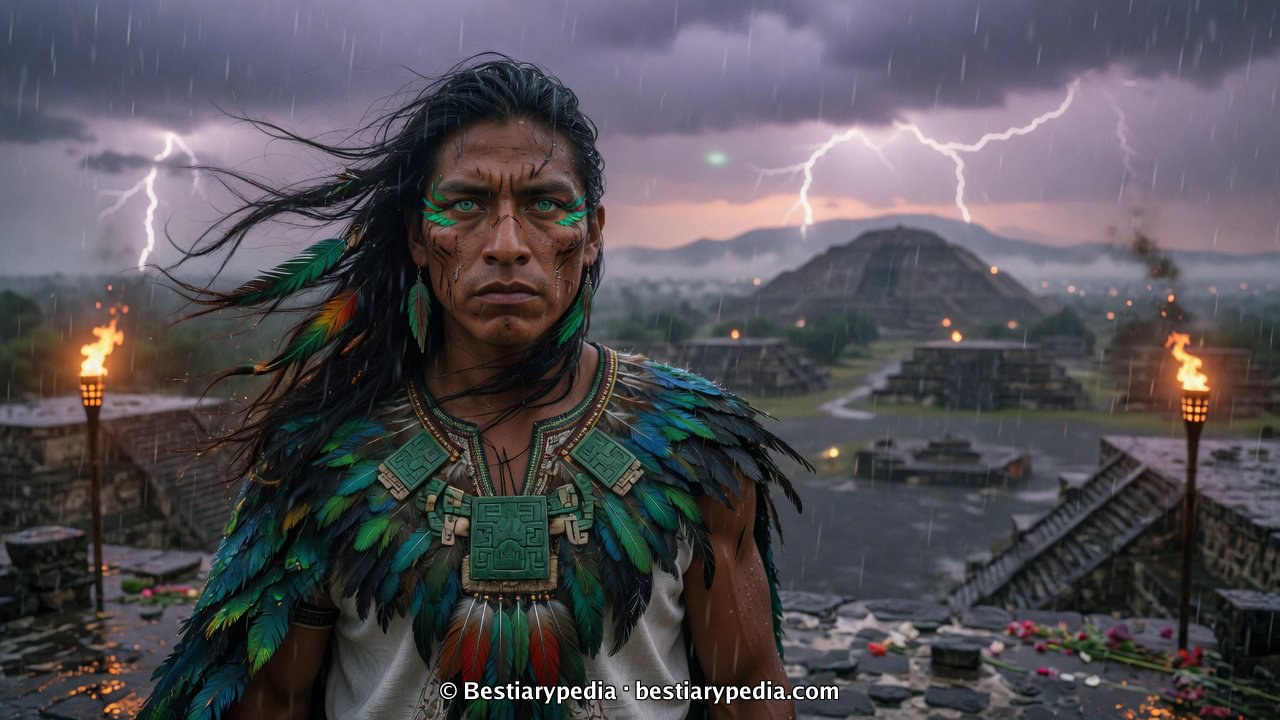
Ryūjin is a cultural variant of Quetzalcoatl as a cosmic aquatic serpent.
🗺️In the Atlas
Travel the beings’ world of origin and the cosmos of their dimensions.
📜 Mythologies
Japanese folklore encompasses oral traditions, myths, legends and supernatural creatures like yōkai and kami, compiled in Edo-period illustrated texts by Toriyama Sekien in works like Gazu Hyakki Yagyō and Konjaku Hyakki Shūi, reflecting Shinto animist beliefs, ecological fears of floods and droughts, and respect for nature in rivers, lakes and rice fields of regions like Shiga, Osaka and Kyoto.
Sources
Kojiki
Ō no Yasumaro · 712
Foundational Japanese text of 712 CE recording myths and imperial genealogies.
Nihon Shoki
Prince Toneri · 720
Official Japanese chronicle of 720 CE complementing the Kojiki with mythic variants.
🔖Cite this entry▾
If you cite this article in an academic, journalistic or editorial publication, use any of these formats:
Bestiarypedia. (2026). Ryūjin. Bestiarypedia. https://bestiarypedia.com/en/beings/ryujin-japanese-sea-dragon-king
Free citation with attribution and canonical link for editorial, academic or journalistic use. Full commercial reuse or creation of derivative products requires prior agreement.