Melinoe
Melinoe, chthonic goddess of specters and nightmares in the Orphic tradition
Curated byBestiarypediaCreated onUpdated on
 Ancient Greece(Greece)
Family Tree


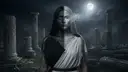
Mythical Origins of Melínoe
Melínoe emerges in the Orphic tradition as daughter of Perséfone, conceived when Zeus adopted the form of Hades or when Hades himself engendered her. The Orphic Hymns present her as chthonic deity born in the underworld, linked to the cycle of death and regeneration. Her origin reflects the fusion of Zeus and Hades in the Orphic theology, where divine identities overlap to explain subterranean forces. This genealogy places her as sister or half sister of figures like Zagreo and Macaria, emphasizing her role in the ancient Greek chthonic pantheon.
Appearance and Attributes of Melínoe
Melínoe possesses a body divided into two contrasting halves, one black like the night of the underworld and another white like the light of the moon, symbolizing the duality between life and death. She carries lit torches that illuminate the paths of the specters and terrify mortals during their nocturnal rounds. This bodily bichromy represents the border between the visible and the invisible world, while her torches evoke the chthonic fire that guides or pursues wandering souls. Her form evokes terror and simultaneous revelation in Orphic mythology.
Functions and Symbology of Melínoe
Melínoe traverses the night sending ghosts and terrors to the mortals, acting as messenger of nightmares and oneiric disturbances from the underworld. Her torches and bodily bichromia symbolize the transition between the realm of the living and that of the dead, as well as the revelation of hidden truths by means of fear. In the Orphic cosmology she represents the terrifying aspect of the beyond that maintains the moral order through reverential fear. Her cult involved nocturnal rituals to appease her spectral sendings and obtain protection against oneiric evils.
Cult and sources of Melínoe
The only ancient source that names her directly is the Orphic Hymn 71, a brief invocation text that asks her to drive away the madness of the soul and appease the specters that she herself sends. Her name reappears engraved on a magical lead tablet found in Pergamon, used in necromancy rituals, which confirms her practical role in Hellenistic chthonic magic. The devotees offered her nocturnal libations of milk and honey to calm her apparitions and protect themselves from nightmares. Scholars link her etymology both to propitiatory sweetness and to the blackness of the underworld, in accordance with her double-colored body.
Relics
🏺 Orphic torch
Torch with which Melinoe, daughter of Persephone, roams the night guiding the specters.
Symbology
Element
Specter
Number
2
Color
Black and white
Animals
Bat
Sigils:
🏷️ Traits
Powers
Weaknesses
Behavioral
Resistances
🗺️In the Atlas
Travel the beings’ world of origin and the cosmos of their dimensions.
📜 Mythologies
Greek mythology developed in Ancient Greece from the Late Bronze Age and reached its most elaborate form during the archaic and classical periods, between the 8th and 4th centuries BCE. It emerged among the Hellenic peoples who inhabited the Greek peninsula, the Aegean islands and the coasts of Asia Minor, and was transmitted mainly through the oral poetry of Homer and Hesiod, as well as local traditions collected in sanctuaries and festivals. Its worldview presents a universe ordered by a hierarchy of divinities that intervene in human and natural affairs, with Olympus as the dwelling of the principal gods and Hades as the destination of the deceased. The central deities include the twelve Olympians, headed by Zeus, god of the sky and sovereign, together with Hera, Poseidon, Athena, Apollo, Artemis, Aphrodite, Ares, Hephaestus, Hermes, Demeter and Dionysus. Before them, the Titans, among whom Cronus and Rhea stand out, ruled the cosmos until they were deposed by the Olympians in the Titanomachy. Other important entities are the Muses, the nymphs, the Cyclopes and the Moirai, who embody cosmic forces and destinies. This tradition exerted a lasting influence on the literature, art and thought of Rome, the European Renaissance and subsequent Western culture, supplying motifs, characters and narrative structures that have endured in philosophy, astronomy and the arts to the present day.
Sources
Detailed lexicon of Greek and Roman mythology
Wilhelm Heinrich Roscher · 1884-1890
Monumental lexicon of Greek and Roman mythology edited by W. H. Roscher (1884-1937), a scholarly reference work in the public domain.
Magical apparatus of Pergamon (curse tablet)
Anonymous inscription (ed. Richard Wünsch) · 3rd century AD (ed. 1905)
Greek magical apparatus found at Pergamon, with curse tablets and a bronze plate for rituals of invocation and divination.
Orphic Hymns
Orpheus (attributed) · -300
Collection of ancient Greek hymns attributed to Orpheus invoking chthonic deities such as Melinoe.
Frequently asked questions
How does the Orphic tradition describe Melinoe's origin?
Melinoe is born of Persephone after union with Zeus disguised as Hades or with Hades. The Orphic Hymns link her to the chthonic underworld.
What does Melinoe's bichromatic body symbolize?
It represents the duality between life and death and the boundary between visible and invisible worlds in Orphic mythology.
What relationship does Melinoe maintain with Hades and Persephone?
She is daughter of Persephone and of Hades or Zeus in Hades' form according to Orphic tradition, integrating the chthonic lineage.
🔖Cite this entry▾
If you cite this article in an academic, journalistic or editorial publication, use any of these formats:
Bestiarypedia. (2026, August 3). Melinoe. Bestiarypedia. https://bestiarypedia.com/en/beings/melinoe
Free citation with attribution and canonical link for editorial, academic or journalistic use. Full commercial reuse or creation of derivative products requires prior agreement.
Similar beings
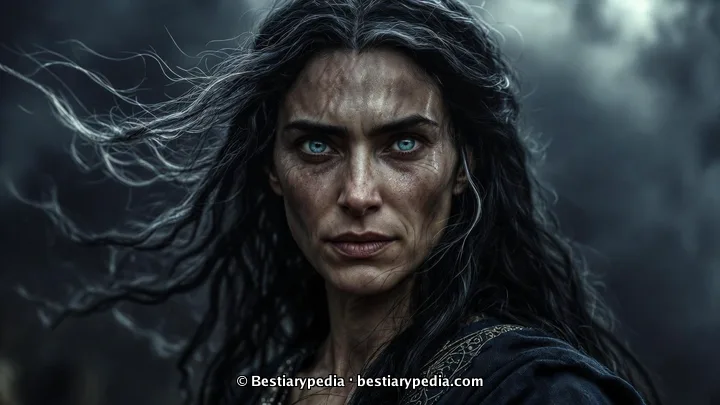
Hecate
Hecate, Greek goddess of magic, the moon, and crossroads
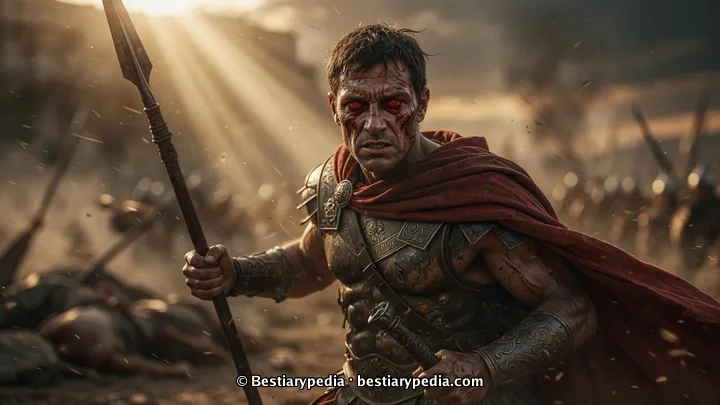
Ares
Ares, the Olympian Greek god of war, violence and martial ardor
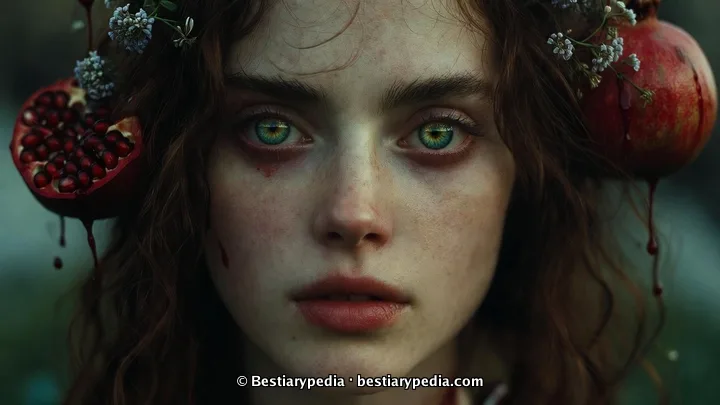
Persephone
Persephone, goddess of rebirth, vegetation and queen of the underworld
Demeter
Demeter, Greek goddess of agriculture, grain and harvests
Hestia
Hestia, goddess of the home, sacred fire, and family in Greek mythology
Artemis
Artemis, Greek goddess of the hunt, the moon and chastity