Susanoo
Susanoo, kami of the storm and the sea in Japanese Shinto folklore
Curated byBestiarypediaCreated on
 Japan(Japan)
Family Tree


Mythical Origins of Susanoo
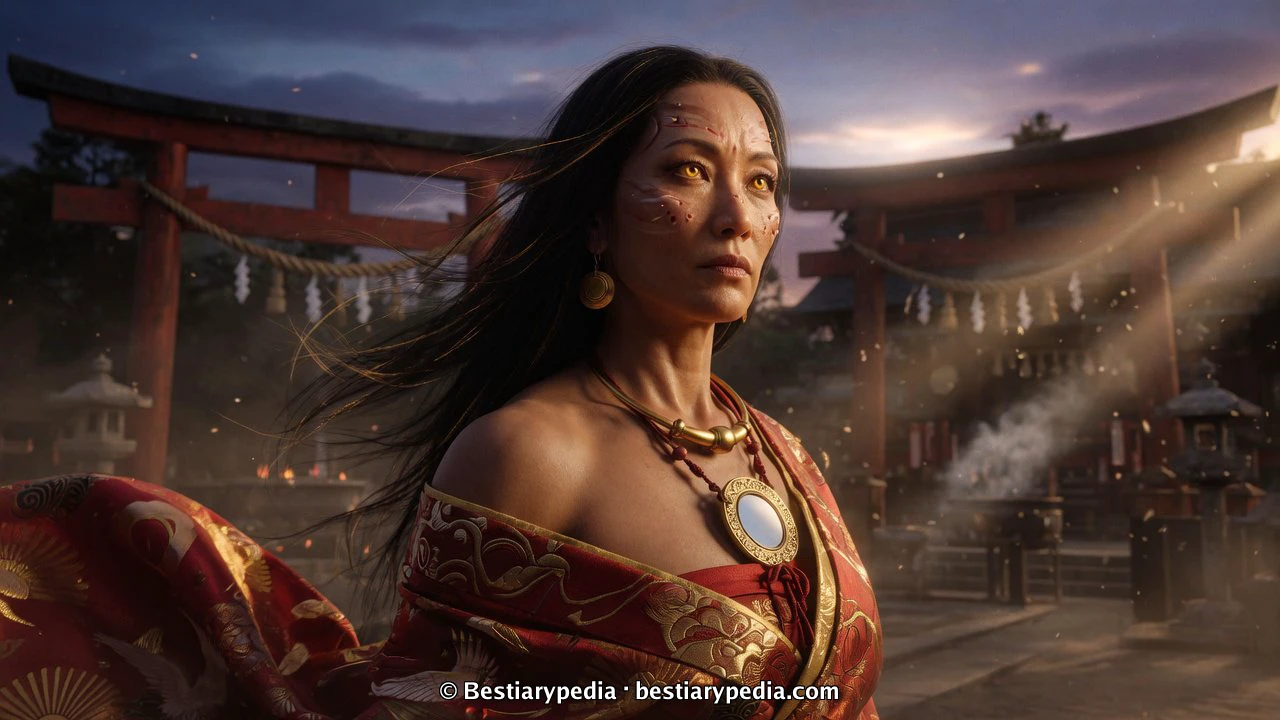
Susanoo emerges in the ancient texts of Japanese Shinto folklore as one of the three kami born from Izanagi's purification after his descent to the underworld. In the Kojiki he is described as the kami of the storm and the sea, brother of Amaterasu and Tsukuyomi, endowed with an innate tempestuous strength that distinguishes him by his wrath and heroism. His birth marks the beginning of cycles of expulsion and redemption that define his divine character in the sacred geography of Japan.
Expulsion Purification and Exploits of Susanoo
After causing chaos in the heavens with his tempestuous wrath Susanoo is expelled from Takamagahara by Amaterasu. In his exile he descends to the land of Izumo where he confronts the eight-headed serpent Yamata no Orochi. After purifying himself in the Hi River he defeats the monster and extracts the Kusanagi sword from its tail. This act of heroism transforms his wrath into divine protection and establishes his bond with serpents and sacred weapons in Japanese myths.
Symbols Powers and Legacy of Susanoo
The Kusanagi sword represents Susanoo's heroic power over marine chaos and storms while serpents symbolize both his tempestuous nature and his capacity for purification. His initial wrath gives way to protective heroism that influences Shinto rituals of exorcism and fertility in Japan. This legacy endures in regional festivals and in the veneration of sacred sites linked to the sea and wind.
Legacy, Cult and Descendants of Susanoo
After subduing Yamata-no-Orochi, Susanoo settled in the land of Izumo, where he built a palace at Suga and married Kushinada-hime, the maiden he had saved from the monster. From that union descended a lineage of earthly kami that culminated in Ōkuninushi, the great lord of Izumo who would later cede the land to Amaterasu's heavenly descendants. In time, Susanoo came to rule Ne-no-Kuni, the deep land of roots associated with the underworld, from where he continued to wield his ambivalent power over life force and destruction. Later Shinto venerated him as a deity who protects against plagues and calamities: at the great Yasaka Shrine in Kyoto and in the many Gion temples he is invoked to ward off epidemics, and the Gion Matsuri festival celebrates each summer his power to purify and turn away misfortune. This dual aspect —the tempestuous, excessive kami banished from heaven and the protecting hero who saves humankind— sums up Susanoo's complex nature within the Shinto pantheon.
Also known as
Relics
🏺 Kusanagi-no-Tsurugi
Sacred sword Susanoo drew from the tail of the serpent Yamata-no-Orochi and offered to Amaterasu; it became one of Japan's three imperial regalia.
Symbology
Element
Storm
Number
8
Color
Blue
Animals
Serpent Yamata no Orochi
Sigils:
🏷️ Traits
Powers
Weaknesses
Behavioral
Resistances
🔗 Relations with other beings
🗺️In the Atlas
Travel the beings’ world of origin and the cosmos of their dimensions.
📜 Mythologies
Japanese folklore encompasses oral traditions, myths, legends and supernatural creatures like yōkai and kami, compiled in Edo-period illustrated texts by Toriyama Sekien in works like Gazu Hyakki Yagyō and Konjaku Hyakki Shūi, reflecting Shinto animist beliefs, ecological fears of floods and droughts, and respect for nature in rivers, lakes and rice fields of regions like Shiga, Osaka and Kyoto.
Sources
Shinto: The Way of the Gods, by W. G. Aston
William George Aston · 1905
Classic study by the British orientalist W. G. Aston on the Shinto religion: its myths, kami, rites and texts, a reference work in the public domain.
Kojiki
Ō no Yasumaro · 712
Foundational Japanese text of 712 CE recording myths and imperial genealogies.
Nihon Shoki
Prince Toneri · 720
Official Japanese chronicle of 720 CE complementing the Kojiki with mythic variants.
Frequently asked questions
How does Susanoo's wrath influence his acts of purification?
Susanoo's tempestuous wrath precedes his purification in the Hi River and the defeat of Orochi. This contrast transforms his destructive strength into protective heroism according to Kojiki myths.
What relationship exists between Susanoo and the Kusanagi sword?
Susanoo extracts the Kusanagi from Orochi's tail after his victory. The sword embodies his dominion over storms and marine chaos in Shinto tradition.
In what way do serpents symbolize Susanoo's attributes?
Serpents embody Susanoo's tempestuous wrath and purifying strength. His confrontation with Orochi illustrates the transition from chaos to divine protection in the myths.
🔖Cite this entry▾
If you cite this article in an academic, journalistic or editorial publication, use any of these formats:
Bestiarypedia. (2026, August 3). Susanoo. Bestiarypedia. https://bestiarypedia.com/en/beings/susanoo
Free citation with attribution and canonical link for editorial, academic or journalistic use. Full commercial reuse or creation of derivative products requires prior agreement.
Similar beings
Izanami
Izanami, creator kami of death and the underworld in the Shinto pantheon
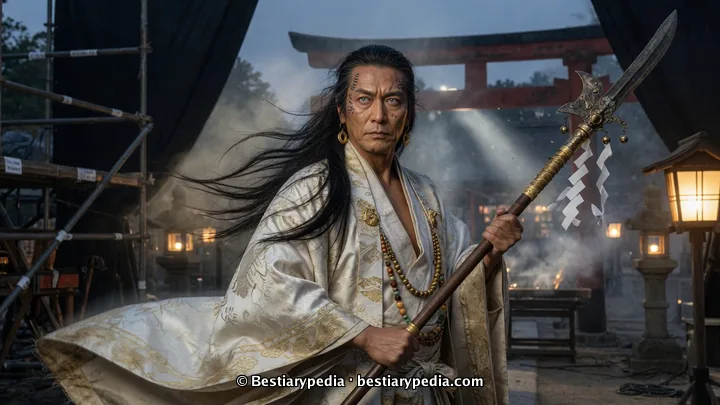
Izanagi
Izanagi, creator kami of the islands of Japan and the principal deities
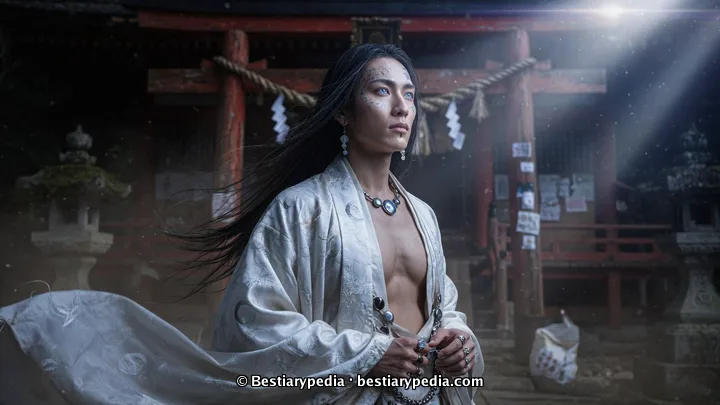
Tsukuyomi
Tsukuyomi, kami of the moon in the Shinto pantheon
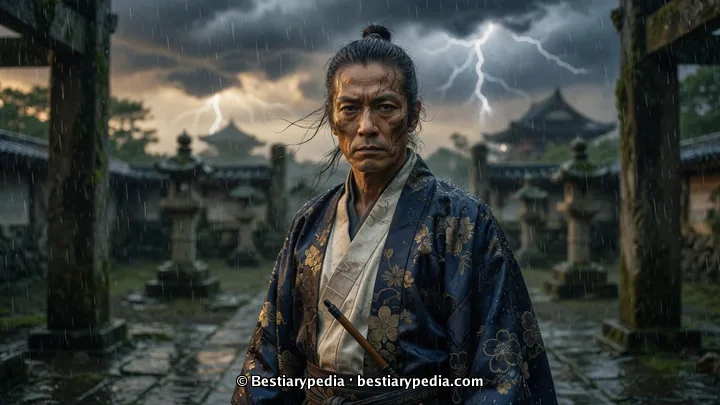
Tenjin
Tenjin, god of lightning and scholarship in the Shinto pantheon
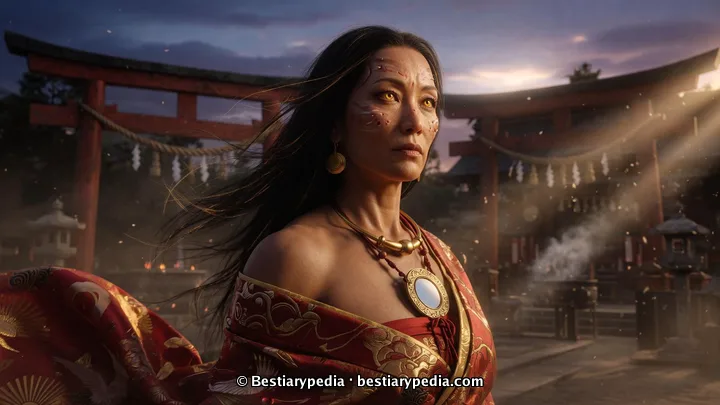
Amaterasu
Amaterasu, goddess of the sun and imperial ancestor in the Shinto pantheon