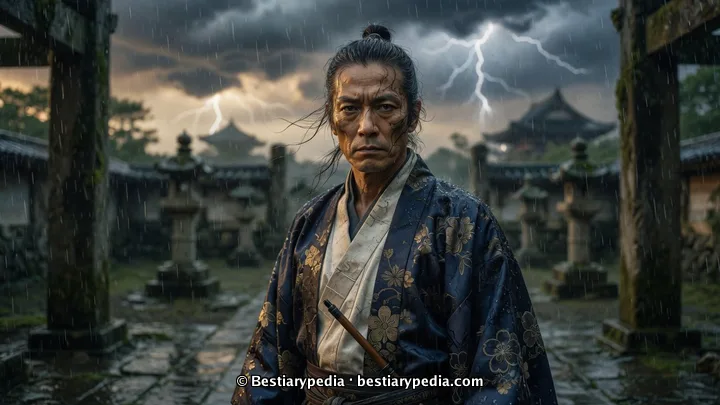
Amaterasu
Amaterasu, goddess of the sun and imperial ancestor in the Shinto pantheon
Curated byBestiarypediaCreated onUpdated on
 Japan(Japan)
Origins of Amaterasu
Amaterasu Ōmikami, «the great deity who shines in the sky», is the sun goddess and the main divinity of the Japanese Shinto pantheon. According to the Kojiki (712) and the Nihon Shoki (720), she was born from the left eye of the god Izanagi while he was purifying himself (misogi) after returning from the underworld; from his right eye emerged Tsukuyomi, god of the moon, and from his nose Susanoo, god of storms. Izanagi entrusted Amaterasu with the government of Takamagahara, the High Plain of Heaven. As the source of light and order, she became the divine ancestor of the Japanese imperial house, whose legitimacy is derived from her, and the guarantor of rice fertility and the country's prosperity.
The myth of the celestial cave
The most celebrated tale of Amaterasu is that of the celestial cave (Ama-no-Iwato). Her brother Susanoo, in a fit of fury, devastated the rice fields, profaned the shrines and threw a flayed celestial horse into the workshop where the weavers worked, causing a death. Horrified and offended, Amaterasu shut herself in a cave and sealed the entrance with a rock, plunging the sky and the earth into darkness and unleashing all kinds of calamities. The eight million kami gathered to make her come out: they hung jewels and a great mirror (the Yata no Kagami) from a sakaki tree, and the goddess Ame-no-Uzume performed a comic and shameless dance that made the gods burst into laughter. Intrigued by the uproar, Amaterasu peered out; upon seeing her own radiance reflected in the mirror she approached, and the burly Ame-no-Tajikarao took her by the hand and pulled her out, while a sacred rope (shimenawa) was stretched to prevent her return. Thus light returned to the world.
Cult and Legacy
The Yata no Kagami mirror that made Amaterasu come out of the cave is counted among the Three Sacred Treasures of Japan, insignia of the imperial legitimacy, together with the sword and the jewel. Its cult is concentrated in the Grand Sanctuary of Ise, the most venerated of Shintoism, where for centuries an imperial princess (the saiō) exercised as priestess and where the inner sanctuary is ritually reconstructed every twenty years. According to the myth, Amaterasu sent her grandson Ninigi to govern the earth, and from him the first emperor, Jimmu, would descend, founding the imperial lineage. Symbol of the rising sun that gives name to the country, Amaterasu endures as one of the central divinities of the Japanese cultural and religious identity.
Relics
🏺 Yata Mirror
Symbology
Element
Sun
Number
1
Color
Gold
Animals
Crow Yatagarasu
Sigils:
🏷️ Traits
Powers
Weaknesses
Behavioral
Resistances
🔗 Relations with other beings
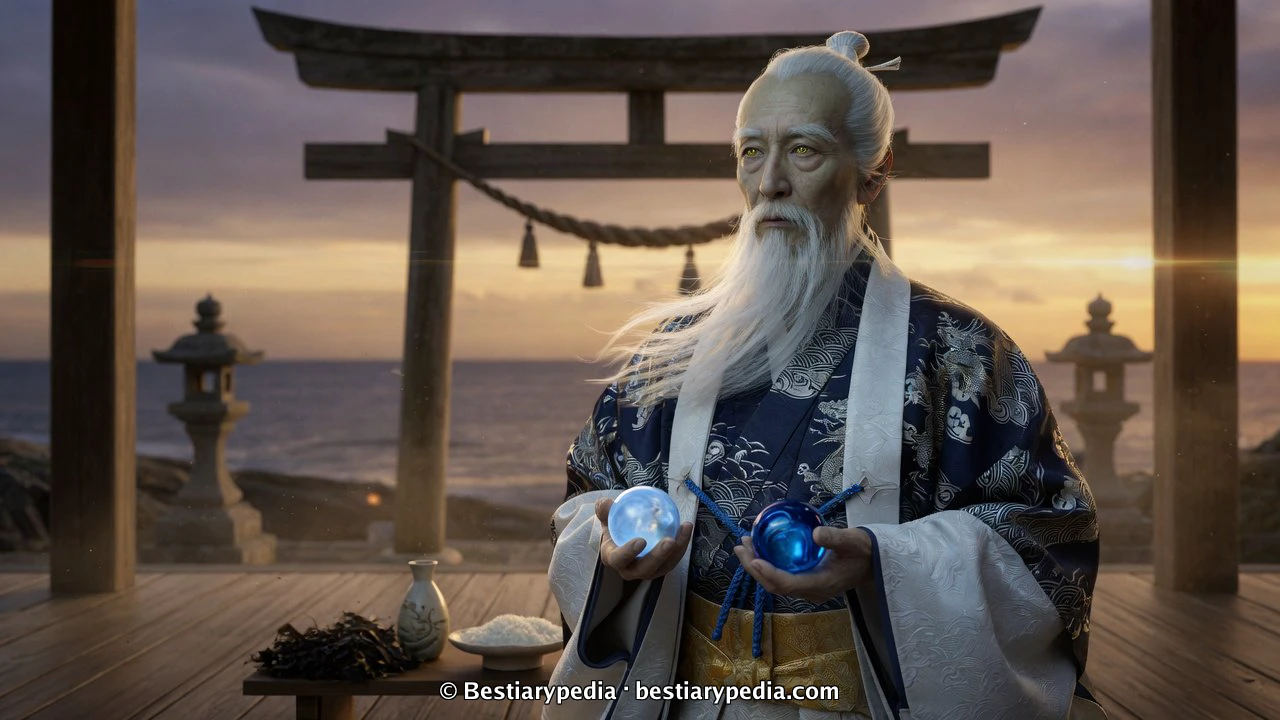
🗺️In the Atlas
Travel the beings’ world of origin and the cosmos of their dimensions.
📜 Mythologies
Japanese folklore encompasses oral traditions, myths, legends and supernatural creatures like yōkai and kami, compiled in Edo-period illustrated texts by Toriyama Sekien in works like Gazu Hyakki Yagyō and Konjaku Hyakki Shūi, reflecting Shinto animist beliefs, ecological fears of floods and droughts, and respect for nature in rivers, lakes and rice fields of regions like Shiga, Osaka and Kyoto.
Sources
Kojiki
Ō no Yasumaro · 712
Foundational Japanese text of 712 CE recording myths and imperial genealogies.
Nihon Shoki
Prince Toneri · 720
Official Japanese chronicle of 720 CE complementing the Kojiki with mythic variants.
Frequently asked questions
How is Amaterasu born according to ancient Shinto texts?
Amaterasu is born from Izanagi's left eye after his purification. This origin directly links her to the Japanese imperial lineage and solar cosmic order.
What main attributes characterize Amaterasu in the Shinto pantheon?
The Yata no Kagami mirror, yatagarasu crows and rice symbolize her purity, divine guidance and agricultural blessing. These elements sustain her cult at Ise.
What family relations does Amaterasu maintain in Shinto mythology?
She is daughter of Izanagi and sister of Susanoo and Tsukuyomi. These connections structure the divine hierarchy and distribution of celestial domains.
🔖Cite this entry▾
If you cite this article in an academic, journalistic or editorial publication, use any of these formats:
Bestiarypedia. (2026, July 26). Amaterasu. Bestiarypedia. https://bestiarypedia.com/en/beings/amaterasu
Free citation with attribution and canonical link for editorial, academic or journalistic use. Full commercial reuse or creation of derivative products requires prior agreement.