Izanagi
Izanagi, creator kami of the islands of Japan and the principal deities
Curated byBestiarypediaCreated on
 Japan(Japan)
Family Tree
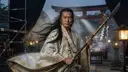
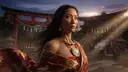

Mythical Origins of Izanagi
Izanagi emerges in the ancient Shinto texts as one of the primordial kami tasked by the celestial deities with shaping the world. Together with his consort Izanami he receives the order to descend from the floating bridge of heaven to stir the primordial ocean with the celestial spear Ama-no-Nuboko. The drops that fall from the spear when stirring the waters form the first island of Onogoro where both establish their dwelling. This narration appears in the Kojiki and the Nihon Shoki as the beginning of the creative process that will give rise to the Japanese archipelago and the principal deities. Izanagi represents the masculine principle of active creation and the subsequent ritual purification that allows the continuity of the cosmos.
Creation of the Islands and the Deities
After forming the initial island Izanagi and Izanami perform the ceremony of circumambulation around the celestial pillar and beget various islands that constitute the Japanese archipelago. Each island is born from the union of both kami and receives specific geographical attributes that reflect the real geography of Japan. Subsequently they generate the deities of the wind of the sea of the mountains and of fire. The birth of the fire kami causes the death of Izanami and marks the end of the shared creative phase. Izanagi then descends to the underworld to attempt to rescue her but returns transformed by the experience. This sequence establishes the model of divine parenthood and the separation between the world of the living and that of the dead in Shinto cosmology.
Purification Rituals and Descendants
Upon returning from the underworld Izanagi performs an extensive purification ritual in the river to remove the contamination of death. From his garments and from his body new deities are born including Amaterasu the sun goddess Tsukuyomi the moon god and Susanoo the storm god. These three principal kami represent the cosmic forces that govern the natural order and the fertility of Japan. The act of purification establishes the foundation of the misogi rites that continue to be practiced in Shinto shrines to restore purity. Izanagi subsequently retires to a celestial dwelling leaving his descendants to govern the world. His spear and the generated islands remain as eternal attributes of his creative and paternal power.
Relics
🏺 Ama-no-Nuboko
Jeweled heavenly spear with which Izanagi stirred the primordial ocean; the drops that fell from its tip formed Onogoro, the first island.
Symbology
Element
Sea water
Number
1
Color
Pure white
Animals
Sacred deer
Sigils:
🏷️ Traits
Powers
Weaknesses
Behavioral
Resistances
🔗 Relations with other beings
🗺️In the Atlas
Travel the beings’ world of origin and the cosmos of their dimensions.
📜 Mythologies
Japanese folklore encompasses oral traditions, myths, legends and supernatural creatures like yōkai and kami, compiled in Edo-period illustrated texts by Toriyama Sekien in works like Gazu Hyakki Yagyō and Konjaku Hyakki Shūi, reflecting Shinto animist beliefs, ecological fears of floods and droughts, and respect for nature in rivers, lakes and rice fields of regions like Shiga, Osaka and Kyoto.
Sources
Shinto: The Way of the Gods, by W. G. Aston
William George Aston · 1905
Classic study by the British orientalist W. G. Aston on the Shinto religion: its myths, kami, rites and texts, a reference work in the public domain.
Kojiki
Ō no Yasumaro · 712
Foundational Japanese text of 712 CE recording myths and imperial genealogies.
Nihon Shoki
Prince Toneri · 720
Official Japanese chronicle of 720 CE complementing the Kojiki with mythic variants.
Frequently asked questions
How did Izanagi use the celestial spear in creation?
Izanagi stirred the primordial ocean with the spear Ama-no-Nuboko. The drops that fell formed the first island. This act initiated the creation of the Japanese archipelago according to the Kojiki.
Which deities were born from Izanagi's purification ritual?
From Izanagi's body and garments emerged Amaterasu Tsukuyomi and Susanoo. They represent the sun the moon and storms. These births followed the misogi in the river after his return from the underworld.
What relationship exists between Izanagi and Izanami in the myths?
Izanagi and Izanami are divine consorts who together created the islands of Japan. After Izanami's death Izanagi tried to rescue her from the underworld. Their union and separation define the cosmology of creation and death.
🔖Cite this entry▾
If you cite this article in an academic, journalistic or editorial publication, use any of these formats:
Bestiarypedia. (2026, August 3). Izanagi. Bestiarypedia. https://bestiarypedia.com/en/beings/izanagi
Free citation with attribution and canonical link for editorial, academic or journalistic use. Full commercial reuse or creation of derivative products requires prior agreement.
Similar beings
Izanami
Izanami, creator kami of death and the underworld in the Shinto pantheon
Tsukuyomi
Tsukuyomi, kami of the moon in the Shinto pantheon
Susanoo
Susanoo, kami of the storm and the sea in Japanese Shinto folklore
Tenjin
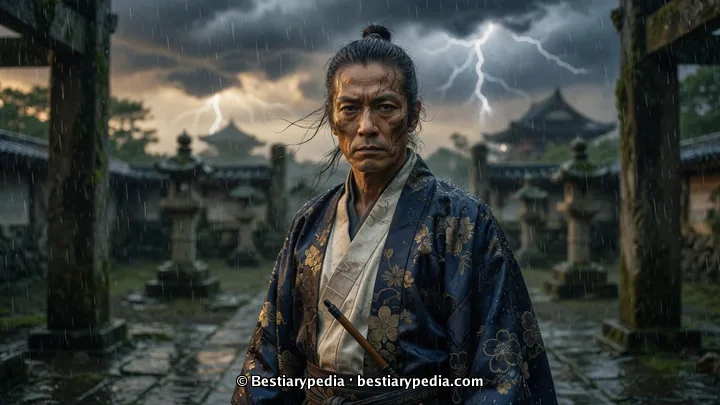
Tenjin, god of lightning and scholarship in the Shinto pantheon
Amaterasu
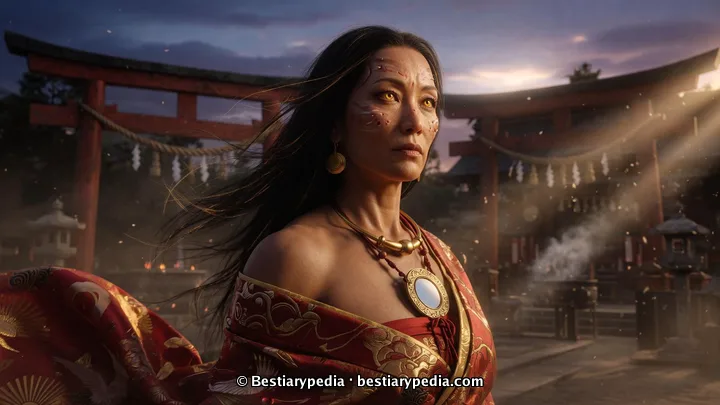
Amaterasu, goddess of the sun and imperial ancestor in the Shinto pantheon