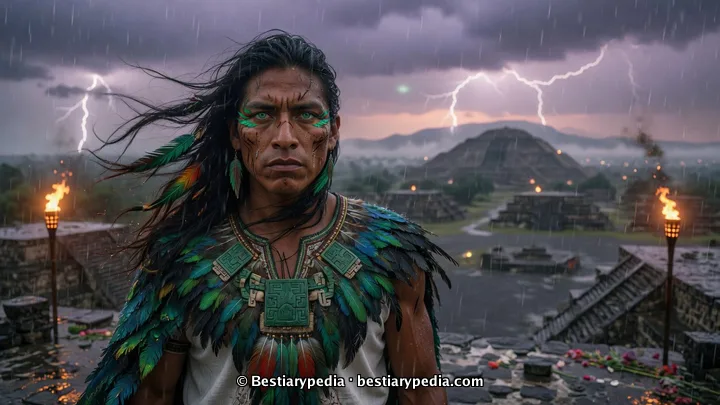
Coatlicue
Mother of Earth and Death
Curated byBestiarypediaCreated onUpdated on
 Central Mexico(Mexico)
Origins of Coatlicue
Coatlicue, whose name means 'Lady of the Serpent Skirt', is one of the oldest and most complex deities in Aztec mythology. According to the chronicles of indigenous informants collected by Fray Bernardino de Sahagún in his 'General History of the Things of New Spain', Coatlicue was the mother of the gods and the stars. Her creation myth is set at Coatepec Hill, 'Serpent Mountain', where she resided as a humble priestess. One day, while sweeping the temple, a ball of hummingbird feathers, symbol of Huitzilopochtli, fell from the sky and adhered to her waist. From this miraculous act she became pregnant with the sun god Huitzilopochtli, the youngest of her 400 children, known as the Centzon Huitznahua, the Southern Stars. This divine pregnancy provoked the wrath of her daughter Coyolxauhqui, goddess of the Moon, and her brothers, who conspired to decapitate their mother for dishonor. However, Huitzilopochtli was born fully armed, with fiery armor and the weapon xiuh cóatl, 'turquoise serpent', emerging from her womb to defend her. He killed Coyolxauhqui and dismembered her brothers, scattering their heads across the mountain, thus consolidating the cosmic order and the triumph of the Sun over the Moon and the stars.
Appearance and Symbolism
The most famous representation of Coatlicue is the monumental basalt sculpture found in 1790 in downtown Mexico City, now in the National Museum of Anthropology. This imposing 2.5-meter-high, 11-ton figure shows the goddess with a skirt of intertwined serpents held by a belt of scorpions, tarantulas, and shells. Her face is covered by two facing serpents forming a mask, symbolizing cosmic duality. Instead of hands, she has feline claws, and her breasts hang flaccid, dripping milk, representing devouring fertility and eternal nourishment. A necklace of human hearts and severed hands adorns her neck, while human skulls hang from her ears. Her feet trample a turtle or jaguar, evoking connection to the earth. This terrifying image reflects her ambivalent nature: creator mother and devourer of the 400 stars she sacrificed to make way for the Fifth Sun. The Spaniards feared it so much they tried to destroy it, breaking it in two, but it was reconstructed. It symbolizes the primordial earth, Tlalli, and the life-death-rebirth cycle, embodying terror and reverence before telluric forces.
Cult and Relationships
The cult of Coatlicue was central in the Templo Mayor of Tenochtitlán, dedicated alongside Huitzilopochtli, her defender son. The Aztecs venerated her as earth mother, offering human sacrifices to nourish the sun in its daily journey, reflecting her role in maintaining the Fifth Sun. Festivals like Toxcatl honored her destructive fertility with dances and blood offerings. In mythological relationships, she is mother of Huitzilopochtli, Coyolxauhqui, and the Centzon Huitznahua; wife or sister of Mixcoatl, god of hunting and the Milky Way; and ancestor of Quetzalcóatl in some versions. Identified with Cihuacóatl, 'Serpent Woman', warrior-maternal aspect, and Tlaltecuhtli, the monstrous earth. Her image influenced the Virgin of Guadalupe, colonial syncretism where the Guadalupana steps on the moon, echo of Coatlicue trampling the turtle-moon. In the pantheon, she embodies the devouring mother, opposed to benign goddesses like Xochiquetzal, but essential for Aztec cosmic balance, where creation demands constant destruction.
Also known as
Relics
🏺 Coatlicue Statue
Colossal Mexica statue of Coatlicue, serpent-skirted mother goddess, unearthed at the Templo Mayor.
Symbology
Element
Earth
Number
400
Color
Black
Animals
Snake
Sigils:
🏷️ Traits
Powers
Weaknesses
Behavioral
Resistances
🗺️In the Atlas
Travel the beings’ world of origin and the cosmos of their dimensions.
📜 Mythologies
Mesoamerican mythology encompasses the religious and cosmological traditions of the pre-Hispanic civilizations of Mesoamerica, including Olmecs, Zapotecs, Mixtecs, Mayas, Toltecs, and Aztecs. It stands out for its complex cosmogonies with cyclic eras of creation and destruction, primordial deities like Quetzalcoatl the Feathered Serpent and Tezcatlipoca, human sacrifice rituals to nourish the sun and the earth, sacred calendars like the tonalpohualli and the haab, and great ceremonial centers like Teotihuacán, Monte Albán, Palenque, Chichén Itzá, and Tenochtitlán. It reflects an animist, dualistic, and polytheistic worldview, influenced by trade, maize agriculture, and flowery wars.
Sources
Florentine Codex
Sahagún, Bernardino de · 1577
Illustrated encyclopedia of Nahua culture compiled by Friar Bernardino de Sahagún around 1577, in Nahuatl and Spanish. It describes in detail the Aztec deities—Quetzalcoatl, Tezcatlipoca, Tlaloc—and numerous beings of the Mesoamerican world.
Florentine Codex - Coatlicue
Bernardino de Sahagún · 1577
Reference and detailed description of the goddess Coatlicue in the Florentine Codex, compiled by fray Bernardino de Sahagún in the 16th century from Nahua indigenous informants, main colonial source on Mexica mythology.
Codex Borgia
Anonymous · c. 1500
Mesoamerican pictographic manuscript of ritual and divinatory content, predating the Spanish conquest. Filled with images of gods such as Quetzalcoatl, Tezcatlipoca and Mictlantecuhtli, it is a fundamental source of the religion and pantheon of central Mexico.
Frequently asked questions
How did the myth of Coatlicue originate on Coatepec Hill according to Sahagún's chronicles?
Coatlicue resided as a priestess on Coatepec Hill. A ball of hummingbird feathers fell from the sky and adhered to her waist, causing her miraculous pregnancy with Huitzilopochtli. This event provoked the wrath of Coyolxauhqui and her brothers, who conspired to decapitate her.
What physical and symbolic attributes does the monumental statue of Coatlicue present in the National Museum of Anthropology?
The statue displays a skirt of intertwined serpents, feline claws instead of hands, and breasts dripping milk. It includes a necklace of human hearts and severed hands, with two facing serpents covering her face as a mask of cosmic duality.
What mythological relationships does Coatlicue maintain with Huitzilopochtli, Coyolxauhqui and Mixcoatl?
Coatlicue is mother of Huitzilopochtli, the solar god born armed to defend her, and of Coyolxauhqui, the lunar goddess beheaded by her son. She is identified as wife or sister of Mixcoatl, god of hunting and the Milky Way, and ancestor of Quetzalcóatl in some versions.
What role does Coatlicue play in the cult of the Templo Mayor and in Aztec cosmic balance?
Her cult was central in the Templo Mayor alongside Huitzilopochtli. The Aztecs offered her human sacrifices to nourish the sun, reflecting her role in maintaining the Fifth Sun. She embodied the devouring mother essential for cosmic balance, where creation demands constant destruction.
🔖Cite this entry▾
If you cite this article in an academic, journalistic or editorial publication, use any of these formats:
Bestiarypedia. (2026, August 3). Coatlicue. Bestiarypedia. https://bestiarypedia.com/en/beings/coatlicue
Free citation with attribution and canonical link for editorial, academic or journalistic use. Full commercial reuse or creation of derivative products requires prior agreement.