Estrie
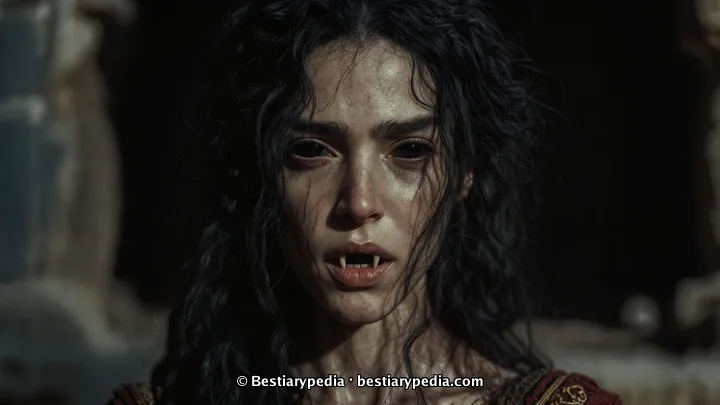
Estrie, medieval Ashkenazi Jewish vampire that takes the form of a bird or cat
Curated byBestiarypediaCreated onUpdated on


 +1Ashkenazi Europe(Romania, Poland, Russia, Germany)
⇄ Cultural variants (3)


4 beings in the lineage
Mythical origins of the estrie
The estries descend from creatures formed at the twilight of the sixth day of creation, when God no longer had time to complete their bodies. The Sefer Hasidim describes them as living women of the Ashkenazi community who, by night, take the form of a bird or cat to fly and drink the blood of children and men. Their name derives from the Latin strix, the Roman blood-sucking owl, linking them to the striga and the Romanian strigoi. This unfinished lineage explains their need for blood to survive and their power of transformation. The alukah, the insatiable leech of the biblical book of Proverbs (30:15), serves as their ancient Hebrew antecedent and bridges the biblical figure and these medieval European vampires.
Powers and weaknesses of the estrie
The estrie must let down her hair before flying to take the form of a bird or cat and hunt. She dies if she ingests bread and salt given by her victim, a ritual that breaks her power. If a deceased woman is suspected, she is buried face down with her mouth full of earth to prevent her return. These practical instructions appear in the Sefer Hasidim with unsettling naturalness, reflecting the belief that estries were living members of the community itself. Her connection to the biblical alukah and Lilith reinforces her role as a cultural variant of the Jewish vampire. The nocturnal transformation and bloodlust distinguish her from other nocturnal beings in Ashkenazi folklore.
Symbology and cultural legacy of the estrie
Loose hair, the nocturnal bird, bread and salt, and burial face down constitute the central symbology of the estrie. These practical signs allowed Ashkenazi communities in Central Europe to identify and neutralize the threat within their own midst. The Sefer Hasidim, compiled by Yehudah he-Hasid in the thirteenth century, records these beliefs with ethnographic detail that places them between the biblical alukah and the later European vampire. Ashkenazi traditions collected in the nineteenth century confirm the persistence of these motifs. Its etymological link to strix and its cultural relationship with strigoi and Lilith underscore its position as an intermediate piece in the evolution of the medieval Jewish vampire.
Relics
🏺 Bread and salt
Bread and salt that, shared with the wounded estrie, force her to cease her attack per Jewish tradition.
Symbology
Element
Blood
Number
6
Color
Red
Animals
Nocturnal bird
Sigils:
🏷️ Traits
Powers
Weaknesses
Behavioral
Resistances
🗺️In the Atlas
Travel the beings’ world of origin and the cosmos of their dimensions.
📜 Mythologies
Esoteric and Kabbalistic traditions within Judaism, encompassing Merkabah mysticism from the Talmudic era, 13th-century Zoharic Kabbalah, 16th-century Lurianic Kabbalah, the 18th-century Hasidic movement, and various meditative, contemplative, and visionary practices aimed at ascending through spiritual worlds, invoking divine names, and achieving mystical union with the divine while unraveling the secrets of the creative universe.
Sources
Sefer Hasidim
Yehudah he-Hasid · c. 1200
Ethical and mystical work compiled by Yehudah he-Hasid in the thirteenth century that records Ashkenazi popular beliefs about demons and spirits with ethnographic detail.
Babylonian Talmud
Several rabbis · ca. 500 CE
Jewish rabbinic text compiled ca. 500 CE, mentions Bar Kokhba in tractates like Sanhedrin 93b as false Messiah, with discussions on Akiva's support.
Tanakh - Proverbs 30:15
Ancient Hebrew Tradition · 6th cent. BC
Hebrew Bible, Proverbs 30:15, describes Alukah as a leech with two greedy daughters, basis for its demonic interpretation.
Frequently asked questions
How is an estrie neutralized according to the Sefer Hasidim?
She is fed bread and salt from the hands of her victim or the suspected deceased is buried face down with her mouth full of earth.
What etymological relationship does the estrie have with the striga and the strigoi?
All derive from the Latin strix, the Roman blood-sucking owl, transmitted through medieval Ashkenazi Jewish folklore.
Why do estries let down their hair before flying?
It is a practical requirement described in the Sefer Hasidim to assume the form of a bird or cat and hunt at night.
🔖Cite this entry▾
If you cite this article in an academic, journalistic or editorial publication, use any of these formats:
Bestiarypedia. (2026, August 3). Estrie. Bestiarypedia. https://bestiarypedia.com/en/beings/estrie
Free citation with attribution and canonical link for editorial, academic or journalistic use. Full commercial reuse or creation of derivative products requires prior agreement.