Rama
Rama, prince of Ayodhya and seventh avatar of Vishnu
Curated byBestiarypediaCreated onUpdated on
 India(India)
 South Asia(India, Nepal)
Origin of Rama
Rama, known as the seventh avatar of Vishnu in Hindu tradition, emerged in the Treta Yuga to restore dharma and defeat the demon Ravana. Born as prince of Ayodhya, son of King Dasharatha and Queen Kaushalya, his birth resulted from a putrakameṣṭi ritual performed by sage Rishyashringa with a divine payasam offering. This divine being embodies human perfection, combining martial strength, devotion, and moral righteousness. His life, narrated in the epic Ramayana composed by sage Valmiki, represents the ideal of the perfect king and devoted husband, influencing Indian culture, religion, and art for millennia.
Appearance of Rama
Rama is described as a man of dark complexion, with lotus eyes and long arms reaching the knees, a symbol of divine royalty. He carries the divine bow Kodanda, a gift from his father, and infallible arrows, wearing royal garments in blue and gold tones. His bearing is majestic, with a serene smile radiating compassion and authority. In artistic representations, he appears with bluish skin like Vishnu, adorned with jewels, flower garlands, and the tilak mark on the forehead. During his exile, he adopts ascetic attire of tree bark and wears wooden sandals, but maintains his aura of divinity.
Powers of Rama
Rama possesses superhuman strength capable of breaking Shiva's bow at Sita's svayamvara, demonstrating his skill as a divine archer. His main weapon, the Kodanda bow, fires Brahmastra arrows that invoke the creator Brahma's energy to destroy invincible enemies like Ravana. He can summon divine allies like Hanuman and the vanara army, and his presence inspires unbreakable loyalty. As Vishnu's avatar, he controls elements like fire and wind in battles, and his dharma grants moral invulnerability against maya illusion. In the Ramayana, he parts the ocean with an arrow to build the Rama Setu bridge to Lanka.
Also known as
Relics
🏺 Rama's Dhanush
Symbology
Element
Divine bow
Number
14
Color
Blue
Animals
Hanuman, Jatayu
Sigils:
🏷️ Traits
Powers
Weaknesses
Behavioral
Resistances
🔗 Relations with other beings
🗺️In the Atlas
Travel the beings’ world of origin and the cosmos of their dimensions.
📜 Mythologies
Hindu mythology originated in the Indian subcontinent from the fusion of the traditions of the Indo-Aryan peoples, who arrived around the second millennium BCE, with the pre-existing cultures of the Indus Valley and other local populations. Its foundational texts, such as the Vedas, composed between approximately 1500 and 500 BCE, contain hymns, rituals and narratives that reflect a worldview in which the universe is governed by cosmic order (ṛta) and by cycles of creation, preservation and destruction. The main Vedic deities include Indra, Agni and Varuṇa, while in later periods, especially from the epic texts Mahābhārata and Rāmāyaṇa and the Purāṇas, the triads of Viṣṇu, Śiva and Devī in their various manifestations gain greater relevance. This tradition conceives reality as a web of existences governed by karma and rebirth (saṃsāra), with the ultimate goal of liberation (mokṣa). The epics and Puranic accounts transmit moral, philosophical and ritual teachings that have shaped the religious and social life of much of the Indian subcontinent over the centuries. Its influence extends to the arts, literature and devotional practices of numerous Hindu communities, as well as to other religious traditions of South and Southeast Asia.
Sources
Rigveda
Anonymous Rishis · 1500 BCE
The oldest of the four Vedic collections (c. 1500-1200 BC): over a thousand hymns to the devas, forming the earliest layer of Indian mythology.
Vishnu Purana
Vyasa (traditionally attributed) · c. 400-500 CE
One of the major Puranas of Hinduism, centred on Vishnu (c. 4th-5th century). It sets out the cosmology, divine genealogies and avatars of the god, and describes many deities and beings of the Hindu pantheon.
Valmiki Ramayana
Valmiki (traditionally attributed) · c. 500-100 BCE
Ancient Hindu epic in Sanskrit attributed to the sage Valmiki, narrating the adventures of Prince Rama, his exile, the search for Sita, and the heroic exploits of Hanuman as the devoted vanara leader, warrior monkey with divine powers.
Frequently asked questions
In which yuga did Rama emerge and what was his main purpose according to Hindu tradition?
Rama emerged in the Treta Yuga as the seventh avatar of Vishnu. His purpose was to restore dharma and defeat the demon Ravana. His life is narrated in Valmiki's Ramayana.
What main weapon does Rama use and what power does he invoke with his arrows?
Rama uses the divine bow Kodanda. His Brahmastra arrows invoke the energy of creator Brahma to destroy invincible enemies like Ravana.
What relationship does Rama maintain with Vishnu and with Hanumán?
Rama is the seventh avatar of Vishnu, that is, the god himself incarnated in a mortal prince. With Hanumán he maintains a bond of lord and devotee: the vanara leads his army and offers him an unbreakable loyalty that tradition considers the very model of devotion.
What place does Rama occupy in the hierarchy of Hindu deities?
Rama occupies the rank of ideal king of Ayodhya within the Hindu hierarchy. As the seventh avatar of Vishnu, he embodies perfect dharma and represents the ideal of the just monarch.
🔖Cite this entry▾
If you cite this article in an academic, journalistic or editorial publication, use any of these formats:
Bestiarypedia. (2026, July 26). Rama. Bestiarypedia. https://bestiarypedia.com/en/beings/rama
Free citation with attribution and canonical link for editorial, academic or journalistic use. Full commercial reuse or creation of derivative products requires prior agreement.
Similar beings
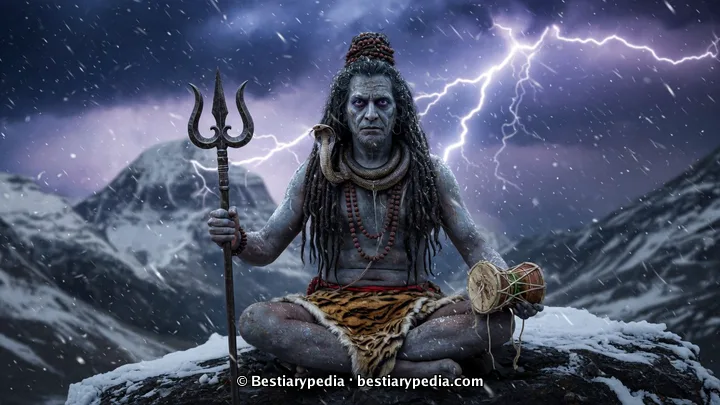
Shiva
Shiva, the destroyer and transformer in the Hindu Trimurti
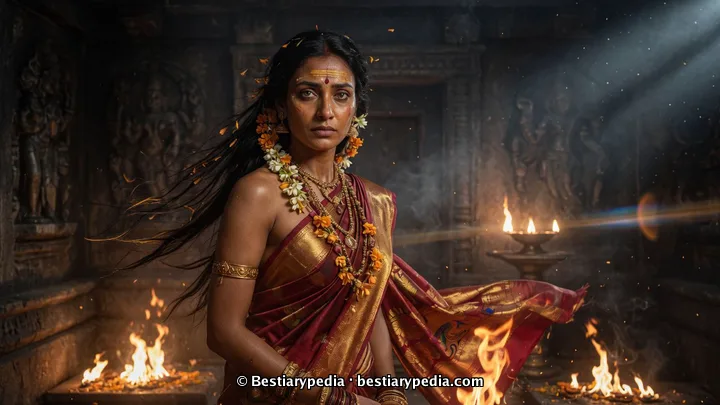
Sati
Sati, first human incarnation of Adi Shakti and original wife of Shiva
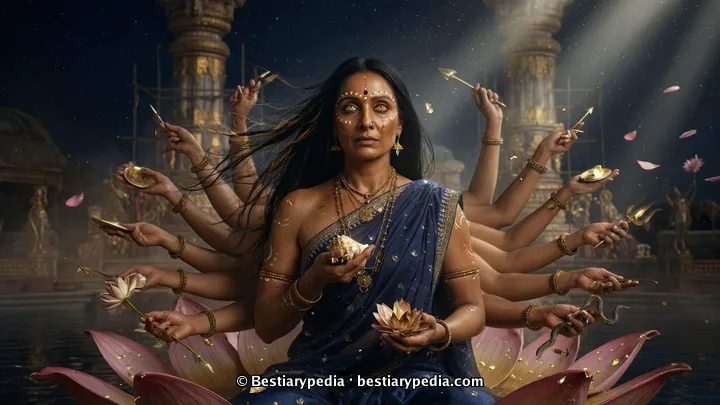
Adi Shakti
Adi Shakti, the primordial cosmic Goddess of Shaktism
Parvati
Goddess of Love and Fertility
Durga
Ten-Armed Warrior Goddess
Kali
Goddess of Destruction and Time