Durga
Ten-Armed Warrior Goddess
Curated byBestiarypediaCreated onUpdated on
 India(India)
 South Asia(India, Nepal)
🔄 Transformation line (Phase 4 of 5)
Origin of Durga
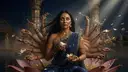
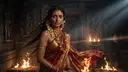
Durga, the invincible goddess of Hinduism, emerged from the collective energy of the gods to combat the demon Mahishasura, who had obtained a boon making him invulnerable to any man or male god. When the devas, led by Brahma, Vishnu, and Shiva, gathered on Mount Himavat, their divine powers fused into a blinding radiance, forming a goddess with ten arms mounted on a fierce lion. This miraculous birth, narrated in the Devi Mahatmya of the Markandeya Purana, symbolizes the supremacy of feminine shakti power over demonic chaos. Durga was not created as a peaceful deity, but as a primordial warrior destined to restore dharma in a world plunged into darkness.
Appearance and Armament
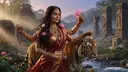
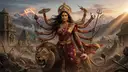
Durga manifests as a woman of fierce and terrible beauty, with golden skin shining like a thousand suns, eight or ten arms holding divine weapons: Shiva's trident, Vishnu's discus, Varuna's conch, Visvakarma's axe, sword, spear, mace, bow, shield, and arrows. Her three flaming eyes emit rays that incinerate evil, and her jet-black hair waves like a storm. Mounted on her lion Dawon, whose roar paralyzes demons, she wears red war garments and a crown of celestial jewels. Each weapon symbolizes an aspect of the cosmos and her power to destroy impurity: the trident pierces illusion, the discus cuts ego, the sword eliminates ignorance. Her face combines maternal grace with destructive fury, reminding that shakti is both creation and annihilation.
Meaning and Legacy
Durga represents the absolute triumph of good over evil, embodying the primordial shakti that balances the masculine universe of the devas. Her victory over Mahishasura during nine days of relentless battle, known as Navaratri, inspires annual festivals where millions of Hindus worship her with fasts, dances, and offerings of sweets and flowers. Beyond war, Durga teaches self-mastery and feminine courage: she transforms fear into power, passivity into action. In tantrism, she is the supreme mother Adi Parashakti, source of all creation. Her legacy endures in temples like Vaishno Devi and in art capturing her compassionate ferocity, reminding that true strength lies in purity of intention and unwavering devotion to cosmic dharma.
Also known as
Relics
🏺 Trishula of Durga
Symbology
Element
fire
Number
ten
Color
red
Animals
tiger, lion
Sigils:
🏷️ Traits
Powers
Weaknesses
Behavioral
Resistances
🗺️In the Atlas
Travel the beings’ world of origin and the cosmos of their dimensions.
📜 Mythologies
Hindu mythology originated in the Indian subcontinent from the fusion of the traditions of the Indo-Aryan peoples, who arrived around the second millennium BCE, with the pre-existing cultures of the Indus Valley and other local populations. Its foundational texts, such as the Vedas, composed between approximately 1500 and 500 BCE, contain hymns, rituals and narratives that reflect a worldview in which the universe is governed by cosmic order (ṛta) and by cycles of creation, preservation and destruction. The main Vedic deities include Indra, Agni and Varuṇa, while in later periods, especially from the epic texts Mahābhārata and Rāmāyaṇa and the Purāṇas, the triads of Viṣṇu, Śiva and Devī in their various manifestations gain greater relevance. This tradition conceives reality as a web of existences governed by karma and rebirth (saṃsāra), with the ultimate goal of liberation (mokṣa). The epics and Puranic accounts transmit moral, philosophical and ritual teachings that have shaped the religious and social life of much of the Indian subcontinent over the centuries. Its influence extends to the arts, literature and devotional practices of numerous Hindu communities, as well as to other religious traditions of South and Southeast Asia.
Sources
Rigveda
Anonymous Rishis · 1500 BCE
The oldest of the four Vedic collections (c. 1500-1200 BC): over a thousand hymns to the devas, forming the earliest layer of Indian mythology.
Devi Mahatmya
Markandeya · c. 500-600
Sixth-century Sanskrit text narrating the exploits of the Great Goddess.
Devi Bhagavata Purana
Vyasa · c. 900-1400
Shakta Purana detailing the cosmology and manifestations of Mahadevi.
Markandeya Purana
Vyasa · circa 400-600 CE
One of the Puranas of Hinduism (4th-6th century), famous for containing the Devi Mahatmya, a hymn to the Great Goddess. It recounts Durga’s triumph over the buffalo demon Mahishasura, a fundamental source of goddess (Shakti) worship.
Frequently asked questions
From which collective energy did Durga emerge according to the Devi Mahatmya?
Durga emerged from the fusion of the divine powers of Brahma, Vishnu and Shiva. This collective energy formed on Mount Himavat to defeat Mahishasura. The account appears in the Devi Mahatmya of the Markandeya Purana.
Which divine weapons does Durga carry and what do they symbolize?
She carries Shiva's trident, Vishnu's discus, Varuna's conch and other weapons. Each symbolizes a cosmic aspect and destroys impurities such as illusion or ego. Her arsenal reflects shakti's power to restore dharma.
What relationship does Durga maintain with Kali in the battle against the demons?
During the battle against Chanda and Munda, Durga created Kali from her forehead. Kali devoured the enemies with insatiable ferocity. This creation shows Durga's ability to manifest destructive forms of shakti.
What place does Durga occupy in the hierarchy of the Hindu pantheon?
Durga is the supreme war goddess of the Hindu pantheon. As an incarnation of Parvati as Shakti, she protects dharma mounted on lion or tiger. Her rank stands at the apex of the female deities' hierarchy.
🔖Cite this entry▾
If you cite this article in an academic, journalistic or editorial publication, use any of these formats:
Bestiarypedia. (2026, July 14). Durga. Bestiarypedia. https://bestiarypedia.com/en/beings/durga
Free citation with attribution and canonical link for editorial, academic or journalistic use. Full commercial reuse or creation of derivative products requires prior agreement.
Similar beings
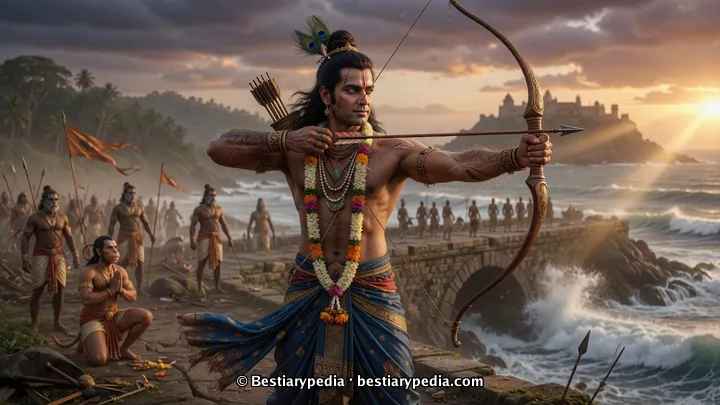
Rama
Rama, prince of Ayodhya and seventh avatar of Vishnu
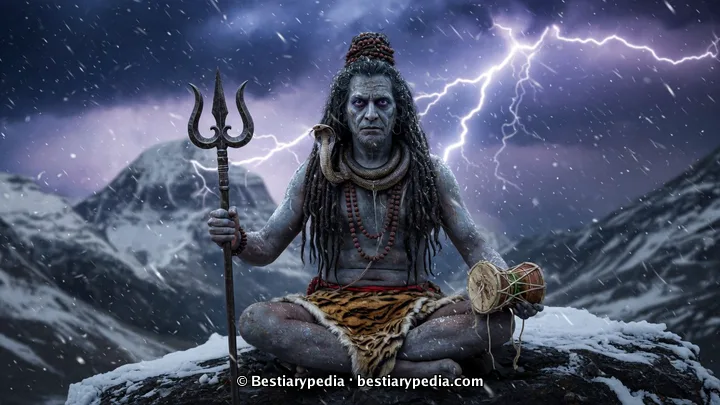
Shiva
Shiva, the destroyer and transformer in the Hindu Trimurti
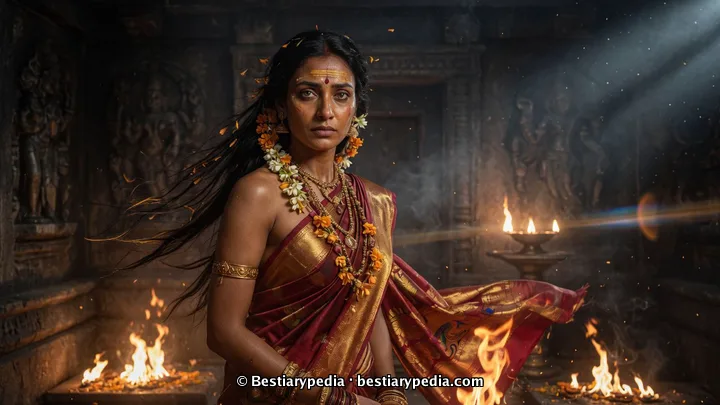
Sati
Sati, first human incarnation of Adi Shakti and original wife of Shiva
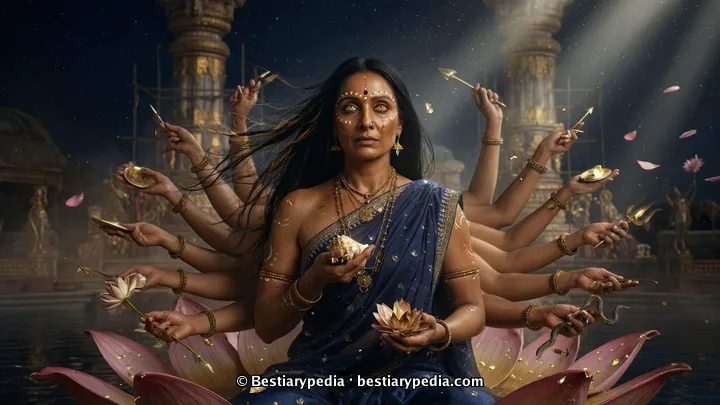
Adi Shakti
Adi Shakti, the primordial cosmic Goddess of Shaktism
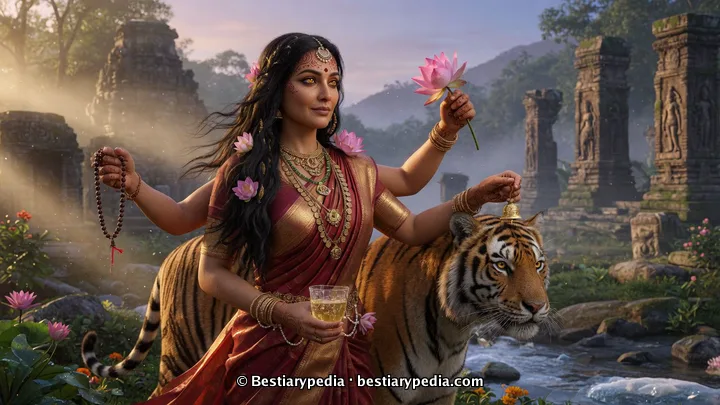
Parvati
Goddess of Love and Fertility
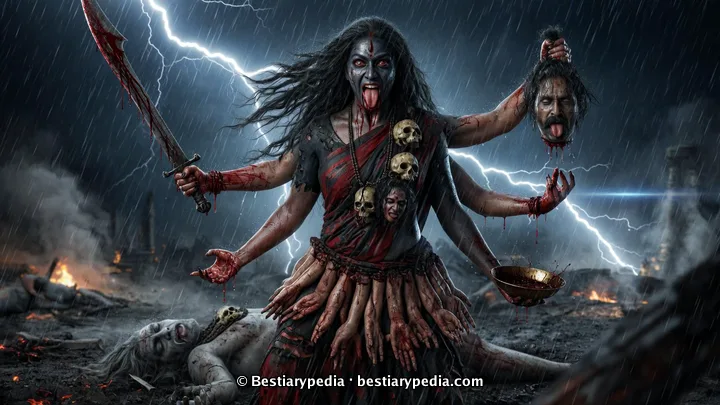
Kali
Goddess of Destruction and Time