Shiva
Shiva, the destroyer and transformer in the Hindu Trimurti
Curated byBestiarypediaCreated onUpdated on
 India(India)
 South Asia(India, Nepal)
Family Tree
Mythical Origins of Shiva
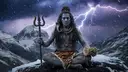
Shiva, known as the Destroyer in the Hindu Trimurti, emerges in the oldest Vedic texts as Rudra, a fierce and stormy god associated with mountains, storms, and hunting. In the Rigveda, Rudra is invoked with fear and reverence, described as the bearer of bows and arrows, lord of wild beasts, and healer through his divine medicines. His evolution into Shiva is consolidated in the Puranas, where he is presented as the third member of the Trimurti alongside Brahma the Creator and Vishnu the Preserver. According to the Shiva Purana, Shiva arises from the primordial nothing at the beginning of the cosmic cycle, manifesting as an infinite pillar of fire (Jyotirlinga) in a dispute between Brahma and Vishnu over supremacy. This lingam form symbolizes his transcendence beyond limited forms, representing the generative and destructive energy of the universe. His birth does not follow conventional anthropomorphic patterns; he is eternal, without beginning or end, embodying the principle of destruction necessary for regeneration.
Appearance and Symbols of Shiva
Shiva is typically depicted with bluish or ash-colored skin, symbolizing his connection to the infinite and the cremation ash he anoints his body with, a reminder of impermanence. His matted hair is piled in a high bun adorned with the crescent moon (Chandra), the Ganges flowing from it, and a cobra snake around the neck, denoting mastery over time, sacred waters, and the poison of ignorance. The third eye on his forehead, source of destructive fire, can incinerate desire and evil. He carries a trident (Trishula) for the three forces: will, action, and knowledge; a damaru (hour drum) that marks the rhythm of creation; and a deer in hand, representing grace. Seated in ardha-paryanka posture on tiger skin, with Nandi the bull as his vehicle, his Nataraja form dances the cosmic creation and destruction in a halo of flames, stepping on the demon Apasmara (ignorance).
Worship and Spiritual Significance
The worship of Shiva, Shaivism, emphasizes meditation, yoga, and bhakti devotion to achieve liberation (moksha) through dissolution of the ego in his supreme consciousness (Shiva-tattva). Festivals like Maha Shivaratri commemorate his cosmic marriage to Parvati and his Tandava dance. Pilgrimages to Jyotirlingas (12 sacred sites) and baths in the Ganges purify karma. Rituals involve offerings of bilva leaves, milk, and vibhuti (sacred ash), chanting mantras like "Om Namah Shivaya". In tantra, Shiva is the masculine principle (Purusha) united with Shakti (feminine energy), culminating in kundalini practices. His worship transcends castes and genders, attracting ascetics (sadhus) who live in cremation grounds, smoking chillum and meditating in samadhi, seeking advaita non-duality.
Also known as
Relics
🏺 Trishula
🏺 Damaru
Symbology
Element
Fire
Number
3
Color
Blue
Animals
Bull Nandi, Serpent Vasuki
Sigils:
🏷️ Traits
Powers
Weaknesses
Behavioral
Resistances
🔗 Relations with other beings
🗺️In the Atlas
Travel the beings’ world of origin and the cosmos of their dimensions.
📜 Mythologies
Hindu mythology originated in the Indian subcontinent from the fusion of the traditions of the Indo-Aryan peoples, who arrived around the second millennium BCE, with the pre-existing cultures of the Indus Valley and other local populations. Its foundational texts, such as the Vedas, composed between approximately 1500 and 500 BCE, contain hymns, rituals and narratives that reflect a worldview in which the universe is governed by cosmic order (ṛta) and by cycles of creation, preservation and destruction. The main Vedic deities include Indra, Agni and Varuṇa, while in later periods, especially from the epic texts Mahābhārata and Rāmāyaṇa and the Purāṇas, the triads of Viṣṇu, Śiva and Devī in their various manifestations gain greater relevance. This tradition conceives reality as a web of existences governed by karma and rebirth (saṃsāra), with the ultimate goal of liberation (mokṣa). The epics and Puranic accounts transmit moral, philosophical and ritual teachings that have shaped the religious and social life of much of the Indian subcontinent over the centuries. Its influence extends to the arts, literature and devotional practices of numerous Hindu communities, as well as to other religious traditions of South and Southeast Asia.
Sources
Rigveda
Anonymous Rishis · 1500 BCE
The oldest of the four Vedic collections (c. 1500-1200 BC): over a thousand hymns to the devas, forming the earliest layer of Indian mythology.
Mahabharata
Vyasa · 400 BCE
The great Sanskrit epic of India (compiled between the 4th century BC and the 4th century AD), over 100,000 verses long. It weaves the Kuru war together with theology, philosophy and foundational Hindu myths, and includes the Bhagavad Gita.
Linga Purana
Vyasa (traditionally attributed) · c. 500-1000 CE
The Linga Purana is a Shaivite Purana classified as one of the eighteen Upapuranas or Mahapuranas, with about 11,000 verses in two parts (Purva-bhaga and Uttara-bhaga), focused on the worship of Shiva's lingam, cosmogony, yoga, and myths about creation, preservation, and destruction.
Shiva Purana
Vyasa · circa 800 CE
One of the major Puranas of Hinduism, dedicated to Shiva. It gathers his mythology, hymns and legends—the marriage to Sati and Parvati, the birth of Ganesha and Kartikeya—and describes many deities and beings of the Hindu pantheon.
Frequently asked questions
How does Shiva arise in the Vedic and Puranic texts?
Shiva appears in the Vedic texts as Rudra, a fierce god associated with the mountains and the storms. In the Puranas he is consolidated as the third member of the Trimurti. The Shiva Purana makes him manifest as an infinite column of fire before Brahma and Vishnu, who disputed which of the two was superior: neither finds its beginning nor its end.
What attributes characterize the iconography of Shiva?
He is represented with bluish skin or covered with ash, the matted hair of the ascetic where he carries the crescent moon and from where the Ganges springs, a cobra at the neck and the third eye on the forehead. He carries the trident trishula, the small drum damaru and a doe. As Nataraja he dances upon the dwarf Apasmara, ignorance, within a circle of fire.
What role does Shiva occupy within the cosmic hierarchy of the Hindu Trimurti?
Shiva is the third member of the Hindu Trimurti alongside Brahma the Creator and Vishnu the Preserver. He represents the cyclical destruction necessary for the universe's regeneration. His principle complements creation and preservation in the cosmic cycle.
How is he worshipped and in what festivals?
His worship combines meditation, yoga and bhakti devotion as paths towards liberation (moksha). The great festival is Maha Shivaratri, "the great night of Shiva", which commemorates his marriage with Parvati and is celebrated in vigil. The usual offerings are bilva leaves, milk poured over the linga and sacred ash (vibhuti), with the recitation of the mantra Om Namah Shivaya.
🔖Cite this entry▾
If you cite this article in an academic, journalistic or editorial publication, use any of these formats:
Bestiarypedia. (2026, July 20). Shiva. Bestiarypedia. https://bestiarypedia.com/en/beings/shiva
Free citation with attribution and canonical link for editorial, academic or journalistic use. Full commercial reuse or creation of derivative products requires prior agreement.
Similar beings
Rama
Rama, prince of Ayodhya and seventh avatar of Vishnu
Sati
Sati, first human incarnation of Adi Shakti and original wife of Shiva
Adi Shakti
Adi Shakti, the primordial cosmic Goddess of Shaktism
Parvati
Goddess of Love and Fertility
Durga
Ten-Armed Warrior Goddess
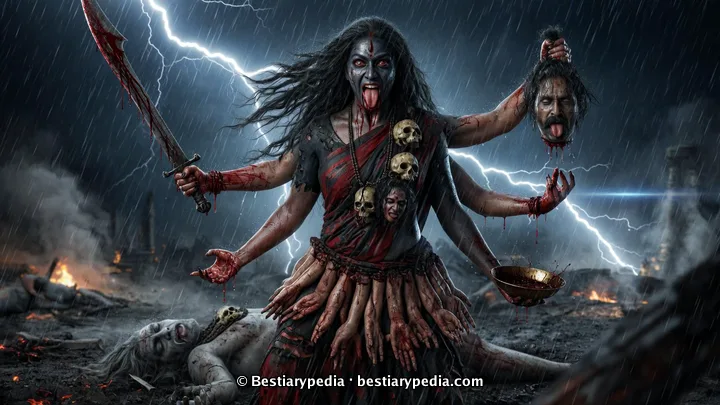
Kali
Goddess of Destruction and Time