Elder Gumiho
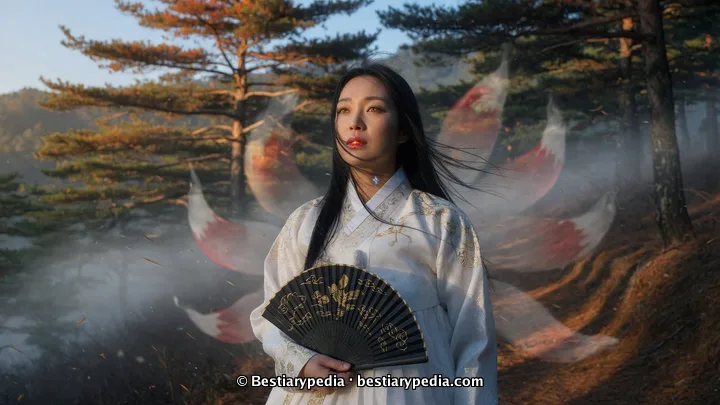
Elder Crone Gumiho, shaman and mentor of mudangs in remote mountain villages
Curated byBestiarypediaCreated onUpdated on
 Korean Peninsula(Korea)
🔄 Transformation line (Phase 3 of 4)

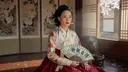


Origins of the Elder Gumiho
Within the life cycle of the Korean gumiho (구미호), the elderly form represents a stage of retirement after centuries of existence among humans. Tired of deception and of courtly or village life, the creature adopts the appearance of a very old woman and withdraws to a remote mountain village, where she lives discreetly confused with the grandmothers of the place. Korean folklore, compiled by authors such as Zong In-sob and James H. Grayson, collects numerous tales of nine-tailed foxes that inhabit long periods among people; this figure develops that motif to its phase of old age and apparent harmlessness, sustained no longer by predation, but by the energy of the forest and the offerings.
Nature and powers
The elderly gumiho has exchanged seduction for knowledge. Tradition attributes to her practices typical of Korean popular culture, such as divination through the interpretation of burned bones (gol-jeom), healing with herbs and spells, and casting curses that only she can undo in exchange for penance. She retains the longevity and transformation power of the nine-tailed fox, although she rarely resorts to her animal form, and maintains communion with the minor spirits of the forest. Unlike the young and predatory forms, she sustains her existence with forest energy and ritual offerings, without actively draining human vitality, which places her in a moral ambiguity between the protector and the witch.
Symbols and Tradition
This figure embodies the archetype of the wise old woman whose benevolence hides a supernatural nature. She is associated with the attributes of the village sorceress: the staff, the talismans, the divination bones and the knowledge of herbs. In Korean tales, the gumiho hidden among humans lives under the constant threat of being discovered, and her fox condition can be revealed in a moment of carelessness. As a stage in the nine-tailed fox cycle, the old woman represents the transition between the phase of social manipulation and the final aspiration to celestial purification: a creature that, having renounced the hunt, silently protects the community that welcomes her, although she punishes those who cross serious ethical lines.
Relics
🏺 Ritual staff of paulownia wood
🏺 Embroidered cloth pouch containing the yeouiju
🏺 Handwritten family spellbook
Symbology
Element
Yin Earth
Number
9
Color
Ochre Brown
Animals
Elder nine-tailed fox, Korean blue magpie, White-tailed deer
Sigils:
🏷️ Traits
Powers
Weaknesses
Behavioral
Resistances
🗺️In the Atlas
Travel the beings’ world of origin and the cosmos of their dimensions.
📜 Mythologies
Korean folklore encompasses oral traditions, myths, legends and supernatural creatures like dokkaebi, associated with streams, waterfalls, water and fertility, compiled in Joseon dynasty texts reflecting animist beliefs, ecological fears and respect for nature in rivers and rice fields of South Korea.
Sources
Anthology of Joseon Korean Folklore
Several anonymous compilers · 1800
Anthology of folk tales from Joseon-dynasty Korea. It gathers myths, legends and stories about gods, ghosts (gwisin) and creatures such as the dokkaebi, and is an essential source of Korean supernatural folklore.
Korean Folk Tales: Imps, Ghosts and Fairies
James S. Gale (trad.); Im Bang y Yi Ryuk · 1913
Collection of Korean folk tales (imps, ghosts and fairies) translated by James S. Gale from the works of Im Bang and Yi Ryuk; one of the earliest compilations of Korean folklore in the West.
Frequently asked questions
How does the Elder Crone Gumiho leave the Joseon court?
After centuries of aristocratic infiltration the creature tires of the social game and adopts the form of an old woman to retire to remote mountain villages.
What divination method does the Elder Crone Gumiho employ?
She practices interpretation of burned bones according to the historical Korean gol-jeom method in addition to herbal healing and reversible curses.
To what superior phase does the Elder Crone Gumiho transform?
After an additional thousand years it transforms into gumiho-ancient-celestial retaining the yeouiju pearl and attaining greater cosmic purity.
🔖Cite this entry▾
If you cite this article in an academic, journalistic or editorial publication, use any of these formats:
Bestiarypedia. (2026, July 26). Elder Gumiho. Bestiarypedia. https://bestiarypedia.com/en/beings/gumiho-elder-crone
Free citation with attribution and canonical link for editorial, academic or journalistic use. Full commercial reuse or creation of derivative products requires prior agreement.
Similar beings
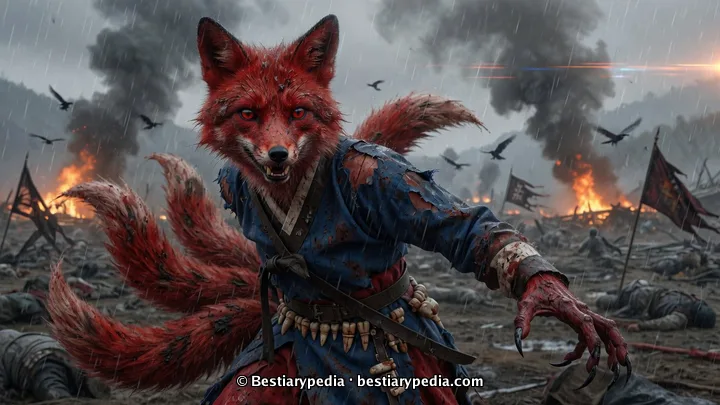
Bloody Gumiho
Blood Omen Gumiho, corrupted branch of the gumiho archetype that emerges in Korean valleys subjected to prolonged collective catastrophes
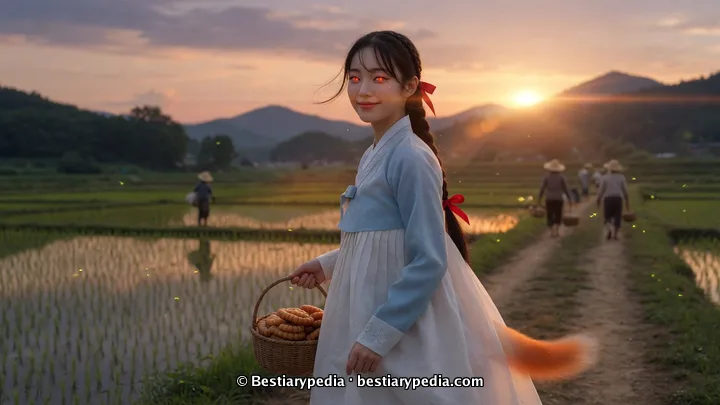
Maiden Gumiho
Maiden Seductress Gumiho, first human phase of the Korean fox after one hundred years
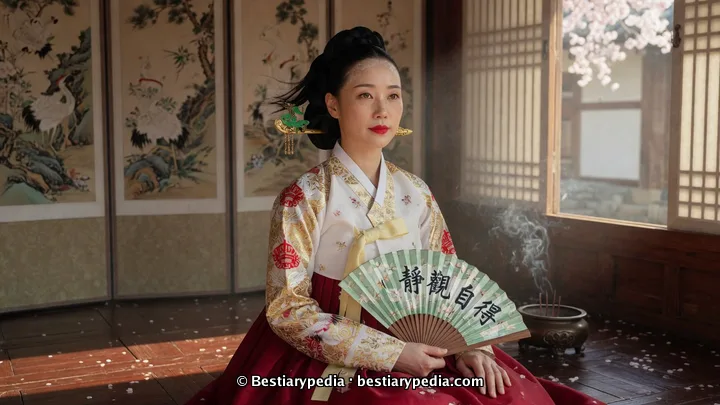
Courtesan Gumiho
Noble Infiltrator Gumiho, yangban lady who infiltrates the Joseon court draining qi from her husbands
Celestial Gumiho
Ancient Celestial Gumiho, supreme form of the archetype after a thousand years without losing the yeouiju pearl