Celestial Gumiho
Ancient Celestial Gumiho, supreme form of the archetype after a thousand years without losing the yeouiju pearl
Curated byBestiarypediaCreated onUpdated on
 Korean Peninsula(Korea)
🔄 Transformation line (Phase 4 of 4)






Origins of the celestial gumiho
The gumiho (구미호, «nine-tailed fox») is one of the most celebrated creatures in Korean folklore, a fox that, after living several centuries, acquires the ability to transform into a human being. The tradition, collected by folklorists such as James H. Grayson and Zong In-sob, describes different destinies for these beings: those who yield to predation remain trapped in their nature, while those who manage to abstain from harming humans for a long period can purify themselves and ascend. The «celestial» or «elder» form represents the culmination of that path: the millennial gumiho that has kept its yeouiju (여의주) intact, the magic pearl that concentrates its energy and its knowledge, and that aspires to transcendence instead of the hunt.
Nature and Powers
In this superior form, the gumiho has renounced tearing out the liver or heart of its victims, the most feared trait of the creature in folk tales, and sustains its existence through vital energy obtained without killing. The yeouiju pearl is at once its source of power and its weak point: tradition holds that whoever manages to swallow it obtains knowledge of heaven, earth and people, and that losing it condemns the fox. It is attributed with mastery of illusion and perfect transformation, extreme longevity and wisdom accumulated over centuries. Linked to the mountains of Korea, it embodies the possibility of redemption within a traditionally malevolent figure, a motif that recent folklore and Korean popular culture have explored with growing sympathy.
Symbols and tradition
The central symbol of the gumiho are its nine tails and the yeouiju pearl, emblem of its spiritual power. In the classic tales the creature is usually female and adopts the form of a woman of great beauty to approach men, so that the revelation of its true nature (a tail that peeks out, the reflection in the water, the instinct of dogs) is a recurring narrative resource. Compared to the Japanese kitsune, more ambivalent, and the Chinese huli-jing, the Korean gumiho was traditionally perceived as a threat that had to be discovered and expelled; only the late versions admit its purification. As a celestial aspect of the archetype, this figure condenses the aspiration to overcome the predatory nature through discipline and renunciation, and constitutes the pinnacle of the life cycle of the nine-tailed fox in Korean tradition.
Relics
🏺 Yeouiju
🏺 Lacquered silk fan with celestial fox motif
Symbology
Element
Yin
Number
9
Color
Red-gold
Animals
Nine-tailed fox, Korean blue magpie, Sika deer
Sigils:
🏷️ Traits
Powers
Weaknesses
Behavioral
Resistances
🗺️In the Atlas
Travel the beings’ world of origin and the cosmos of their dimensions.
📜 Mythologies
Korean folklore encompasses oral traditions, myths, legends and supernatural creatures like dokkaebi, associated with streams, waterfalls, water and fertility, compiled in Joseon dynasty texts reflecting animist beliefs, ecological fears and respect for nature in rivers and rice fields of South Korea.
Sources
Korean Mythology Anthology
Several compilers · 1900
Collection of traditional Korean folk tales documenting water spirits and supernatural beings associated with rivers and fertility.
Korean Folk Tales: Imps, Ghosts and Fairies
James S. Gale (trad.); Im Bang y Yi Ryuk · 1913
Collection of Korean folk tales (imps, ghosts and fairies) translated by James S. Gale from the works of Im Bang and Yi Ryuk; one of the earliest compilations of Korean folklore in the West.
Frequently asked questions
How does a gumiho attain the ancient celestial form?
After a thousand years without losing the yeouiju pearl through discipline and rejection of predation. The count starts with the first human transformation.
In what manner does the Ancient Celestial Gumiho feed?
Through consented ritual kisses with virtuous humans extracting residual qi without grave deception.
What symbols distinguish the Ancient Celestial Gumiho?
Nine semi-transparent tails in spiritual vision, blue-white foxfire on full moon and Li trigram on the neck.
🔖Cite this entry▾
If you cite this article in an academic, journalistic or editorial publication, use any of these formats:
Bestiarypedia. (2026, July 14). Celestial Gumiho. Bestiarypedia. https://bestiarypedia.com/en/beings/gumiho-ancient-celestial
Free citation with attribution and canonical link for editorial, academic or journalistic use. Full commercial reuse or creation of derivative products requires prior agreement.
Similar beings
Bloody Gumiho
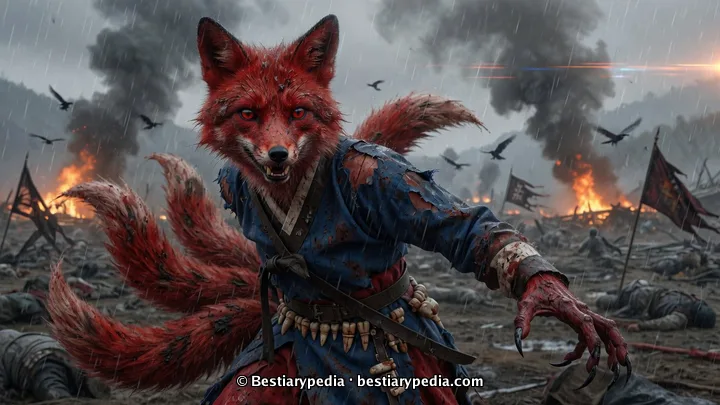
Blood Omen Gumiho, corrupted branch of the gumiho archetype that emerges in Korean valleys subjected to prolonged collective catastrophes

Maiden Gumiho
Maiden Seductress Gumiho, first human phase of the Korean fox after one hundred years

Courtesan Gumiho
Noble Infiltrator Gumiho, yangban lady who infiltrates the Joseon court draining qi from her husbands

Elder Gumiho
Elder Crone Gumiho, shaman and mentor of mudangs in remote mountain villages