Bloody Gumiho
Blood Omen Gumiho, corrupted branch of the gumiho archetype that emerges in Korean valleys subjected to prolonged collective catastrophes
Curated byBestiarypediaCreated onUpdated on
 Korean Peninsula(Korea)
Origins of the Blood Omen Gumiho
When a Korean valley suffers sustained collective catastrophe such as famine exceeding three seasons, foreign military occupation with civilian massacres or epidemic with mortality above forty percent, unburied souls and residual qi saturate the air with negative emotion. If a young or maiden-phase gumiho is present in that valley the saturation can corrupt it. The creature devours its own yeouiju pearl in an act of self-corruption and mutates into an uncontrollable blood-red form. Once transformed there is no turning back. This manifestation arises spontaneously when a valley's despair reaches a critical threshold and is associated with the Hideyoshi invasions from fifteen ninety-two to fifteen ninety-eight, the Korean War from nineteen fifty to nineteen fifty-three and other historical catastrophes.
Powers and Manifestation of the Blood Omen Gumiho
The Blood Omen Gumiho performs direct bestial charges without prior seduction, emits an omen howl that paralyzes humans at a distance, possesses red fur that absorbs blood and grows more vivid with each victim, and manifests nine solid physical tails used as whips in combat. It lacks immunity to sorrow and remorse and possesses supernatural vision of past and future massacres in the valley where it manifests. Its element is corrupted fire known as hyeolhwa or blood fire and its associated number is nine due to the physical manifestation of the tails.
Appearance and Symbology of the Blood Omen Gumiho
The Blood Omen Gumiho presents a bipedal fox-humanoid hybrid form with elongated face partial snout eyes without distinguishable pupil only bright red body covered in intense red fur with dried blood spots nine solid physical tails elongated claws and decomposed remains of looted human garments. Its symbology includes red fur absence of yeouiju pearl with blackened palate elongated claws dried blood spots on the tails and four-claw prints marking territory. It lacks jewels or ritual ornaments all rejected or destroyed and its territory is always a single valley without migration.
Relics
🏺 Bloodied leather belt of fallen military officer
🏺 Human victim fangs tied around the neck with rope
Symbology
Element
Blood fire
Number
9
Color
Blood red
Animals
Red hybrid fox, Korean crows, Joseon wolf
Sigils:
🏷️ Traits
Powers
Weaknesses
Behavioral
Resistances
🗺️In the Atlas
Travel the beings’ world of origin and the cosmos of their dimensions.
📜 Mythologies
Korean folklore encompasses oral traditions, myths, legends and supernatural creatures like dokkaebi, associated with streams, waterfalls, water and fertility, compiled in Joseon dynasty texts reflecting animist beliefs, ecological fears and respect for nature in rivers and rice fields of South Korea.
Sources
Anthology of Joseon Korean Folklore
Several anonymous compilers · 1800
Anthology of folk tales from Joseon-dynasty Korea. It gathers myths, legends and stories about gods, ghosts (gwisin) and creatures such as the dokkaebi, and is an essential source of Korean supernatural folklore.
Korean Folk Tales: Imps, Ghosts and Fairies
James S. Gale (trad.); Im Bang y Yi Ryuk · 1913
Collection of Korean folk tales (imps, ghosts and fairies) translated by James S. Gale from the works of Im Bang and Yi Ryuk; one of the earliest compilations of Korean folklore in the West.
Frequently asked questions
How does the Blood Omen Gumiho emerge in Korean valleys?
It emerges when collective despair saturates the valley and corrupts a young gumiho that devours its yeouiju pearl. No return is possible after mutation.
What distinctive powers does the Blood Omen Gumiho possess?
It performs direct charges, emits paralyzing howls, uses nine physical tails as whips and absorbs blood with its red fur. It lacks remorse.
What relationships does it maintain with other beings of Korean folklore?
It is a corrupted variant of gumiho-ancient-celestial gumiho-elder-crone gumiho-noble-infiltrator and gumiho-maiden-seductress. Territorial rival of dokkaebi-rojo.
🔖Cite this entry▾
If you cite this article in an academic, journalistic or editorial publication, use any of these formats:
Bestiarypedia. (2026, July 14). Bloody Gumiho. Bestiarypedia. https://bestiarypedia.com/en/beings/gumiho-blood-omen
Free citation with attribution and canonical link for editorial, academic or journalistic use. Full commercial reuse or creation of derivative products requires prior agreement.
Similar beings
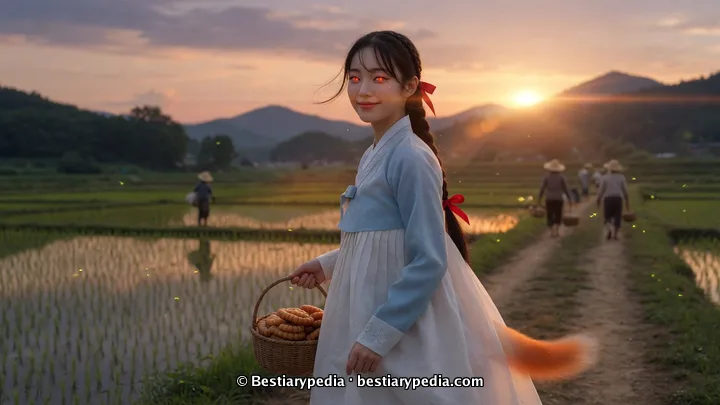
Maiden Gumiho
Maiden Seductress Gumiho, first human phase of the Korean fox after one hundred years
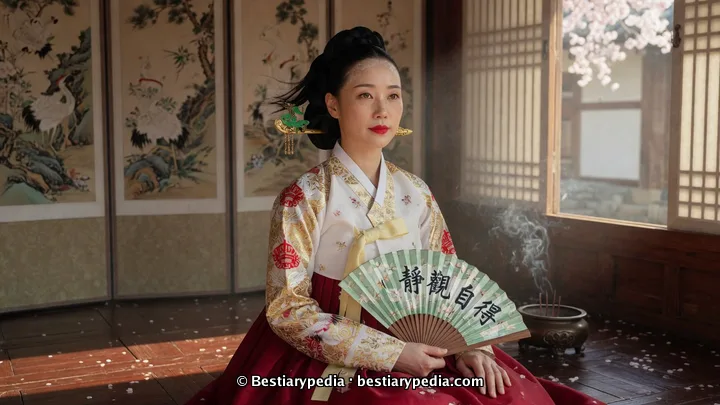
Courtesan Gumiho
Noble Infiltrator Gumiho, yangban lady who infiltrates the Joseon court draining qi from her husbands
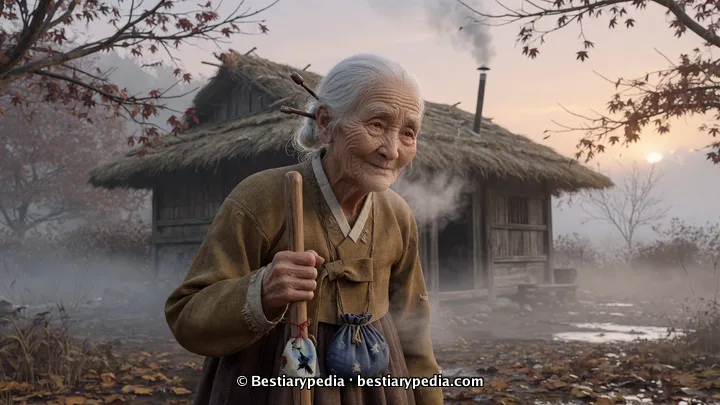
Elder Gumiho
Elder Crone Gumiho, shaman and mentor of mudangs in remote mountain villages
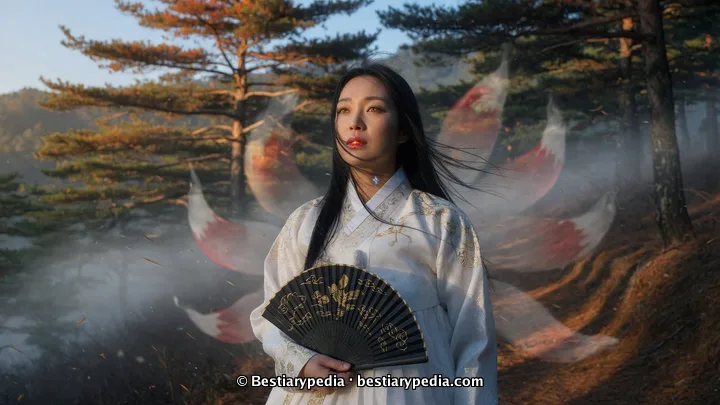
Celestial Gumiho
Ancient Celestial Gumiho, supreme form of the archetype after a thousand years without losing the yeouiju pearl