Krasue
Krasue Floating Head with Entrails
Curated byBestiarypediaCreated on
 Thailand(Thailand)
Origin of the Krasue and the witch hunt of Isan
The Krasue is the Thai version of a terror that runs throughout Southeast Asia: the woman's head that detaches at night and flies dragging its viscera, the same archetype as the Malay Penanggalan and the Balinese Leyak. Tradition says that a woman becomes a Krasue by practicing forbidden black magic, by receiving the curse of an occult master (a saiyasat) or by inheriting the condition from another dying Krasue, who passes on her evil through saliva or through a ritual object, such as a bone comb or a mirror, before dying. The belief was not harmless: in northeastern Thailand, the Isan region, accusations of being Krasue fell on solitary, elderly or marginalized women, and led to documented lynchings during the 19th and 20th centuries. As in the European witch hunt, the figure of the Krasue served to channel rural fears towards the suspicious woman, the foreigner and the one who lived on the margins of the community.
The flying head and its preys
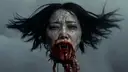
At dusk, the head of the Krasue separates from the body and rises floating one or two meters from the ground, sliding silently over the rice fields and the farmhouses. From its severed neck hangs a cluster of still living organs, the heart beating, the lungs, the liver and the long intestines, which in many accounts emit a reddish and phosphorescent light visible in the distance like a will-o'-the-wisp. Those viscera serve it as an apparatus to feed: it seeks blood and entrails of pregnant women, of newborns and of livestock, and also carrion and excrement, which links it to the fear of hygiene and disease in the countryside. It has a supernatural sense of smell to detect young prey and eyes that shine between yellow and red in the darkness. Its great weakness is the same as that of its Malay relatives: the decapitated body that it has left behind must receive the head again before dawn. If someone finds it and covers it, hides it or burns it, the head remains in the open and dies with the light of the sun.
Diurnal form and nocturnal form
By day the Krasue is not distinguished from any other Thai woman: she wears the traditional phasin skirt and a discreet blouse, works and lives with normality in the village, and nothing betrays her nature except, in some versions, an absent air or a fondness for raw meat. It is at nightfall when her body remains stretched out and inert and the head undertakes the flight with its retinue of hanging organs; the long black hair floats below the face and the viscera radiate that reddish glow that betrays her in the distance. This configuration, head and entrails but without torso, is what distinguishes her clearly from the Filipino Manananggal, which splits at the waist but conserves the entire torso and some bat wings. The Krasue has neither wings nor body: it is pure head and viscera floating in the night, and in that minimal and repulsive image resides a good part of her capacity to terrify, to the point of becoming today an icon of Thai horror cinema.
Relics
🏺 Ritual bone comb
Symbology
Element
Night air with entrails
Number
None
Color
Blood red, black hair, faint organ phosphorescence
Animals
Chicken, Newborn pig
Sigils:
🏷️ Traits
Powers
Weaknesses
Behavioral
Resistances
🗺️In the Atlas
Travel the beings’ world of origin and the cosmos of their dimensions.
📜 Mythologies
Supernatural tradition of the Kingdom of Thailand: syncretism among native Tai-Kadai animism, Theravada Buddhism (since 13th c.), residual Hindu Brahmanism (Phra Indra, Phra Phrom) and Chinese beliefs. The unifying concept is Phi (spirits): phi tai hong (violent death), krasue (floating head with entrails), nang tani (banana), phi pop (possessor).
Sources
Malay Magic
Walter William Skeat · 1900
1900 work documenting langsuir domestication rituals in detail in Malay folklore.
Pagan Races of the Malay Peninsula, by Skeat and Blagden
Walter Skeat y Charles Blagden · 1906
Southeast Asian Vampire Folklore
Various oral traditions · Pre-20th century
Collection of oral traditions and Malay-Indonesian texts describing the Penanggalan and kin like Leyak, focusing on transformative rituals and folk protections against these flying entities.
Frequently asked questions
How is the krasue gift transmitted among women?
The gift is transmitted through ritual saliva or a talismanic object such as a bone comb. This transfer occurs among women in Thai rural contexts.
What iconographically distinguishes the krasue from the manananggal?
The krasue flies only with head and dangling entrails while the manananggal retains the entire torso. This difference is the absolute distinguishing trait between both regional variants.
What is the fatal weak point of the krasue?
If the decapitated body is covered, burned or moved during the night, the head cannot rejoin at dawn and dies exposed to the sun. This vulnerability determines its fate.
🔖Cite this entry▾
If you cite this article in an academic, journalistic or editorial publication, use any of these formats:
Bestiarypedia. (2026, July 25). Krasue. Bestiarypedia. https://bestiarypedia.com/en/beings/krasue-floating-entrails-head
Free citation with attribution and canonical link for editorial, academic or journalistic use. Full commercial reuse or creation of derivative products requires prior agreement.