Penanggalan
Penanggalan, the Malay vampire of floating head and glowing entrails
Curated byBestiarypediaCreated on
 Malaysia(Malaysia)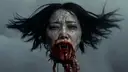

Origin of the Penanggalan in Malay folklore
The Penanggalan is one of the most feared creatures of Malay and Indonesian folklore: a woman who by day passes for an ordinary neighbor, often a midwife or practitioner of occult arts, and who at night becomes a flying head that drags her viscera. According to the accounts collected by Walter Skeat in Malay Magic (1900), her condition is born from a beauty ritual or black magic that is executed badly, or from a pact that forces the woman to detach her head every night to seek blood. The most characteristic detail of the legend is what she does upon returning: she submerges her entrails in a jar of vinegar so that they shrink and fit again inside the body before dawn, and that is why it is said that it smells of vinegar wherever she has been. The same creature reappears with other names in neighboring cultures, which reveals a shared archetype throughout Southeast Asia: it is the Leyak in Bali and the Krasue in Thailand. The legend condenses the rural fear of secret female rituals and of the woman who seeks a beauty that does not correspond to her.
Appearance and nocturnal manifestation
By day the Penanggalan is indistinguishable from any other woman of the village, with the entire body and normal appearance, which makes it almost impossible to identify it. At nightfall, the head separates from the body taking with it the stomach, the lungs, the liver and the intestines, which hang below forming a moist and shiny cluster. Many accounts describe those viscera emitting a faint phosphorescence, greenish or whitish, which allows seeing it cross the sky in silence like a wandering light. The face is pale and terrifying, framed by a long black mane that waves in the air, and the eyes shine with a sickly red. The decapitated body remains hidden at home, inert, waiting for the return of the head. That double nature, impeccable woman by day and dismembered horror at night, is the core of the terror it inspires: anyone could be it.
Powers and behavior
The Penanggalan flies without noise using its own hanging entrails as ballast and rudder, and it slides through the narrowest openings, the cracks in the walls and the gaps under the roof of the houses built on stilts. Its favorite prey are the women who have just given birth and the newborns: it drinks the blood and feeds in the trance of childbirth, so that the hemorrhages, the puerperal fevers and the crib deaths that traditional medicine could not explain were attributed to its visit. In some accounts it emits a soft moan, similar to the cry of a baby, to attract its victims or to locate them in the dark. It attacks only at night and must return to the body before dawn; if it does not succeed, or if the body has been altered, it dies with the first light. That is why the Penanggalan is, above all, a symbol of the danger that lurked for the mother and the child in the villages before modern medicine.
How to protect yourself and destroy it
The defenses against the Penanggalan attack precisely what makes it vulnerable: the exposed viscera and the need to return to the body. The most widespread remedy is to surround the house, and especially the windows and the space under the floor where a woman in labor rests, with thorny plants: pineapple leaves, jeruju branches (sea thistle) or rattan spines, which catch on the hanging organs and tear them when the creature tries to enter. Garlic is also attributed with repulsion, which is hung on doors and windows. The way to kill it, however, involves the body it left behind: if someone finds it during the night and fills the neck hollow with glass, or turns it over, or directly burns it, the head cannot reunite with it and is consumed at dawn. These customs, which Skeat describes among the Malays, turn the discovery of the decapitated body into the key to ending it.
Also known as
Relics
🏺 Vinegar Jar
🏺 Fresh Garlic
Symbology
Element
Blood
Number
1
Color
Glowing Green
Animals
Rooster, Dog
Sigils:
🏷️ Traits
Powers
Weaknesses
Behavioral
Resistances
🗺️In the Atlas
Travel the beings’ world of origin and the cosmos of their dimensions.
📜 Mythologies
Malay folklore encompasses a set of beliefs, stories and practices transmitted orally among the populations of the Malay Peninsula and the Indonesian archipelago, with roots dating back to prehistoric periods and incorporating influences from indigenous, Hindu, Buddhist and Islamic traditions over the centuries. Its origins are linked to the Austronesian communities that populated the region since ancient times, integrating animist elements with conceptions of the natural and supernatural world that reflect the interaction between humans, spirits and cosmic forces. In this tradition, the universe is conceived as a space inhabited by spiritual entities that influence daily life, including spirits of nature, ancestors and supernatural beings such as the pontianak or the orang minyak, along with figures derived from epic tales like the Ramayana adapted locally. Ritual and narrative practices seek to maintain balance between these planes, although variants differ according to regions and ethnic groups. The cultural legacy of Malay folklore persists in classical literature, shadow theatre, traditional dances and contemporary festivities of Malaysia and Indonesia, where stories and beliefs continue to influence collective identity and modern artistic expressions.
Sources
Malay Magic
Walter William Skeat · 1900
1900 work documenting langsuir domestication rituals in detail in Malay folklore.
Pagan Races of the Malay Peninsula, by Skeat and Blagden
Walter Skeat y Charles Blagden · 1906
Southeast Asian Vampire Folklore
Various oral traditions · Pre-20th century
Collection of oral traditions and Malay-Indonesian texts describing the Penanggalan and kin like Leyak, focusing on transformative rituals and folk protections against these flying entities.
Frequently asked questions
From which failed rituals does the Penanggalan arise according to Malay folklore?
It arises from a woman performing black magic rituals or vinegar mixtures for eternal beauty. Failure forces her head to detach nightly. The Indonesian Leyak shares a similar origin but differs in rituals.
What physical attributes allow the Penanggalan to fly and attack silently?
Its detached head carries glowing green or white entrails that function as flexible wings. This enables silent flight in darkness. The entrails also serve to drain blood and enter narrow cracks.
What relationship does the Penanggalan maintain with the Indonesian figure known as Leyak?
The Indonesian Leyak shares a similar origin but is more associated with Bali and Java. It differs in rituals such as using holy oils or specific herbs. Both reflect fears of forbidden female rituals.
What does the Penanggalan symbolize in rural Malaysian communities?
It symbolizes cultural fears of secret magic and forbidden female rituals. It represents the horrific side of forbidden femininity and the greed for eternal beauty. It also embodies fear of maternal death and bodily corruption.
🔖Cite this entry▾
If you cite this article in an academic, journalistic or editorial publication, use any of these formats:
Bestiarypedia. (2026, July 25). Penanggalan. Bestiarypedia. https://bestiarypedia.com/en/beings/penanggalan
Free citation with attribution and canonical link for editorial, academic or journalistic use. Full commercial reuse or creation of derivative products requires prior agreement.