Aswang
Aswang, nocturnal shapeshifting witch of Filipino folklore
Curated byBestiarypediaCreated onUpdated on
 Philippines(Philippines)
Origins of the aswang
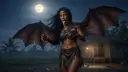
The aswang is the most celebrated and feared creature of Filipino folklore, a term that actually encompasses several types of monstrous beings (corpse eaters, witches, vampires and shapeshifters) especially associated with the Bisayas islands and Mindanao. In its shapeshifting witch aspect, it is conceived as a woman who by day lives as an ordinary villager and at night adopts monstrous forms to hunt. Tradition holds that the aswang condition is transmitted, often through the female line: an elderly aswang must pass on her power to a successor before dying, for otherwise she fails to expire; the transfer is described through images such as the delivery of a breath, a saliva or a black offspring that passes from one to another.
Powers
The aswang is a shapeshifter capable of adopting the form of animals such as the dog, the pig or, above all, a large nocturnal bird. Its most characteristic feature is a long, thin and tubular tongue with which, perched on the roof of a house, it reaches its victims to suck their blood; it is considered especially dangerous for pregnant women and newborns, whose blood or whose fetus it is said to crave. Tradition attributes to it a supernatural sense of smell to detect pregnant women and great speed. Among its vulnerabilities, folklore points to salt, vinegar, garlic, holy water and various apotropaic objects and plants, as well as the fact that its reflection or its shadow can reveal its true nature.
Appearance and tradition
By day, the aswang is indistinguishable from an ordinary person, which fuels the fear that any neighbor could be one; folklore attributes to it, as a telltale sign, bloodshot eyes or an inverted image reflected in its pupils. When transforming, it adopts bestial and shadowy forms, with bird or dog features. The belief in the aswang remains very much alive in wide rural areas of the Philippines, where it structures a good part of the imaginary of nocturnal fear, and has been widely documented by folklorists such as Damiana Eugenio and Francisco Demetrio. As a category rather than as a unique creature, the aswang constitutes the core of Filipino supernatural folklore and one of its most original contributions to the world catalog of monsters.
Relics
🏺 don-transmitting worm
🏺 blessed buyo
Symbology
Element
dark-earth, night
Number
13
Color
oxide-red and black
Animals
black pig, skinny dog, giant crow, humpbacked hyena
Sigils:
🏷️ Traits
Powers
Weaknesses
Behavioral
Resistances
🗺️In the Atlas
Travel the beings’ world of origin and the cosmos of their dimensions.
📜 Mythologies
Body of supernatural beliefs and narratives of the Philippine archipelago: syncretism among native Austronesian traditions, pre-colonial Sino-Malay influences, Hispanic Catholicism (1565-1898) and American modernity. Vampiric (aswang, manananggal, tiyanak), shapeshifters (tikbalang), tree giants (kapre) and nature spirits (engkanto, duwende).
Sources
Filipino Popular Tales
Dean S. Fansler · 1921
Extensive scholarly compilation of Filipino folk tales gathered by Dean S. Fansler in the early twentieth century, a classic source for the narrative folklore of the Philippines.
Southeast Asian Vampire Folklore
Various oral traditions · Pre-20th century
Collection of oral traditions and Malay-Indonesian texts describing the Penanggalan and kin like Leyak, focusing on transformative rituals and folk protections against these flying entities.
Frequently asked questions
How is the black gift of the aswang transmitted?
The gift passes from mother to daughter via saliva or a black worm before the elder aswang dies. Without a successor the body writhes for days until decomposition.
What specific weaknesses affect the aswang?
Salt, vinegar, garlic, Catholic holy water and betel leaves blessed by a priest neutralize its powers and repel it.
What relationship exists between the aswang and the manananggal?
The manananggal is a specific branch of the aswang that segments into a flying torso to hunt. It belongs to the same nocturnal shapeshifter umbrella.
🔖Cite this entry▾
If you cite this article in an academic, journalistic or editorial publication, use any of these formats:
Bestiarypedia. (2026, July 16). Aswang. Bestiarypedia. https://bestiarypedia.com/en/beings/aswang-shapeshifting-witch
Free citation with attribution and canonical link for editorial, academic or journalistic use. Full commercial reuse or creation of derivative products requires prior agreement.