Bestla
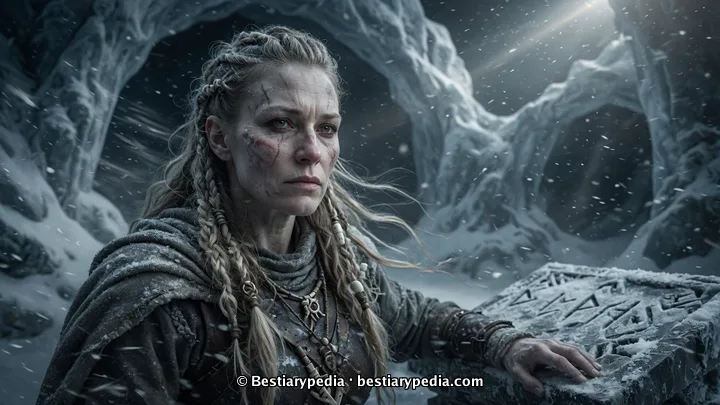
Bestla, jotun mother of Odin and wife of Borr in Norse mythology
Curated byBestiarypediaCreated on


 Scandinavia(Denmark, Norway, Sweden)
Family Tree
Primordial origins of Bestla
Bestla is a giantess daughter of Bölþorn, and with her begins the lineage of the Norse gods. The Gylfaginning of Snorri recounts that she united with Borr, son of Búri (the first being, licked from the primordial ice by the cow Auðumbla), and that from that union were born Odín, Vili and Vé. The genealogy has a consequence that Norse mythology never hides: the Æsir are half giants from the origin, and the border between gods and jötnar is of side, not of blood. It is convenient to specify the source, because it is usually cited badly: Bestla does not appear in the Völuspá, but in the Gylfaginning, in the Skáldskaparmál and, in an indirect form but very suggestive, in the Hávamál.
Mother of the three creators
His three sons are the ones who give shape to the world. Odín, Vili and Vé kill the primordial giant Ymir and with his body they construct the cosmos: from the flesh, the earth; from the blood, the sea; from the bones, the mountains; from the skull, the vault of the sky, sustained by four dwarves. With two trunks found on the shore they make the first human couple, Ask and Embla, and each brother gives him a gift. Bestla does not intervene in any of those episodes and, however, the whole story depends on her: she is the mother of the three, and her jötunn blood is at the bottom of the character of Odín, who throughout the myth resembles much more a cunning giant than a serene god.
The brother of Bestla and the nine cantos
The Hávamál keeps its most intriguing trace. Odín, recounting how he obtained wisdom, says he learned nine powerful songs from the famous son of Bölþorn, that is, from his own maternal uncle, brother of Bestla. The name of that giant is not preserved, and the passage suggests that the magical knowledge of Odín, his most precious good, does not come from the Æsir but from the family of his mother. That the supreme god of the pantheon owes his magic to the giants he fights summarizes well the class of mythology that this is. Bestla barely has myths of her own, but her position is irreplaceable: without her there is no Odín, and without Odín there is no world.
Also known as
Relics
🏺 Bölþorn Stone
Symbology
Element
Earth
Number
Three
Color
Earthy brown
Animals
Mountain goat
Sigils:
🏷️ Traits
Powers
Resistances
🗺️In the Atlas
Travel the beings’ world of origin and the cosmos of their dimensions.
📜 Mythologies
Norse mythology developed among the Germanic peoples of northern Europe, especially in Scandinavia, from the late Iron Age until the progressive Christianization between the 8th and 11th centuries. Its stories are preserved mainly in medieval Icelandic sources such as the Poetic Edda and the Prose Edda of Snorri Sturluson, which collect earlier oral traditions. The universe is conceived as a set of nine worlds connected by the cosmic tree Yggdrasil, in which gods, giants, humans and other beings coexist, and where the destiny of all is ruled by the Norns. The main gods are divided into two groups: the æsir, among whom Odin, Thor and Tyr stand out, and the vanir, represented by Njörðr, Freyr and Freyja, although both groups eventually integrated after a mythical war. Odin, associated with wisdom, war and poetry, occupies a central place, while Thor, god of thunder, protects humans from the giants. The end of the world, known as Ragnarök, involves a catastrophic battle in which most of the gods perish, although a later rebirth is foreseen. This tradition has exerted a lasting influence on literature, art and popular culture in Europe and America, from medieval sagas to modern representations in operas, novels and audiovisual media. Elements such as Valhalla or the valkyries have become part of the Western collective imagination, although often reinterpreted outside their original context.
Sources
Gylfaginning
Snorri Sturluson · 1220
First mythological part of Snorri Sturluson’s Prose Edda (c. 1220). Through King Gylfi, who questions the Æsir, it expounds the creation of the world, the Nine Realms and the fate of the gods at Ragnarök, key to Norse mythology.
Poetic Edda
Anonymous · 1200
Collection of ancient poems including Grímnismál with allusions to the wolves pursuing the Sun and Moon.
Prose Edda
Snorri Sturluson · 1220
Snorri Sturluson's 13th-century handbook of poetics, compiling and organising Norse mythology from the origin of the world to Ragnarök. Together with the Poetic Edda, the main source for the Scandinavian pantheon.
Frequently asked questions
Who is Bestla and why does it matter?
It is the giantess daughter of Bölþorn who, united with Borr, gave birth to Odín, Vili and Vé. With her begins the lineage of the Norse gods, and from her comes a fact that mythology never disguises: the Æsir are half giants from the origin.
In what source does Bestla appear?
In the Gylfaginning and the Skáldskaparmál of Snorri, and indirectly in the Hávamál. It is convenient to specify it because it is usually cited incorrectly: Bestla does NOT appear in the Völuspá, despite the fact that it is often attributed to her.
What did their three sons do?
They killed the primordial giant Ymir and with his body they made the world: the earth from his flesh, the sea from his blood, the mountains from his bones and the vault of the sky from his skull. Afterwards they created the first human couple, Ask and Embla, with two trunks found on the shore.
What relationship does Bestla have with Odin's magic?
The Hávamál tells that Odín learned nine powerful songs from the «famous son of Bölþorn», that is, from his maternal uncle, brother of Bestla. The magical knowledge of the supreme god does not proceed from the Æsir, but from the giant family of his mother.
🔖Cite this entry▾
If you cite this article in an academic, journalistic or editorial publication, use any of these formats:
Bestiarypedia. (2026, July 20). Bestla. Bestiarypedia. https://bestiarypedia.com/en/beings/bestla
Free citation with attribution and canonical link for editorial, academic or journalistic use. Full commercial reuse or creation of derivative products requires prior agreement.