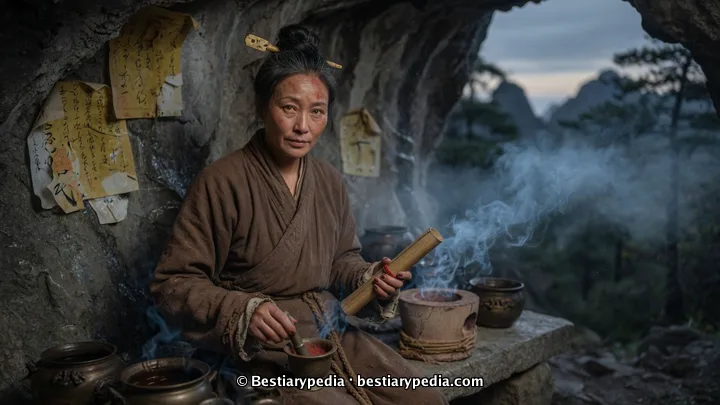
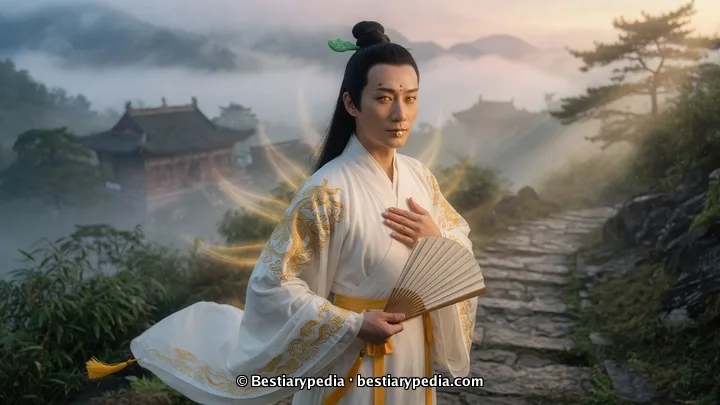
Courtesan Huli Jing
Court Temptress Huli Jing, concubine infiltrated in Chinese imperial palaces
Curated byBestiarypediaCreated onUpdated on
 China(China)
⇄ Cultural variants (3)


4 beings in the lineage
Origins of the Court Seductress
The «court seductress» is the most feared form of the Chinese huli-jing (狐狸精): the fox that leaves the villages to infiltrate the imperial court, where vital energy and power are concentrated to the maximum. The archetype has deep roots in Chinese tradition, which attributed to fox spirits the fall of dynasties; the most celebrated example is Daji, the concubine of the last king Zhou of the Shang dynasty, presented in the novel Fengshen Yanyi as a nine-tailed fox whose influence ruined the sovereign. The creature infiltrates the capital (Chang'an under the Tang, Bianjing or Lin'an under the Song) posing as the daughter of a deceased provincial official, without relatives who could disprove her identity.
Nature and powers
The imperial seductress combines supernatural beauty with acute political intelligence. She exerts a subtle fascination over susceptible males, reads palace intrigues, masters calligraphy and poetry and manipulates favors, horoscopes and factions to progressively control the emperor's will and drain his vital energy without arousing immediate medical suspicions. Tradition attributes to her the fear of bronze mirrors, which reveal her true fox form, and her downfall usually comes at the hands of a Taoist official or diviner who identifies her through divination. She retains the magic pearl and the nine tails proper to the archetype, hidden under her human appearance until her nature is revealed.
Symbols and tradition
The court seductress embodies the ancient Chinese fear of the beautiful woman who corrupts the sovereign and ruins the State, a moralizing topic that Confucian historiography projected onto figures like Daji or Bao Si. Her symbology is associated with the emblems of the imperial concubine (the peony, the phoenix, the embroidered silk) and the bronze mirror that reveals her condition. She is the dark counterpart of the celestial fox: while this one chooses cultivation and ascension, the seductress chooses political power and predation. She belongs to the same family as the Japanese Tamamo-no-Mae, explicitly identified with Daji in the legend, and represents, within the cycle of the huli-jing, the path of earthly ambition versus the path of transcendence.
Relics
🏺 Silk fan with Li Po calligraphy
🏺 Small bronze mirror in lacquered case
Symbology
Element
Yin fire
Number
9
Color
Vermilion red with gold
Animals
Huli jing, Golden phoenix, Crowned crane
Sigils:
🏷️ Traits
Powers
Weaknesses
Behavioral
Resistances
🗺️In the Atlas
Travel the beings’ world of origin and the cosmos of their dimensions.
📜 Mythologies
Chinese folklore encompasses a set of beliefs, stories and practices transmitted over millennia among the populations of the northern plains and the Yellow River valley, with continuity in periods such as the Shang and Zhou dynasties. Its origins trace back to oral traditions and rituals of agricultural and aristocratic communities that integrated the veneration of ancestors, natural forces and tutelary spirits in a system where cosmic order depended on the balance between heaven, earth and human beings. The narratives include entities such as the dragon associated with waters and imperial power, the phoenix as a symbol of renewal, and various local deities linked to mountains, rivers and villages. These traditions shaped a worldview in which the harmony between yin and yang, together with the influence of currents such as Taoism and Confucianism, guided both ritual practices and social organization. Stories about immortals, ghosts and celestial guardians were preserved in texts such as the Shanhaijing and in festivals that still endure, transmitting values of filial respect, obedience to the natural order and recognition of the invisible forces that govern existence. The legacy of Chinese folklore is manifested in classical literature, theater, visual arts and contemporary celebrations that keep alive figures such as the Monkey King or the household deities, influencing the cultural identity of China and the communities of the diaspora.
Sources
Strange Tales from a Chinese Studio
Pu Songling · 1766
'Liaozhai Zhiyi' (Strange Tales from a Chinese Studio) by Pu Songling (1766) is a Ming-Qing supernatural story collection influencing jiangshi imagery and wandering spirits despite no direct mention.
Zi Bu Yu
Yuan Mei · 1788
'Zi Bu Yu' (子不語, 'What the Son Does Not Say') by Yuan Mei (1788) is a Qing collection of supernatural tales, first documented mention of jiangshi as corpses returning due to poor burial.
Shan Hai Jing
Anonymous · 4th cent. BC - 2nd cent. AD
Classic of Mountains and Seas ancient Chinese mythological geographical text.
Frequently asked questions
How does the Court Temptress Huli Jing infiltrate imperial palaces?
She poses as the daughter of a deceased provincial official with no relatives to refute her and enters the court as an elite concubine.
What method does she use to drain the emperor's qi?
She progressively controls imperial qi over decades through sustained intimacy without arousing immediate medical suspicions.
What relationship does she maintain with the celestial immortal variant?
She is a variant of the celestial immortal huli-jing because she chose political power instead of Taoist cultivation.
🔖Cite this entry▾
If you cite this article in an academic, journalistic or editorial publication, use any of these formats:
Bestiarypedia. (2026, July 26). Courtesan Huli Jing. Bestiarypedia. https://bestiarypedia.com/en/beings/huli-jing-court-temptress
Free citation with attribution and canonical link for editorial, academic or journalistic use. Full commercial reuse or creation of derivative products requires prior agreement.