Celestial Huli Jing
Celestial Immortal Huli Jing, Taoist messenger of the xian pantheon
Curated byBestiarypediaCreated onUpdated on
 China(China)



Origins of the Chinese celestial fox
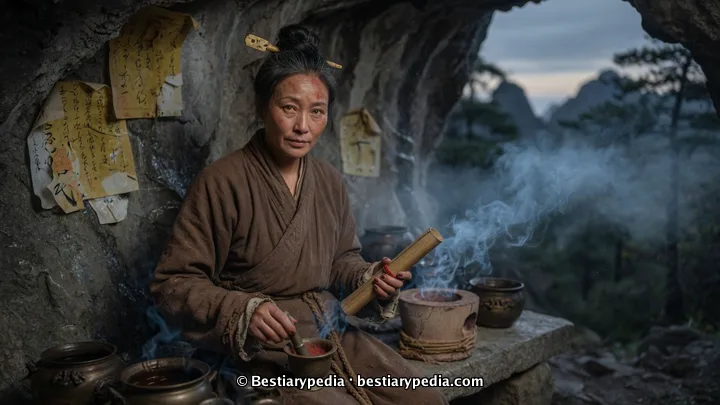
The huli-jing (狐狸精) is the fox-spirit of Chinese tradition, attested since ancient times: the Classic of Mountains and Seas (Shanhaijing) already describes the nine-tailed fox of Qingqiu, and later collections such as the Liaozhai Zhiyi of Pu Songling or the Zi Bu Yu of Yuan Mei collect numerous tales of foxes that take human form. In the Taoist worldview, a fox that lives long enough and practices inner cultivation (neidan) can refine its energy and ascend to the category of celestial fox (tianhu, 天狐) or fox-immortal (huxian, 狐仙). This «celestial immortal» form represents the culmination of that process: the millennial fox that, after centuries of discipline, reaches the pantheon and is counted among the xian, the immortals.
Nature and powers
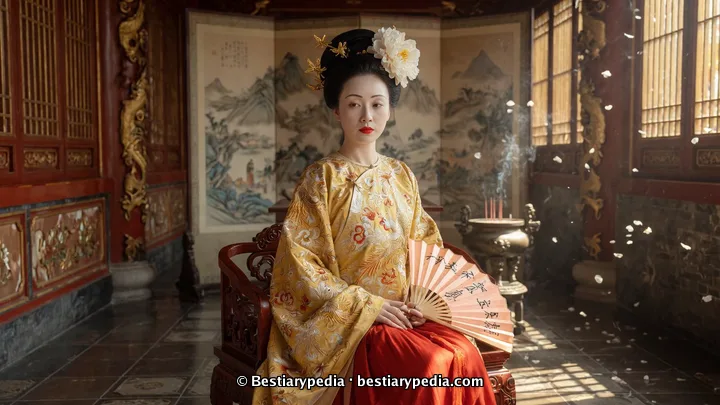
The celestial fox has left behind the predation of vital energy typical of young specimens and sustains its existence through Taoist cultivation and the conservation of its magic pearl (húwán or hújīng), source of its spiritual power and main vulnerability if it is taken from it. The tradition attributes to it the free transformation between human, fox and hybrid form of nine tails, flight between heaven and earth, mastery of mists and messaging between deities. It can grant healing, fortune and success in imperial examinations to virtuous mortals, and it is considered almost invulnerable except before the highest-ranking Taoist talismans. It is associated with sacred mountains, dwelling of immortals, and with occasional service to Xi Wangmu, the Queen Mother of the West.
Symbols and tradition
As huxian, the celestial fox was an object of popular worship in broad regions of China, where offerings were made to it to obtain protection and prosperity. Its iconography is linked to the nine-tailed fox, emblem both of auspice (in its beneficial aspect, sign of peace and good government) as of danger (in its seductive aspect). It is thus distinguished from the predatory forms of the archetype by its benevolent character and its spiritual elevation. It belongs to the same family as the Korean gumiho and the Japanese kitsune, with which it shares the motif of the fox that ascends through longevity and discipline, and represents, within the cycle of the huli-jing, the ultimate goal of the transformation: the passage from the cunning beast to the venerated immortal.
Relics
🏺 Huwan Pearl
🏺 Taoist white feather fan
🏺 Hand-calligraphed fulu talisman
Symbology
Element
Yang Metal
Number
9
Color
Celestial gold
Animals
Nine-tailed fox, Crowned white crane, Western white tiger
Sigils:
🏷️ Traits
Powers
Weaknesses
Behavioral
Resistances
🔗 Relations with other beings
🗺️In the Atlas
Travel the beings’ world of origin and the cosmos of their dimensions.
📜 Mythologies
Chinese folklore encompasses a set of beliefs, stories and practices transmitted over millennia among the populations of the northern plains and the Yellow River valley, with continuity in periods such as the Shang and Zhou dynasties. Its origins trace back to oral traditions and rituals of agricultural and aristocratic communities that integrated the veneration of ancestors, natural forces and tutelary spirits in a system where cosmic order depended on the balance between heaven, earth and human beings. The narratives include entities such as the dragon associated with waters and imperial power, the phoenix as a symbol of renewal, and various local deities linked to mountains, rivers and villages. These traditions shaped a worldview in which the harmony between yin and yang, together with the influence of currents such as Taoism and Confucianism, guided both ritual practices and social organization. Stories about immortals, ghosts and celestial guardians were preserved in texts such as the Shanhaijing and in festivals that still endure, transmitting values of filial respect, obedience to the natural order and recognition of the invisible forces that govern existence. The legacy of Chinese folklore is manifested in classical literature, theater, visual arts and contemporary celebrations that keep alive figures such as the Monkey King or the household deities, influencing the cultural identity of China and the communities of the diaspora.
Sources
Strange Tales from a Chinese Studio
Pu Songling · 1766
'Liaozhai Zhiyi' (Strange Tales from a Chinese Studio) by Pu Songling (1766) is a Ming-Qing supernatural story collection influencing jiangshi imagery and wandering spirits despite no direct mention.
Zi Bu Yu
Yuan Mei · 1788
'Zi Bu Yu' (子不語, 'What the Son Does Not Say') by Yuan Mei (1788) is a Qing collection of supernatural tales, first documented mention of jiangshi as corpses returning due to poor burial.
Shan Hai Jing
Anonymous · 4th cent. BC - 2nd cent. AD
Classic of Mountains and Seas ancient Chinese mythological geographical text.
Frequently asked questions
How does a huli-jing attain celestial immortality?
After a thousand years of neidan with the húwán pearl intact and nine spiritual bodies cultivated it ascends as xian.
What vulnerability does the húwán pearl present?
Its capture by mortals can force another's cultivation and constitutes the main weakness of the celestial being.
Where does the celestial huli-jing usually reside?
In hidden caves of sacred Taoist mountains such as Wudangshan Huashan Qingchengshan and Longhushan.
🔖Cite this entry▾
If you cite this article in an academic, journalistic or editorial publication, use any of these formats:
Bestiarypedia. (2026, July 14). Celestial Huli Jing. Bestiarypedia. https://bestiarypedia.com/en/beings/huli-jing-celestial-immortal
Free citation with attribution and canonical link for editorial, academic or journalistic use. Full commercial reuse or creation of derivative products requires prior agreement.