Tamamo no Mae
Tamamo no Mae, the transmigratory imperial seductress of nine tails
Curated byBestiarypediaCreated onUpdated on
 Japan(Japan)
⇄ Cultural variants (3)




4 beings in the lineage
Origins of Tamamo-no-Mae
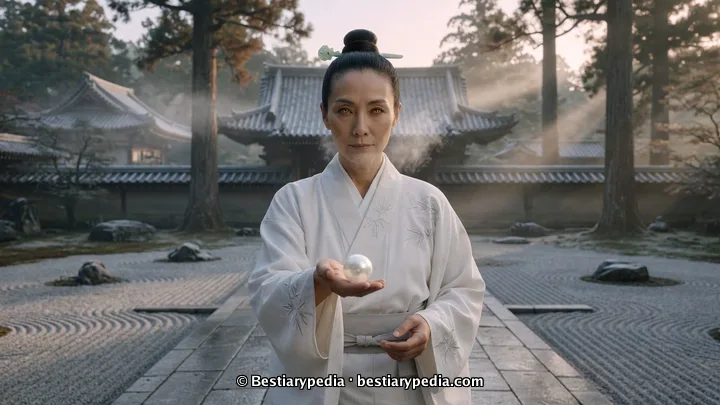
Tamamo-no-Mae (玉藻前) is the most celebrated of the malevolent kitsune of Japanese legend, a nine-tailed fox whose story was fixed in the medieval period, especially in otogizōshi tales such as the Tamamo no Sōshi and in nō and kabuki theater. According to the fully developed legend, it is the same millennial fox that successively incarnated in different courts of Asia: in China as Daji, the concubine who ruined the last king of the Shang dynasty; in India as the consort of a legendary prince (identified with the figure of Hua Yang or «Lady Kayō»); and finally in Japan of Emperor Toba, around the 12th century, under the name of Tamamo-no-Mae. This chain of incarnations, proper to the late Japanese tradition, makes her the supreme archetype of the fatal seductress.
Nature and powers
In the court of Emperor Toba, Tamamo-no-Mae presented herself as a lady of incomparable beauty and erudition, admired for her knowledge, until the sovereign fell ill without apparent cause. The onmyōji (yin-yang master) Abe no Yasunari (in some versions, a descendant of Abe no Seimei) discovered through divination that the lady was in reality a nine-tailed fox that was draining the life of the emperor. Unmasked, the creature fled to the Nasu plains, where it was pursued and killed by the warriors Miura no Suke and Kazusa no Suke. Tradition attributes to her immutable beauty, the transformation into a golden nine-tailed fox and the power to manipulate an entire court, draining the vital energy of the monarch she served.
Symbols and legacy
After her death, according to the legend, the spirit of Tamamo-no-Mae transformed into the Sesshō-seki (殺生石), the «stone that kills», a volcanic rock from Nasu that emanated poisonous gases and killed all who approached it, until the monk Gennō exorcised it and split it. The stone, a real place, fractured naturally in March 2022, a fact that revived the fame of the legend. Tamamo-no-Mae appears represented in the work of Toriyama Sekien and in countless pieces of Japanese theater and art as an emblem of the imperial seductress. She maintains a relationship of cultural variant with the Chinese huli-jing (through Daji) and embodies, within the nine-tailed fox family, the pinnacle of the path of seduction and ambition, in opposition to the ascetic and benevolent forms of the archetype.
Also known as
Relics
🏺 Golden ōgi fan with classical Japanese calligraphy
Symbology
Element
Yin Fire
Number
9
Color
Imperial gold
Animals
Nine-tailed golden kitsune, Japanese crowned crane, Black swan
Sigils:
🏷️ Traits
Powers
Weaknesses
Behavioral
Resistances
🔗 Relations with other beings

🗺️In the Atlas
Travel the beings’ world of origin and the cosmos of their dimensions.
📜 Mythologies
Japanese folklore encompasses oral traditions, myths, legends and supernatural creatures like yōkai and kami, compiled in Edo-period illustrated texts by Toriyama Sekien in works like Gazu Hyakki Yagyō and Konjaku Hyakki Shūi, reflecting Shinto animist beliefs, ecological fears of floods and droughts, and respect for nature in rivers, lakes and rice fields of regions like Shiga, Osaka and Kyoto.
Sources
Konjaku Monogatarishū
Unknown compiler · 12th century
Vast Japanese collection of more than a thousand tales (setsuwa) from the late Heian period (c. 12th century). It gathers Buddhist, secular and supernatural stories from India, China and Japan, and is an essential source for yōkai, oni and spirits of Japanese folklore.
Asai Ryōi Otogibōko
Asai Ryōi · 1660
Otogibōko (1666) by Asai Ryōi, a Japanese collection of ghost stories (kaidan) from the Edo period, adapted from Chinese tales. It popularized stories of yūrei and vengeful spirits, such as the famous "The Peony Lantern" (Botan Dōrō).
Gazu Hyakki Yagyō
Toriyama Sekien · 1776
Illustrated bestiary by Toriyama Sekien, part of his influential series of yokai catalogues (1776-1784) that defined the classic image of Japanese folklore creatures.
Frequently asked questions
How did Tamamo no Mae’s transmigratory identity originate?
It syncretizes Daji of Shang China, Princess Kayō of India and the Heian court lady of twelfth-century Japan into one nine-tailed kitsune.
What power allows Tamamo no Mae to influence emperors without directly assassinating them?
Sustained imperial qi drainage combined with massive illusion projection that progressively weakens the monarch.
What relationship does Tamamo no Mae maintain with the Sessho-seki stone?
After her hunt in Nasu her residual qi contaminated the volcanic rock, which poisoned those who approached for eight hundred years; the stone remains linked to her essence.
🔖Cite this entry▾
If you cite this article in an academic, journalistic or editorial publication, use any of these formats:
Bestiarypedia. (2026, July 26). Tamamo no Mae. Bestiarypedia. https://bestiarypedia.com/en/beings/kitsune-tamamo-no-mae
Free citation with attribution and canonical link for editorial, academic or journalistic use. Full commercial reuse or creation of derivative products requires prior agreement.