Si'lat
Si'lat Desert Seductress
Curated byBestiarypediaCreated onUpdated on
 Arabian Peninsula(Saudi Arabia)
⇄ Cultural variants (3)



4 beings in the lineage
Origins of the Si'lat in pre-Islamic Arabian folklore
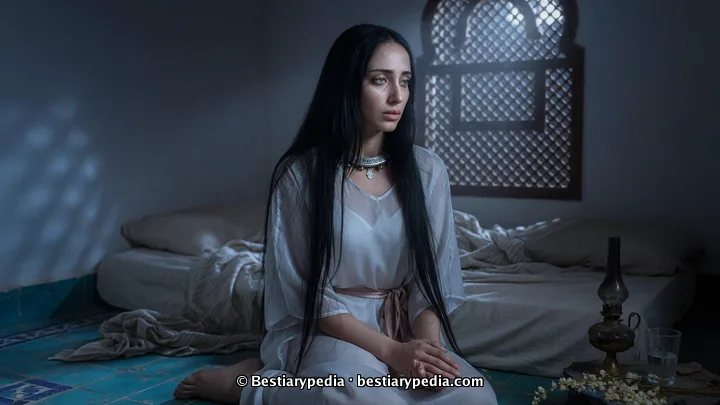
The Si'lat emerges as a female jinn of the Arabian desert after generations inhabiting remote oases and isolated wadis of the Rub al-Jali and Al-Ula. Her zoomorphic affinity with desert wolves, gazelles and hyenas consolidated during the Jahiliya era, when Bedouin poets mentioned her in odes as a warning against following solitary women in wadis. Sources such as al-Jahiz in Kitab al-Hayawan describe her zoological ontology as a shapeshifting predator. Ibn al-Wardi in Kharidat al-Ajaib collects Sahrawi accounts linking her to illusory palaces in caves. This autonomous figure does not derive from jann but evolves independently as a lethal seductress of travelers.
Powers of seduction and transformation of the Si'lat
The Si'lat possesses perfect henge between the form of an Arabian wolf with sand-golden fur and a beautiful woman with chestnut-golden hair, hypnotic voice audible among dunes and creation of illusions of lush oases that hide her real cave. She keeps lovers in permanent love trance through rituals with wine and dates. Her indefinite longevity and knowledge of the desert allow perfect camouflage. The hybrid form revealed under Quranic light shows a bipedal body covered in fur with visible tail. These powers equate her to cross-cultural variants like the kitsune but adapted to the Bedouin environment.
Cross-cultural relations and rivalries of the Si'lat
The Si'lat maintains cultural-variant relations with Tamamo-no-Mae kitsune, court huli-jing and maiden gumiho seductress, sharing the lethal beast-woman archetype across distinct cultures. She is rival to the corpse-eating ghoul due to opposite predation methods on travelers. Her symbology includes sand-golden fur, Bedouin jewelry, eyes with subtle vertical pupil and illusory oasis as relic. She operates in concrete geography such as Rub al-Jali and Wadi Rum, selecting loners for eternal slavery or devouring.
Relics
🏺 personal illusory oasis
Symbology
Element
tierra-yang (desert sand, golden-warm)
Number
9
Color
desert tanned sand-gold
Animals
Arabian desert wolf
Sigils:
🏷️ Traits
Powers
Weaknesses
Behavioral
Resistances
🗺️In the Atlas
Travel the beings’ world of origin and the cosmos of their dimensions.
📜 Mythologies
Arabian folklore encompasses oral traditions, tales from One Thousand and One Nights, and supernatural beings like djinn, ifrit and marid, spirits created from smokeless fire according to the Quran (Surah 55:15), originating in pre-Islamic myths of the Arabian Peninsula, reflecting Bedouin animism, fears of desert spirits, sandstorms and oases, compiled in medieval literature like the works of Al-Jahiz and transmitted in regions like Hijaz, Yemen and the Maghreb.
Sources
Kharidat al-Aja'ib
Ibn al-Wardi · 1450
"Kharidat al-Aja’ib" (The Pearl of Wonders), an Arabic cosmography attributed to Siraj al-Din ibn al-Wardi (15th century). It describes the geography of the known world, its peoples and the wondrous creatures—jinn, demons and beasts—that tradition placed at its edges.
One Thousand and One Nights
Anonymous (traditional compilation) · VIII-XIV
Anonymous compilation of medieval Arab folk tales (8th-14th centuries), where ifrits appear in stories like 'The Fisherman and the Ifrit', illustrating their power, vengeance and submission to magical seals.
Kitāb al-Ḥayawān (Book of Animals)
Al-Jāḥiẓ (Abū ʿUthmān ʿAmr ibn Baḥr al-Kinānī) · c. 776-868
Zoological and theological encyclopedia in 7 volumes by Basran polymath Al-Jāḥiẓ (776-868 CE), foundational reference on jinn, ifrit, ghul and other Arabic creatures from both naturalist and cultural-religious perspectives. Includes theological debates on jinn ontology and catalogs of mafáhim on supernatural desert behavior.
Frequently asked questions
What is the zoomorphic origin of the Si'lat?
It arises from generations in remote oases acquiring affinity with desert wolves and hyenas according to Jahiliya accounts.
How does the Si'lat use the oasis illusion?
She creates lush oases around her cave to lure lone travelers and then retain or devour them in trance.
What relation does the Si'lat have with the kitsune?
It is a direct cultural variant of the same lethal seductive beast-woman archetype shared with Tamamo-no-Mae.
🔖Cite this entry▾
If you cite this article in an academic, journalistic or editorial publication, use any of these formats:
Bestiarypedia. (2026, July 22). Si'lat. Bestiarypedia. https://bestiarypedia.com/en/beings/si-lat-shapeshifter
Free citation with attribution and canonical link for editorial, academic or journalistic use. Full commercial reuse or creation of derivative products requires prior agreement.