Nascent Jiangshi
Recently Deceased Jiangshi, initial phase of the jiangshi lineage
Curated byBestiarypediaCreated onUpdated on
 China(China)
🔄 Transformation line (Phase 1 of 3)


Origins of the newly deceased jiangshi
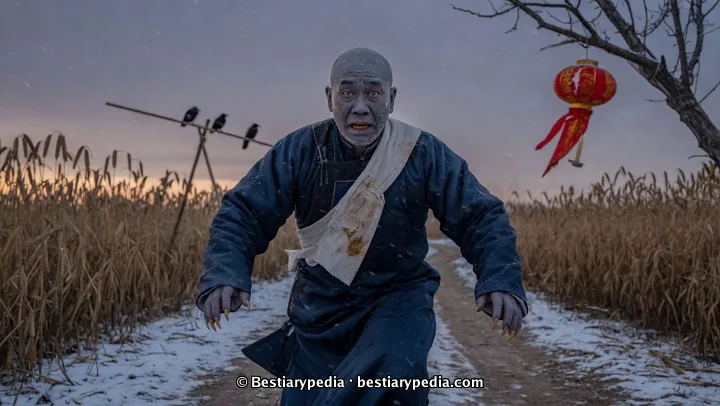
The jiangshi (僵尸, «stiff corpse») is the reanimated dead from Chinese folklore, popularly known in the West as «hopping vampire». Tradition holds that a corpse can reanimate when the person dies in irregular circumstances (violence, accident, death far from home) or when it does not receive the appropriate funeral rites. This form, that of the «newly deceased», represents the initial phase of the process: in the hours following death, the body begins to manifest an anomalous rigidity, beyond natural rigor mortis, together with a slight bluish lividity. Folklore, collected in collections such as Zi Bu Yu by Yuan Mei, attributes this awakening to the retention of the lower soul (po) in the corpse, which fails to transit to the beyond.
Manifestation and process
In this early stage the powers of the jiangshi are minimal and the body remains essentially passive. The residual senses allow it to perceive the presence of the living, but it does not yet attack or move by jumping, a trait proper to the more developed forms. The rigidity advances progressively over several days, and an intermittent and involuntary breathing reveals that the transition has begun. The Taoist tradition holds that a priest can stop the process through the correct rites, sealing the body before it hardens completely. If nothing prevents it, the corpse evolves towards the fully active jumping jiangshi, capable of draining the vital energy of its victims.
Symbols and tradition
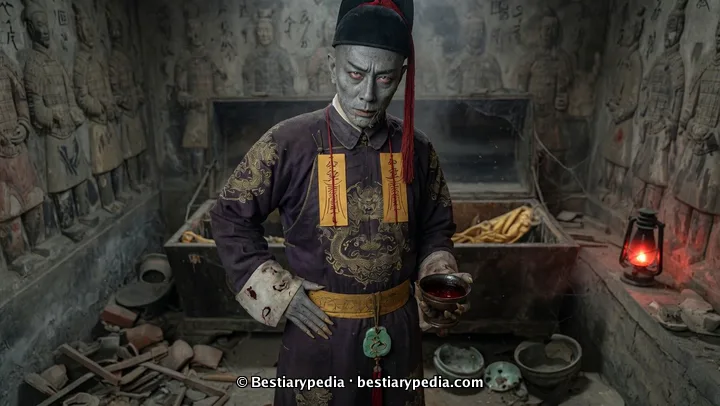
The iconography of this phase refers to the traditional Chinese wake: the everyday clothes in which the deceased died, the white candles of mourning, the incense burner, the tablet with the name of the dead and the coins placed on the eyes. The associated element is the earth-yin, and the funerary motif dominates all its symbology. The family usually attributes the first anomalous signs to mourning, until a Taoist priest recognizes the danger. As the first link in the jiangshi cycle, the recently deceased embodies the Chinese fear of a «badly closed» death, without the rites that guarantee the rest of the soul, and the belief that an incorrect funeral can turn a loved one into a threat.
Relics
🏺 Qing funerary coins
Symbology
Element
Neutral yin earth
Number
7
Color
Pale slate gray
Animals
Crow perched on the temple eaves, House domestic dog
Sigils:
🏷️ Traits
Powers
Weaknesses
Behavioral
Resistances
🗺️In the Atlas
Travel the beings’ world of origin and the cosmos of their dimensions.
📜 Mythologies
Chinese folklore encompasses a set of beliefs, stories and practices transmitted over millennia among the populations of the northern plains and the Yellow River valley, with continuity in periods such as the Shang and Zhou dynasties. Its origins trace back to oral traditions and rituals of agricultural and aristocratic communities that integrated the veneration of ancestors, natural forces and tutelary spirits in a system where cosmic order depended on the balance between heaven, earth and human beings. The narratives include entities such as the dragon associated with waters and imperial power, the phoenix as a symbol of renewal, and various local deities linked to mountains, rivers and villages. These traditions shaped a worldview in which the harmony between yin and yang, together with the influence of currents such as Taoism and Confucianism, guided both ritual practices and social organization. Stories about immortals, ghosts and celestial guardians were preserved in texts such as the Shanhaijing and in festivals that still endure, transmitting values of filial respect, obedience to the natural order and recognition of the invisible forces that govern existence. The legacy of Chinese folklore is manifested in classical literature, theater, visual arts and contemporary celebrations that keep alive figures such as the Monkey King or the household deities, influencing the cultural identity of China and the communities of the diaspora.
Sources
Strange Tales from a Chinese Studio
Pu Songling · 1766
'Liaozhai Zhiyi' (Strange Tales from a Chinese Studio) by Pu Songling (1766) is a Ming-Qing supernatural story collection influencing jiangshi imagery and wandering spirits despite no direct mention.
Zi Bu Yu
Yuan Mei · 1788
'Zi Bu Yu' (子不語, 'What the Son Does Not Say') by Yuan Mei (1788) is a Qing collection of supernatural tales, first documented mention of jiangshi as corpses returning due to poor burial.
Frequently asked questions
Under what circumstances does the Recently Deceased Jiangshi arise?
It arises from violent or distant death without proper funerary rites. The body begins transition in twenty-four to seventy-two hours with rigidity and post-mortem breathing.
What relation does it have with the Jiangshi Hopping Corpse?
It is the start of the lineage and transforms into hopping-corpse if Taoist rites are not performed in the first or second week.
What symbols characterize its initial phase?
Everyday clothing, white candles, bronze censer, Qing coins on eyes and shouyi papers in rural wake with neutral yin-earth and number seven.
🔖Cite this entry▾
If you cite this article in an academic, journalistic or editorial publication, use any of these formats:
Bestiarypedia. (2026, July 14). Nascent Jiangshi. Bestiarypedia. https://bestiarypedia.com/en/beings/jiangshi-recently-deceased
Free citation with attribution and canonical link for editorial, academic or journalistic use. Full commercial reuse or creation of derivative products requires prior agreement.