Hopping Jiangshi
Hopping Corpse Jiangshi, intermediate phase of the jiangshi lineage rooted in northern Chinese funerary tradition
Curated byBestiarypediaCreated onUpdated on
 China(China)
🔄 Transformation line (Phase 2 of 3)


Origins of the Jumping Corpse
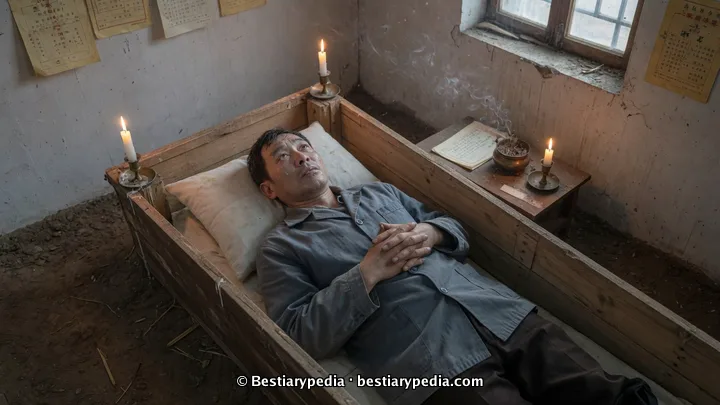
The jumping jiangshi is the classic and most recognizable form of the Chinese reanimated dead. Tradition links it to the corpse that dies far from its native village and is not returned in time to receive ritual burial; the critical period is set at forty-nine days (Buddhist tradition) or one hundred (Taoist tradition). A historical motive fueled the legend: the «corpse drivers» of Hunan (xiangxi ganshi), who supposedly transported at night the bodies of the emigrants back to their villages, guiding them in a line with bells under the direction of Taoist priests. From that image of «walking» corpses emerged the figure of the jiangshi that advances by jumps due to the rigidity of its limbs.
Nature and powers
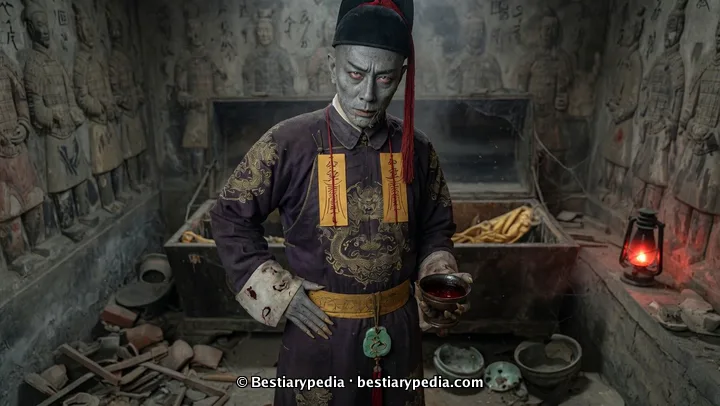
The hopping jiangshi moves by leaps, with rigid arms extended forward, because cadaveric rigidity prevents it from walking or bending the joints. Its food is not blood, but qi, the breath or vital energy of the living, which it absorbs when approaching them; the blood vampirism sometimes attributed to it is a modern elaboration, popularized by Hong Kong cinema of the eighties, alien to classical folklore. It possesses notable strength and hardened claws, and tracks its victims by breath. Tradition holds that a Taoist talisman of yellow paper (fú) stuck on the forehead, with the formula «急急如律令», paralyzes it, and that holding the breath prevents it from detecting it.
Symbols and tradition
The image of the jiangshi is fixed by its attire: the funeral uniform of a Qing dynasty official, with its hat, over grayish or greenish skin. The yellow paper talisman on the forehead is its most characteristic emblem, symbol of the Taoist power that subdues it. It is combated with decapitation, fire, peach tree wood, glutinous rice, black rooster blood and mirrors, all apotropaic elements of Chinese tradition. As the central figure of the jiangshi cycle, the hopping corpse embodies the belief that a restless soul can animate its own body, and has become one of the most iconic monsters of East Asian popular culture.
Also known as
Relics
🏺 Yellow Taoist Seal
Symbology
Element
Yin Earth
Number
7
Color
Cadaveric Gray
Animals
Crow, Feral Street Dog
Sigils:
🏷️ Traits
Powers
Weaknesses
Behavioral
Resistances
🗺️In the Atlas
Travel the beings’ world of origin and the cosmos of their dimensions.
📜 Mythologies
Chinese folklore encompasses a set of beliefs, stories and practices transmitted over millennia among the populations of the northern plains and the Yellow River valley, with continuity in periods such as the Shang and Zhou dynasties. Its origins trace back to oral traditions and rituals of agricultural and aristocratic communities that integrated the veneration of ancestors, natural forces and tutelary spirits in a system where cosmic order depended on the balance between heaven, earth and human beings. The narratives include entities such as the dragon associated with waters and imperial power, the phoenix as a symbol of renewal, and various local deities linked to mountains, rivers and villages. These traditions shaped a worldview in which the harmony between yin and yang, together with the influence of currents such as Taoism and Confucianism, guided both ritual practices and social organization. Stories about immortals, ghosts and celestial guardians were preserved in texts such as the Shanhaijing and in festivals that still endure, transmitting values of filial respect, obedience to the natural order and recognition of the invisible forces that govern existence. The legacy of Chinese folklore is manifested in classical literature, theater, visual arts and contemporary celebrations that keep alive figures such as the Monkey King or the household deities, influencing the cultural identity of China and the communities of the diaspora.
Sources
Strange Tales from a Chinese Studio
Pu Songling · 1766
'Liaozhai Zhiyi' (Strange Tales from a Chinese Studio) by Pu Songling (1766) is a Ming-Qing supernatural story collection influencing jiangshi imagery and wandering spirits despite no direct mention.
Zi Bu Yu
Yuan Mei · 1788
'Zi Bu Yu' (子不語, 'What the Son Does Not Say') by Yuan Mei (1788) is a Qing collection of supernatural tales, first documented mention of jiangshi as corpses returning due to poor burial.
Frequently asked questions
How does the intermediate phase of the Hopping Corpse Jiangshi arise?
It arises from a corpse without proper ritual burial after 49 or 100 days. The body hardens by rigor mortis and hops rigidly draining qi.
What temporarily stops the Hopping Corpse Jiangshi?
A correctly calligraphed yellow Taoist seal with characters 急急如律令 affixed to the forehead temporarily stops it.
Into what superior form does the Hopping Corpse Jiangshi transform?
It transforms into jiangshi-blood-eater-emperor maintaining its lineage within the hierarchy of Chinese folklore spirits.
🔖Cite this entry▾
If you cite this article in an academic, journalistic or editorial publication, use any of these formats:
Bestiarypedia. (2026, July 16). Hopping Jiangshi. Bestiarypedia. https://bestiarypedia.com/en/beings/jiangshi-hopping-corpse
Free citation with attribution and canonical link for editorial, academic or journalistic use. Full commercial reuse or creation of derivative products requires prior agreement.