Cŵn Annwn
Cŵn Annwn, the pack of Arawn and Gwyn ap Nudd
Curated byBestiarypediaCreated onUpdated on
 Europe
 Wales(Wales)
⇄ Cultural variants (1)


Same archetype
Other readings of Cù Sìth

Pwyll's Offence in the First Branch
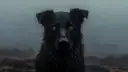
The Cŵn Annwn first appear in the First Branch of the Mabinogi, and they appear causing trouble. Pwyll, prince of Dyfed, rides out hunting and finds a pack that is not his own pulling down a stag: dogs of a gleaming white, with red ears, the pair of colours by which insular tradition marks everything that comes from the Otherworld. Pwyll drives them off and sets his own hounds on the kill, and with that gesture commits the discourtesy that sets the story in motion. The dogs belonged to Arawn, king of Annwn, who appears to reproach him. The reparation Arawn demands (that they exchange shapes and kingdoms for a year, and that Pwyll kill his rival Hafgan in his stead) is the whole plot of the branch.
It is worth holding on to what the medieval text says and what it does not. It says the pack belongs to Arawn's court and that its colouring marks it as supernatural. It nowhere says that the hounds foretell anyone's death: that comes later, from oral folklore, and it is a separate layer that should not be projected backwards.
The Bark That Sounds Backwards
In Welsh oral tradition the Cŵn Annwn no longer hunt stags but souls, and hearing them is the warning. Their baying comes at night, from overhead, carried on the wind, and whoever hears it understands that someone in the household is about to die. The belief is anchored in specific hunting grounds: the most often cited is Cadair Idris, where the howling of these hounds was said to foretell death to anyone who heard it.
What sets them apart from the other prophetic dogs of Europe is acoustic, and it works backwards. Wirt Sikes records it in «British Goblins»: the bark sounds louder the further off the pack is, and fades as it draws near. The practical consequence is cruel, and it is the whole point of the motif: whoever hears them loud has time, and whoever can barely make them out already has them overhead. There is no fleeing them by ear.
There is also a natural explanation that the folklore itself half concedes. In Wales the pack was associated with flights of migrating geese: their honking at night, moving across the sky in formation, sounds a great deal like dogs baying far above.
Two Masters and a Christianisation
The Cŵn Annwn do not hunt alone: they have a master, and the master changes with the period. In the First Branch of the Mabinogi he is Arawn, king of Annwn. In later medieval tradition and in folklore he is Gwyn ap Nudd, lord of the Otherworld and king of the tylwyth teg, the Welsh fair folk, and it is he who leads the hunt. Both names coexist in the sources without any of them bothering to reconcile them, and that duplication is not a transmission error: it is the trace of two superimposed layers of the same tradition.
With Christianisation the hunt changes meaning. The pack stops pursuing stags or souls at large and starts harrying the damned, and Annwn, which in the older material is an Otherworld neither good nor evil, comes to be read as hell. John Rhys records in «Celtic Folklore» already Christianised versions in which the hounds chase souls in torment. It is the same piece reinterpreted: the colours are still the Celtic ones, white with red ears, but the motif has turned moral and the hunt has become a punishment.
Hence the being reads today in two registers at once. It is the royal pack of an Otherworld king, and it is the infernal hunt that drags souls away. Neither reading is the false one; they are two moments of a single figure that folklore never got round to deciding between.
Relics
Symbology
Element
Wind
Number
∞
Color
White
Animals
White dog
Sigils:
Traits
Powers
Weaknesses
Behavioral
Resistances
In the Atlas
Travel the beings’ world of origin and the cosmos of their dimensions.
Mythologies
Welsh folklore encompasses oral traditions, myths and supernatural creatures like the Cŵn Annwn, preserved in texts such as the Mabinogion and reflecting Celtic beliefs about the Otherworld.
Sources
The Mabinogion
Lady Charlotte Guest (trans.) · 1849
Collection of medieval Welsh tales translated by Lady Charlotte Guest in 1849, primary source of insular Celtic folklore.
British Goblins
Wirt Sikes · 1880
Nineteenth-century study of Welsh folklore by Wirt Sikes documenting beliefs about omens and Otherworld beings.
Celtic Folklore
John Rhys · 1901
Work by John Rhys compiling Celtic traditions about omens, the Wild Hunt and Otherworld beings in Wales.
Frequently asked questions
Were the Cŵn Annwn already a death omen in the Mabinogi?
No. In the First Branch they are Arawn's hunting pack, and their function in the story is to provoke Pwyll's offence; the text attributes no augury to them. The omen is a much later folkloric layer, which is why the same being reads two ways depending on which source you consult. Projecting the omen backwards is the commonest mistake in retelling it.
Why does their bark sound louder the further away they are?
Because the motif exists precisely so that they cannot be escaped. If the ear deceives, whoever hears them faintly already has them overhead, and whoever still hears them clearly has a margin he cannot measure. It is a deliberate inversion of the physics of sound, and it is what distinguishes them from the other prophetic dogs of Europe, which merely howl louder as they approach.
Who commands the pack, Arawn or Gwyn ap Nudd?
Both, depending on the source. Arawn in the First Branch of the Mabinogi; Gwyn ap Nudd in later medieval tradition and in folklore, where he also leads the Wild Hunt. The sources do not reconcile them and the catalogue should not either: they are two layers of one tradition, and picking a single one would be inventing a coherence the tradition never had.
🔖Cite this entry▾
If you cite this article in an academic, journalistic or editorial publication, use any of these formats:
Bestiarypedia. (2026, August 25). Cŵn Annwn. Bestiarypedia. https://bestiarypedia.com/en/beings/cwn-annwn
Free citation with attribution and canonical link for editorial, academic or journalistic use. Full commercial reuse or creation of derivative products requires prior agreement.