Iblis
Iblis, the jinn who would not bow
Curated byBestiarypediaCreated onUpdated on
 Arabian Peninsula(Saudi Arabia)
Family Tree


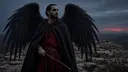
The refusal: the origin of Iblis
Iblis enters the Quran through a scene, not a genealogy. God shapes Adam from clay and orders the angels to bow before him, and all obey but one. The argument behind the refusal is in sura 7:12: "You created me from fire, and him You created from clay." Sura 18:50 specifies that "he was one of the jinn", and from there springs a debate that occupied Islamic theology for centuries. If he was an angel who sinned, one would have to grant that angels can disobey, which most schools reject; if he was a jinn, it remains to be explained what he was doing among the angels when the command was given. The commentaries of al-Tabari and Ibn Kathir preserve a tradition credited to Ibn Abbas according to which his name before the fall was Azazil, and he had worshipped God for millennia until sheer devotion earned him a place among the heavenly host. The sin Islam places at the origin of evil is neither lust nor lying, but the pride of believing oneself made of finer stuff.
The respite and the whisper
What the Quran grants Iblis is not strength but time. In sura 15:36 he asks to be reprieved until the day of resurrection and is granted it, and in 7:16 and 7:17 he announces that he will lie in wait for humans from before and behind, from their right and their left. His instrument is waswasa, the whisper: he compels no one, he suggests. Iblis says so himself on judgment day, in sura 14:22: "I had no authority over you, except that I called you and you answered me." That line is the key to his whole power, because it strips him of coercion and leaves him only insinuation. Tradition adds that he works methodically. A hadith recorded by Muslim (2813) has him set his throne upon the waters and send out detachments, promoting whichever of them manages to part a man from his wife. He is also credited with taking human shape: the Meccan accounts have him appear as an old man from the Arabian interior to advise the Quraysh, and sura 8:48 shows him appearing to his followers on the day of Badr and deserting once he sees what is coming. Against the whisper, custom prescribes reciting the last two suras of the Quran, al-Falaq and an-Nas, called for that reason the muawwidhatan, "the two that give refuge".
An image the Quran never gives
The Quran describes Iblis in not a single verse. His entire image is later and was born in illustrated Persian manuscripts: in the tradition of Balami's Tarikh and in the Safavid Qisas al-anbiya he is painted with a blackened face, flaming eyes, an oversized head bearing horns, a tail and claws, and headgear that is never the Muslim turban. Yet what really identifies him in those miniatures is no feature of the body but a posture: the scene shows him standing upright amid angels who bow. The refusal is his emblem, and it is enough to recognise him without reading a line of text. Later tradition also assigned him two animal accomplices, the serpent and the peacock, who in the tales of the prophets smuggle him into the garden so that he may speak with Adam and his wife. The peacock resurfaces centuries afterwards, by disputed routes on which scholars do not agree, in the Malak Taus of the Yazidis, a parallel often cited that should be handled with care, since the Yazidis themselves do not understand him as a fallen figure.
The Sufis and the five sons
The strangest reading of this figure came not from the jurists but from the mystics. Al-Hallaj, in the Kitab al-Tawasin, and later Ayn al-Qudat Hamadani and Rumi, inverted the meaning of the refusal: a monotheist so strict that he preferred eternal damnation to bowing before anything that was not God. In that reading Iblis is the faithful lover punished precisely for his fidelity, which is why some Persian miniatures draw him as a venerable pir or a wandering qalandar rather than a monster. The mainstream never accepted that interpretation, but neither did it manage to erase it, and without it one cannot understand how Iblis can appear in Persian poetry as a tragic figure instead of an enemy. His offspring belong to another register altogether, far more domestic. The commentaries credit him with five sons, Thabr, al-Awar, Sut, Dasim and Zalanbur, and parcel out concrete trades among them: calamities and accidents, lust, lying, discord between spouses and fraud in the marketplace. Of the five, only Dasim keeps a living function outside the manuals, because he is the one who slips into the house as the husband comes through the door and gets the couple quarrelling before supper.
Relics
Symbology
Element
Fallen fire
Number
1
Color
Deep blackish red
Animals
Black serpent, Peacock, Desert vulture
Sigils:
Traits
Powers
Weaknesses
Behavioral
Resistances
Relations with other beings


In the Atlas
Travel the beings’ world of origin and the cosmos of their dimensions.
Mythologies
Arabian folklore encompasses oral traditions, tales from One Thousand and One Nights, and supernatural beings like djinn, ifrit and marid, spirits created from smokeless fire according to the Quran (Surah 55:15), originating in pre-Islamic myths of the Arabian Peninsula, reflecting Bedouin animism, fears of desert spirits, sandstorms and oases, compiled in medieval literature like the works of Al-Jahiz and transmitted in regions like Hijaz, Yemen and the Maghreb.
Sources
The Quran
Muhammad (traditional revelation) · 632
Holy book of Islam, revealed to the prophet Muhammad in the 7th century. Beyond its religious message, it mentions angels such as Jibril and Mika’il, the jinn created from smokeless fire and figures like Iblis, and is a primary source for many beings of Islamic tradition.
Quranic Verses on Adam
Prophet Muhammad (revealed) · 610-632 AD
Surahs like Al-Baqara 2:30-39 and Al-Hijr 15:26-29 describe Adam's creation from clay, teaching of names, and angels' prostration, basis of Quranic narrative.
Tafsir of al-Tabari
Muhammad ibn Jarir al-Tabari · 915
Classic Quranic commentary compiled by Muhammad ibn Jarir al-Tabari in the tenth century.
Frequently asked questions
Was Iblis an angel or a jinn?
Sura 18:50 says he "was one of the jinn". Even so, much of the early exegesis took him for an angel, since the command to bow was addressed to the angels and it was he who disobeyed it. Accepting that would mean granting that angels sin, and on those grounds the majority opinion eventually settled on the jinn admitted among them through his devotion.
Why did he refuse to bow before Adam?
Over substance. His argument, in sura 7:12, is that the fire he was made of outranks Adam's clay. Tradition reads it as the first act of pride rather than plain disobedience, and the difference matters: Iblis does not dispute that the order comes from God, he disputes the standing of the one meant to receive the gesture.
Are Iblis, shaytan and Satan the same thing?
Not quite. Iblis is a proper name. Shaytan is a class, that of the rebellious jinn, and the Quran applies it to him too, so that every Iblis is a shaytan but not every shaytan is Iblis. Satan is the equivalent figure in Christian tradition, and he falls for a different reason: he rebels against God, not over refusing to honour a man. That is why they are filed as cultural variants and not as one being.
What is recited against his whisper?
The last two suras of the Quran, al-Falaq and an-Nas, known for that reason as the muawwidhatan, "the two that give refuge". Custom prescribes them because they ask for shelter precisely from "the one who whispers and slinks away". It fits what Iblis himself concedes in sura 14:22: he has no power to compel anyone, only to call.
🔖Cite this entry▾
If you cite this article in an academic, journalistic or editorial publication, use any of these formats:
Bestiarypedia. (2026, August 21). Iblis. Bestiarypedia. https://bestiarypedia.com/en/beings/iblis-fallen-jinn-king
Free citation with attribution and canonical link for editorial, academic or journalistic use. Full commercial reuse or creation of derivative products requires prior agreement.
