Satan
Satan, the Adversary
Curated byBestiarypediaCreated onUpdated on
 Holy Land(Israel)
🔄 Transformation line (Phase 2 of 2)




The accuser: an office before a name
In Hebrew, satan is a common noun meaning adversary, the one who stands in the way, and the Bible uses it first of people: of political enemies and of a king's rivals. The first time it designates a heavenly being, the result is disconcerting. In the book of Numbers, when Balaam is on his way to curse Israel, the one who blocks his path as a satan is the angel of the Lord. There the adversary is an envoy of God doing his job.
In the book of Job the word carries the article: ha-satan, the adversary, and that is enough to know it is not yet a proper name but a post. He is a member of the divine council, he presents himself with the other sons of God, and his function is that of prosecutor: he argues that Job's piety is self-interested and asks permission to test it. He asks, and it is granted. In Zechariah he does the same before the high priest Joshua, and there too he is rebuked, not expelled.
The moment when the office becomes a person can be pointed at, because the Bible tells the same episode twice. The second book of Samuel says that the anger of the Lord was kindled against Israel and incited David to take the census. The first book of Chronicles, written centuries later, tells the same thing and changes the subject: Satan stood up against Israel and incited David. No article. Between one book and the other, the adversary has stopped being a function of the heavenly council and has become someone.
The rest is done by the literature of the Second Temple, which fuses him with Belial, with Mastema and with the chiefs of the Watchers, and gives him what he lacked: a host, a kingdom and a date of falling.
How he is depicted, and since when
No biblical text describes Satan. Neither the Old Testament nor the gospels say a word about his appearance: in the temptation in the desert he speaks, and he is not painted. Everything the reader recognises today was manufactured afterwards, and it can be dated.
First comes the dragon. The twelfth chapter of Revelation presents a great red dragon with seven heads and ten horns, and identifies it with the ancient serpent, the devil and Satan; from there comes the winged, prehensile-tailed monster of medieval art that devours the damned on Romanesque tympanums. Then comes the pagan loan: the goat horns, the cloven hooves and the hairy legs come from satyrs and from Pan, and served Christian artists to mark bestiality and lust. The pitchfork is later still and is not even his: it was lent to him by the iconography of the Greco-Roman underworld.
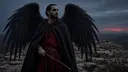
The handsome devil, by contrast, is modern. The fallen angel of tragic beauty and broken wings is born with Milton's Paradise Lost in the seventeenth century, and his definitive image is fixed by Gustave Doré illustrating it, already in the nineteenth. Kabbalah crosses him with Samael, and the French occultism of that same century supplies the inverted pentagram and the goat's head that are his signature today. None of this is ancient, and saying so takes nothing from him: it dates him.
The serpent Genesis does not identify
The third chapter of Genesis does not say the serpent is Satan. It says he was the most cunning of all the beasts of the field that the Lord God had made: an animal, not an angel. And the punishment he receives is an animal's, to crawl on his belly and eat dust all the days of his life, which makes no sense if the condemned is a spirit.
The identification is later and has authors. The book of Wisdom, written in Greek around the first century before our era, says that through the devil's envy death entered the world, and that phrase is the first seam. The second and decisive one is given by Revelation, which lists four names as if they were one: the great dragon, the ancient serpent, who is called the devil and Satan. With that verse, the reptile of Eden, the prosecutor of Job, the dragon of the vision and the tempter of the gospels are welded into a single character, and so it has remained.
The apple, for its part, is nowhere: Genesis says fruit, and no more. The apple arrives with the Latin of the Vulgate and with a pun, because malum means both apple and evil. A tree of the knowledge of good and evil became, by homonymy, an apple tree.
The New Testament, the grimoires and the archetype
In the gospels Satan is already a character with a name and a plan. He tempts Jesus in the desert offering him the kingdoms of the world, he is called the prince of this world and the father of lies, and he enters into Judas. Paul calls him the god of this age. It is here, and not in the Old Testament, that the enemy the culture recognises is born: the prosecutor who used to ask permission has become a rival.
Late demonology placed him at the top of a bureaucracy. The grimoires and the infernal dictionaries, above all Collin de Plancy's Dictionnaire infernal of 1818, give him a court of princes with portfolios: Beelzebub, Asmodeus, Mammon. A point everyone gets wrong deserves stating: Satan is not among the seventy-two spirits of the Ars Goetia, which is a catalogue of something else. And in several of those hierarchies Lucifer and Satan appear as two distinct entities, with the former above.
In Islam the role is taken by Iblis, the one who refused to bow before Adam, also called Shaytan; the Qur'an treats him as a jinn and not as a fallen angel, and that difference is real and not a nuance. And in the twentieth century Anton LaVey turns the character completely round: in his Church of Satan he is not a literal entity but a symbol of self-assertion against authority. From the prosecutor who asked God's permission to the emblem of individualism there are three thousand years and a remarkable number of translations.
Also known as
Relics
Symbology
Element
Infernal Fire
Number
666
Color
Blood Red
Animals
serpent, black goat, dragon
Sigils:
Traits
Powers
Weaknesses
Behavioral
Resistances
Relations with other beings
Defeated by

Master of


In the Atlas
Travel the beings’ world of origin and the cosmos of their dimensions.
Mythologies
The Abrahamic religions comprise Judaism, Christianity and Islam, three monotheistic traditions that share a common origin in the figure of Abraham, regarded as patriarch in all three. Originating in the ancient Near East, Judaism developed among the Hebrews during the second millennium BCE, Christianity arose in the 1st century CE in the context of Second Temple Judaism and Islam appeared in the 7th century on the Arabian Peninsula. Each is based on divine revelations transmitted through prophets and sacred scriptures, such as the Torah, the Bible and the Qur'an, and upholds the belief in a single creator and judge God.
Sources
Book of Revelation
John of Patmos · 95
Last book of the New Testament, attributed to John of Patmos (c. 95). Its apocalyptic vision is filled with angels, the beast, the dragon and the horsemen of the end times, and is a primary source for countless figures of Christian eschatology.
The Quran
Muhammad (traditional revelation) · 632
Holy book of Islam, revealed to the prophet Muhammad in the 7th century. Beyond its religious message, it mentions angels such as Jibril and Mika’il, the jinn created from smokeless fire and figures like Iblis, and is a primary source for many beings of Islamic tradition.
Zohar
Moses de León · c. 1280
Fundamental thirteenth-century Kabbalistic work that expands the mythology of Lilith and her demonic descendants.
Book of Genesis
Mosaic Tradition (Moses) · 6th-5th c. BCE
The first book of the Hebrew Bible and the Old Testament, which narrates the angelic intervention that stops the sacrifice of Isaac.
Dictionnaire Infernal
Collin de Plancy · 1818
Demonological dictionary by Collin de Plancy (1818), famous for the illustrations by Louis Le Breton in its 1863 edition. It catalogues demons, superstitions and infernal beings, and popularized the visual image of many entities of goetia.
Job 1-2
Anonymous · 6th-4th cent. BC
The two prologue chapters, where ha-satan appears with the article: not a proper name but an office, that of prosecutor of the divine council, who asks God's permission before testing the righteous man and gets it.
Frequently asked questions
What was Satan like before he became the absolute enemy?
In the book of Job he appears as ha-satan, with the article: the accuser. It is an office, not a proper name. He presents himself before God with the other members of the heavenly council, argues that Job's piety is self-interested and asks permission to test it; permission that is granted. He is no rebel: he is the prosecutor of a court, working inside the system.
How old are the horns, the pitchfork and the red colour?
Always later. No biblical text describes Satan: in the temptation in the desert he speaks and is not painted. The dragon comes from Revelation 12; the goat horns and hooves were lent by satyrs and Pan; the pitchfork comes from the Greco-Roman underworld and was not even his. The handsome devil is invented by Milton in the seventeenth century and fixed by Gustave Doré in the nineteenth, along with the inverted pentagram of French occultism.
Is Satan the serpent of Eden?
Genesis does not say so. It presents the serpent as the most cunning of the beasts of the field, and punishes him as an animal: to crawl and eat dust, which would make no sense for a spirit. The identification comes with the book of Wisdom, which speaks of the devil's envy, and is sealed in Revelation 12:9, where the great dragon, the ancient serpent, the devil and Satan are listed as one being. Nor is the apple there: Genesis says fruit, and the apple enters through a Latin pun.
Are Satan and Lucifer the same?
Only if one accepts a particular Christian reading, and not always. Lucifer is born of translating into Latin the morning star of Isaiah 14, a poem against the king of Babylon; it was Origen and other Fathers who fused him with the Satan of the gospels. But the fusion is not universal: in several infernal hierarchies of the grimoires and of the Dictionnaire infernal, Lucifer and Satan are two distinct princes, with Lucifer above. Here they are modelled as two states of one figure, which is the majority reading.
🔖Cite this entry▾
If you cite this article in an academic, journalistic or editorial publication, use any of these formats:
Bestiarypedia. (2026, August 20). Satan. Bestiarypedia. https://bestiarypedia.com/en/beings/satan
Free citation with attribution and canonical link for editorial, academic or journalistic use. Full commercial reuse or creation of derivative products requires prior agreement.


