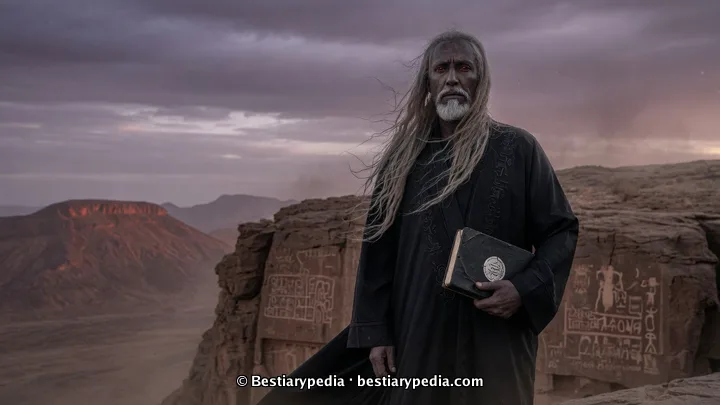
Shaitan
Shaitan Whisperer Tempter, common soldier of Iblis's rebel legion
Curated byBestiarypediaCreated onUpdated on
 Arabian Peninsula(Saudi Arabia)
Family Tree



Origins of the shaitan
The shayatín (singular shaitan) are, in Islamic cosmology, the rebellious jinn who after the fall of Iblís joined his disobedience and received the mission to tempt human beings until the end of the world. Unlike Christian demonology, hierarchized in princes with proper names, the shayatín form a broad and horizontal legion of anonymous soldiers. Their condition is more ontological than mythological: according to the Quran (2:34 and 7:11-18), every jinn (and even, in a figurative sense, every being) that refuses to prostrate before the divine order and gives itself to evil enters this category. Iblís himself is called Shaytan par excellence, and from him the others derive. The term thus designates both concrete entities and the very principle of temptation and deviation.
Nature and powers
The characteristic power of the shaitan is the waswasa, the insidious whisper that introduces into the human mind thoughts that this one perceives as its own, gradually pushing it toward doubt, vice and disobedience. Invisible by nature, the shaitan can adopt a seductive human form to deceive, and it uses lies, the false promise of pleasure, wealth or power, and the incitement to discord. Tradition teaches that each person has assigned a personal shaitan, the qarín, that accompanies it from birth whispering evil to it, against which the believer protects himself with prayer, the remembrance of God (dikr) and the search for refuge (istiʿada). The shayatín cannot force the will: they only suggest, and their power ends where the human being decides to resist.
Symbology and protection
The Quran does not describe the physical appearance of the shayatín, since their own form is invisible; popular imagery and later Sufi descriptions represent them as tall and lean humanoid figures, with reddish and dry skin, short and twisted horns, completely black eyes and dark garments. The black serpent is the animal usually associated with them. Tradition records that they retreat before certain acts of devotion: the recitation of the Quran, especially the «Throne» (Ayat al-Kursi) and the protective suras (al-Falaq and an-Nas), the call to prayer and dawn. As the principle of evil rather than as an individualized demon, the shaitan embodies in Islam the permanent temptation that tests faith, and its defeat is not a cosmic battle, but the inner victory of whoever resists the whisper.
Relics
🏺 Corrupted human soul
Symbology
Element
Corrupt fire
Number
6
Color
Dry oxide red
Animals
Black serpent, Carrion crow
Sigils:
🏷️ Traits
Powers
Weaknesses
Behavioral
Resistances
🔗 Relations with other beings

🗺️In the Atlas
Travel the beings’ world of origin and the cosmos of their dimensions.
📜 Mythologies
Arabian folklore encompasses oral traditions, tales from One Thousand and One Nights, and supernatural beings like djinn, ifrit and marid, spirits created from smokeless fire according to the Quran (Surah 55:15), originating in pre-Islamic myths of the Arabian Peninsula, reflecting Bedouin animism, fears of desert spirits, sandstorms and oases, compiled in medieval literature like the works of Al-Jahiz and transmitted in regions like Hijaz, Yemen and the Maghreb.
Sources
The Quran
Mahoma (revelación tradicional) · 632
Holy book of Islam, revealed to the prophet Muhammad in the 7th century. Beyond its religious message, it mentions angels such as Jibril and Mika’il, the jinn created from smokeless fire and figures like Iblis, and is a primary source for many beings of Islamic tradition.
Sira of Ibn Ishaq
Ibn Ishaq · c. 767
The "Sira" or biography of the prophet Muhammad compiled by Ibn Ishaq in the 8th century, preserved in Ibn Hisham’s recension. Alongside the historical account it records traditions about angels, jinn and wonders, and is an early source of the Islamic imagination.
Kitāb al-Ḥayawān (Book of Animals)
Al-Jāḥiẓ (Abū ʿUthmān ʿAmr ibn Baḥr al-Kinānī) · c. 776-868
Zoological and theological encyclopedia in 7 volumes by Basran polymath Al-Jāḥiẓ (776-868 CE), foundational reference on jinn, ifrit, ghul and other Arabic creatures from both naturalist and cultural-religious perspectives. Includes theological debates on jinn ontology and catalogs of mafáhim on supernatural desert behavior.
Frequently asked questions
What is the ontological origin of the shayatin according to the Quran?
The shayatin are jinn who refused to prostrate before Adam and joined Iblis's rebellion. Their category is ontological, not individual mythological.
How does the shaitan's waswasa operate on the human being?
Waswasa is a mental whisper perceived as one's own thought that induces seduction, greed or pride. The human combats it with dhikr and Sura An-Nas.
What relationship does the shaitan maintain with Iblis and with each human being?
The shaitan is a common soldier of Iblis's legion. Every human possesses a personal qarin that tempts him from birth until death.
🔖Cite this entry▾
If you cite this article in an academic, journalistic or editorial publication, use any of these formats:
Bestiarypedia. (2026, July 16). Shaitan. Bestiarypedia. https://bestiarypedia.com/en/beings/shaitan-tempter
Free citation with attribution and canonical link for editorial, academic or journalistic use. Full commercial reuse or creation of derivative products requires prior agreement.