Nut
Nut, Egyptian goddess of the sky who arches over the Earth
Curated byBestiarypediaCreated onUpdated on
 Ancient Egypt(Egypt)
Family Tree



Mythical Origins of Nut
Nut is the sky goddess in the cosmogony of Heliopolis: daughter of Shu, the air, and Tefnut, the moisture, and therefore granddaughter of Atum, the creator emerged from the Nun. United with her brother Geb, the earth, she formed with him an undivided mass until Shu interposed and raised her, arched, over the world. The Pyramid Texts invoke her as the mother who welcomes the deceased, and her starry body delimits the space in which creation exists: all that is under her belongs to order; all that remains outside, to the primordial chaos from which everything came.
Appearance and Symbols of Nut
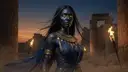
She is represented as a naked and elongated woman who arches over Geb, touching the ground only with the tips of her fingers and feet, while Shu supports her by the belly. Her blue or black skin appears sown with stars and constellations. This image presides over the ceilings of tombs and the interior of sarcophagus lids, where Nut leans over the deceased: lying in the coffin is equivalent to returning to the mother's body. She also adopts the form of a celestial cow that carries the sun between her horns, and that of the sycamore that offers water and shade to the dead.
Family and Cosmological Relations of Nut
Each evening Nut swallows the sun, which travels through her body during the night, and at dawn gives birth to it again in the east: the cycle that guarantees that the world continues to exist. Plutarch records why her children were not born in the year: Ra cursed her not to give birth in any month, and Thoth won from the Moon five days added to the calendar; in them Osiris, Horus the Elder, Set, Isis and Nephthys came into the world. Wife of Geb and mother of that generation, Nut is also grandmother of Horus. Her separation from Geb is not a sterile punishment: it is the act that opens the space where life fits.
Relics
🏺 Starry Vault
Symbology
Element
Sky
Number
5
Color
Dark Blue
Animals
Great Serpent
Sigils:
🏷️ Traits
Powers
Weaknesses
Behavioral
Resistances
🗺️In the Atlas
Travel the beings’ world of origin and the cosmos of their dimensions.
📜 Mythologies
Egyptian mythology developed in ancient Egypt over more than three millennia, from the predynastic period to the Roman era, and was closely linked to the civilization that inhabited the banks of the Nile. Its beliefs were based on a worldview in which cosmic order, represented by the concept of maat, was maintained through the action of the gods and the performance of rituals by humans. The Egyptian pantheon included numerous local and national deities, among which Ra stood out, associated with the sun and creation, and Osiris, god of resurrection and the underworld, along with other figures such as Isis, Horus, Seth and Amun. Mythological narratives explained the origin of the world, the daily cycle of the sun and the fate of the soul after death, integrating elements of the nature of the Nile valley and astronomical observation. Funerary texts, such as the Book of the Dead, and temple reliefs constitute the main sources for the knowledge of these beliefs. Although official worship declined with the Christianization of Egypt, Egyptian mythology has exerted a lasting influence on art, literature and the Western imagination, and continues to be the subject of study in Egyptology.
Sources
Pyramid Texts
Unknown · -2400
Collection of ancient Egyptian funerary texts inscribed in the pyramids of the Fifth and Sixth Dynasties.
On Isis and Osiris
Plutarch · 100
Treatise by Plutarch (1st-2nd century AD) preserving the most complete account of the Osirian cycle and the Egyptian divine family, interpreted for the Greco-Roman world. A key classical source on Egyptian religion.
Coffin Texts
Unknown · c. 2000 BCE
Egyptian funerary texts inscribed on coffins from the Middle Kingdom.
Frequently asked questions
Who is Nut in Egyptian mythology?
She is the goddess of the sky, daughter of Shu and Tefnut and granddaughter of Atum. She is represented as a naked and starry woman, arched over her brother and husband Geb, the earth, to which she only touches with the tips of the fingers and the feet while Shu holds her by the belly.
What happens to the sun inside the body of Nut?
Each sunset Nut swallows the sun, which crosses her body during the night, and at dawn gives birth to it again by the east. That daily birth is what guarantees that the world continues to exist, and turns the goddess into the very image of rebirth.
Why is Nut painted on the inside of the sarcophagi?
Because Nut is the mother who welcomes the deceased. Her arched figure presides over the ceilings of the tombs and the interior of the lids of the coffins: lying down in the sarcophagus is equivalent to returning to the body of the mother and waiting there for the same rebirth that each night grants to the sun.
Why were their children born outside the calendar?
Plutarch recounts that Ra cursed Nut to not give birth in any month of the year. Thoth won from the Moon five days that he added to the calendar, and in them, outside the cursed year, Osiris, Horus the Elder, Set, Isis and Nephthys were born.
🔖Cite this entry▾
If you cite this article in an academic, journalistic or editorial publication, use any of these formats:
Bestiarypedia. (2026, July 26). Nut. Bestiarypedia. https://bestiarypedia.com/en/beings/nut
Free citation with attribution and canonical link for editorial, academic or journalistic use. Full commercial reuse or creation of derivative products requires prior agreement.
Similar beings
Nephthys
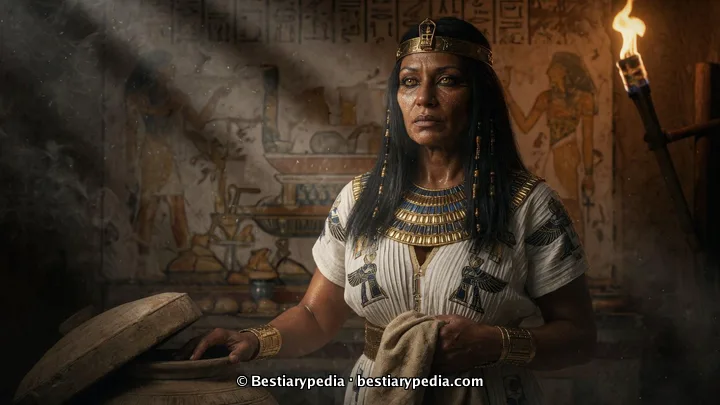
Nephthys, Egyptian funerary goddess, sister of Isis, wife of Set and mother of Anubis
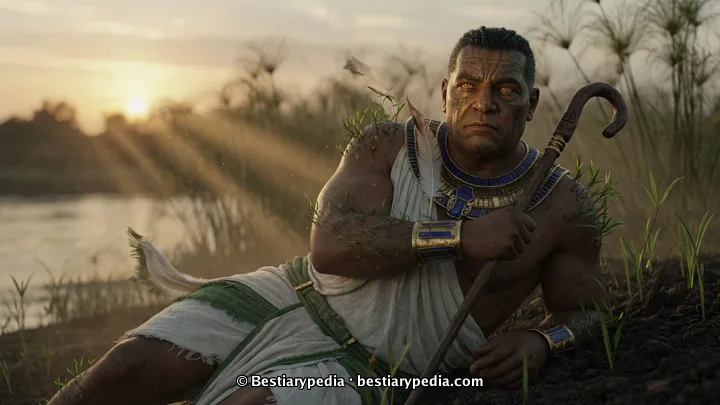
Geb
Geb, Egyptian god of the Earth, son of Shu and Tefnut
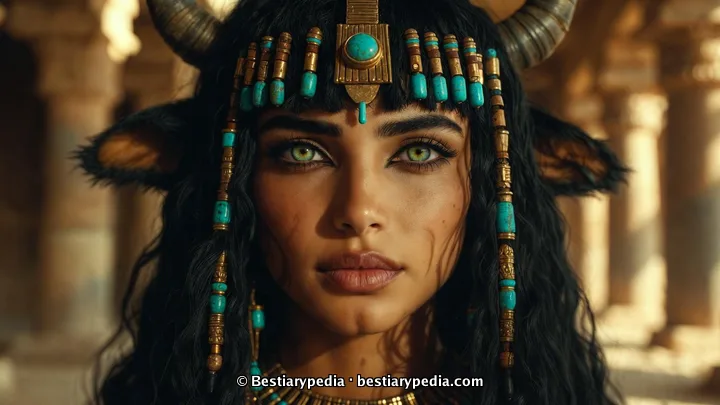
Hathor
Hathor, goddess of love, beauty, music and motherhood in Egyptian mythology

Set
Set, god of chaos, storm and violence in Egyptian mythology
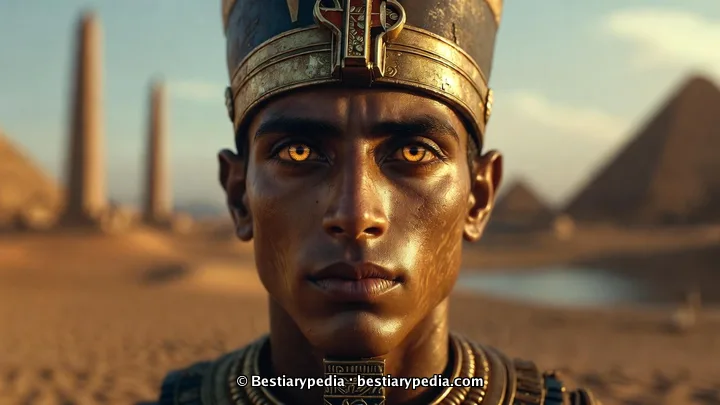
Ra
Ra, Egyptian god of the sun, creator of the world and father of the gods
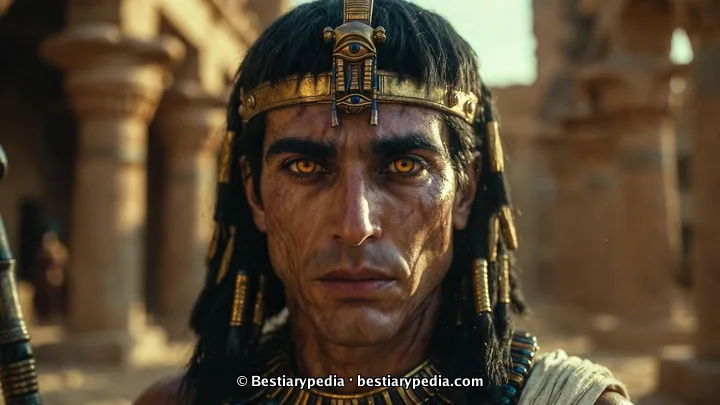
Horus
Horus, god of the sky, kingship and war in Egyptian mythology
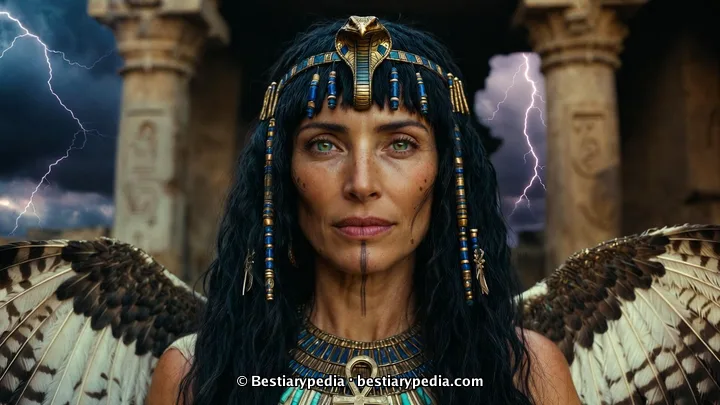
Isis
Isis, Egyptian goddess of motherhood, magic and resurrection
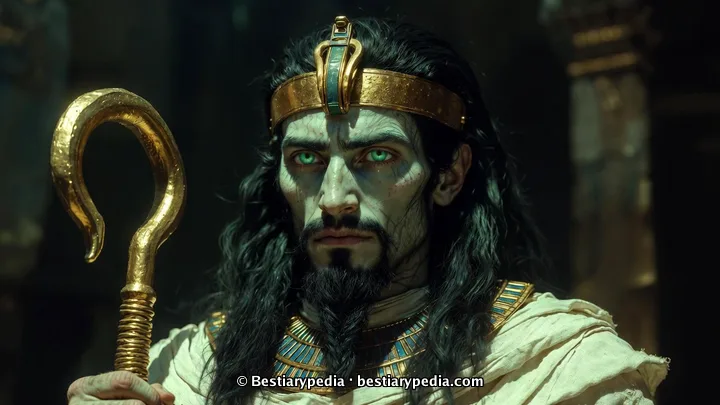
Osiris, Lord of the Dead
Osiris, Lord of the Dead and god of resurrection in Egyptian mythology