Osiris, the Living King
Osiris, god of resurrection, fertility, and the underworld
Curated byBestiarypediaCreated onUpdated on
 Ancient Egypt(Egypt)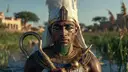



Mythical origins of Osiris
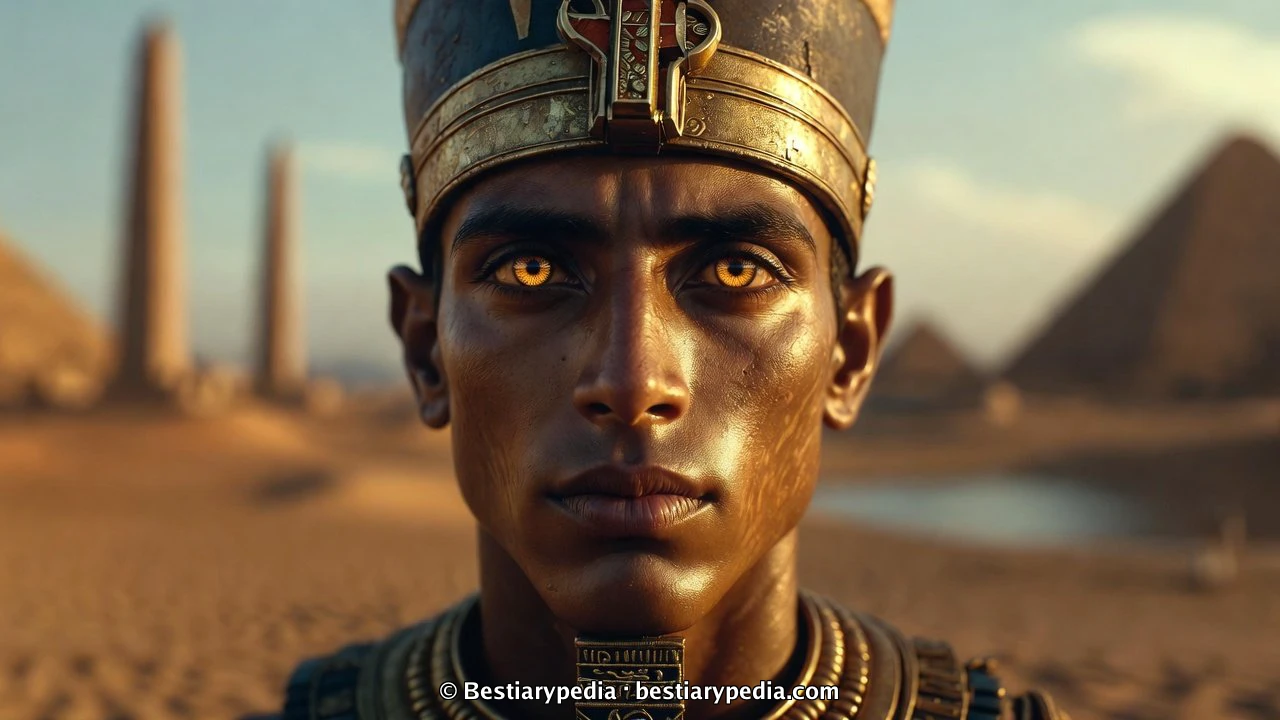
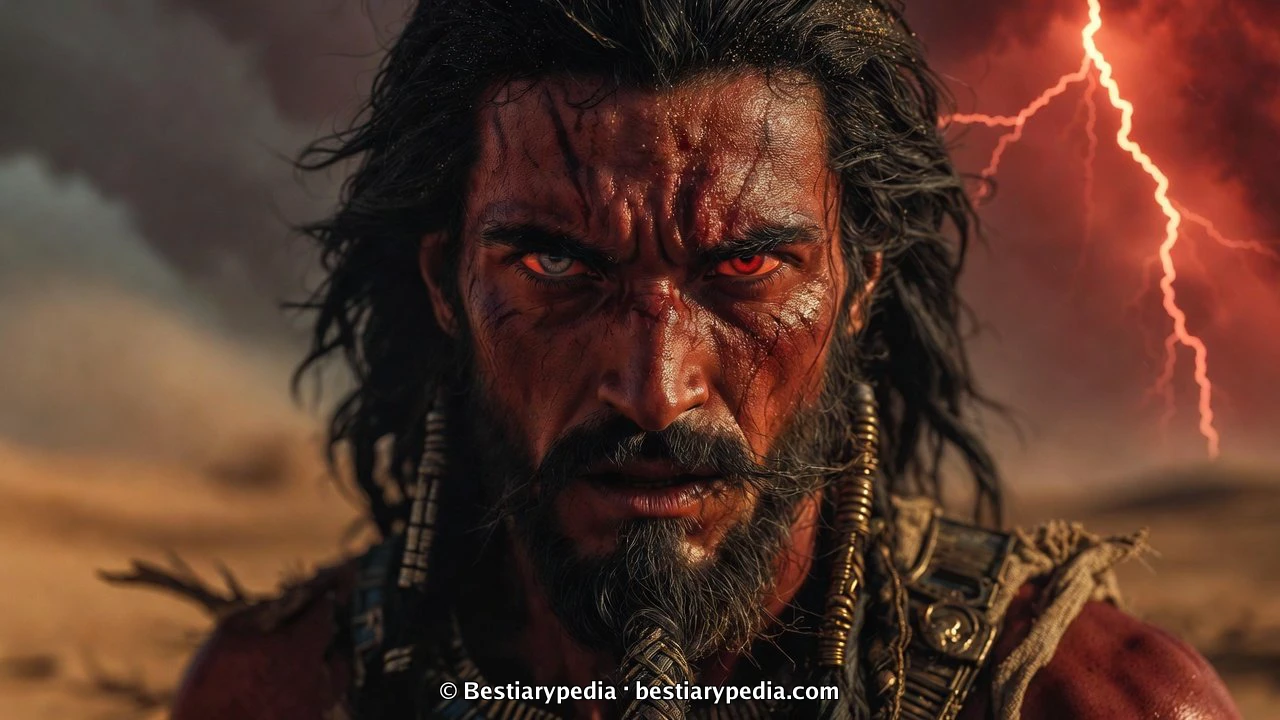
Osiris (Usir in ancient Egyptian) is, in the Heliopolitan theology, the firstborn son of Geb, god of the earth, and Nut, goddess of the sky, and therefore a member of the Ennead of Heliopolis together with his siblings Isis, Set and Nephthys. Mythical king of primeval Egypt, he is credited with having drawn humanity out of savagery: he taught them agriculture and viticulture, gave them just laws and showed them the worship of the gods, inaugurating a golden age of order and abundance. As lord of vegetation, Osiris is identified with the cycle of the grain that dies underground and is reborn, and with the annual rise of the Nile that fertilizes the fields. His green or black skin in iconography refers precisely to that regenerative force of the fertile earth and the river's silt. He took his sister Isis as his wife, with whom he formed the sovereign couple of the myth.
Death, resurrection and legacy
The core of the myth, whose most complete narration has reached us through Plutarch's treatise De Iside et Osiride, recounts the betrayal of his brother Set. Envious of the throne, Set tricks Osiris into lying down in a chest made to his measure, seals it and throws it into the Nile; later he recovers the body and dismembers it into fourteen pieces that he scatters throughout Egypt. Isis, helped by her sister Nephthys, travels the country gathering the fragments and, with the funerary magic that characterizes her and the intervention of Anubis in the first mummification, returns Osiris to a form of life. Transformed into a kite, Isis conceives Horus from him, the heir who will avenge his father. Osiris does not return, however, to the world of the living: resurrected, he becomes sovereign of the afterlife. This account made him the paradigm of victory over death, and every Egyptian deceased aspired to identify with him in order to be reborn, to the point that in funerary texts the deceased is called «Osiris N.», placing his name before that of the god.
Role as judge of the underworld
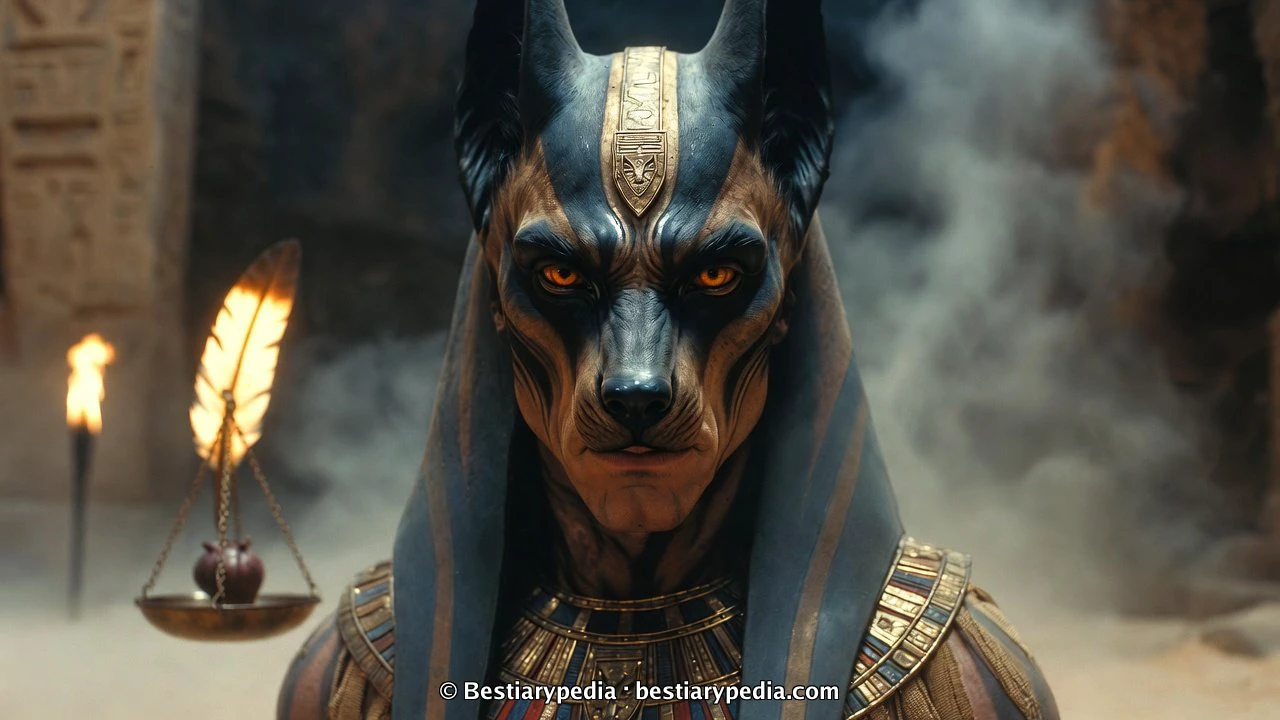
As lord of the Duat, the Egyptian underworld, Osiris presides over the tribunal where the fate of souls is decided. In the scene of the weighing of the heart (psychostasia), described and illustrated in the Book of the Dead, the heart of the deceased is placed on one pan of the scale and the feather of Maat, symbol of truth and justice, on the other. Thoth records the verdict and Anubis watches the pointer of the scale. If the heart proves light, the deceased is declared «just of voice» and gains access to the fertile fields of Aaru; if it weighs down due to his faults, Ammit, the Devourer, devours it and the soul suffers the second death. Enthroned, wrapped like a mummy and carrying the crook (heka) and the flail (nekhekh), insignia of royalty, Osiris guarantees at once cosmic justice and the hope of personal resurrection. His cult, centered in Abydos, where mysteries commemorating his passion and his triumph were celebrated, was one of the most enduring and widespread in all of ancient Egypt.
Also known as
Relics
🏺 Djed Pillar
Symbol of stability and eternal resurrection.
🏺 Crook Heka and Flail
Royal insignias of power and protection over vegetation.
Symbology
Element
Earth and Water
Number
Four
Color
Green
Animals
Apis Bull
Sigils:
🏷️ Traits
Powers
Weaknesses
Behavioral
Resistances
🔗 Relations with other beings
🗺️In the Atlas
Travel the beings’ world of origin and the cosmos of their dimensions.
📜 Mythologies
Egyptian mythology developed in ancient Egypt over more than three millennia, from the predynastic period to the Roman era, and was closely linked to the civilization that inhabited the banks of the Nile. Its beliefs were based on a worldview in which cosmic order, represented by the concept of maat, was maintained through the action of the gods and the performance of rituals by humans. The Egyptian pantheon included numerous local and national deities, among which Ra stood out, associated with the sun and creation, and Osiris, god of resurrection and the underworld, along with other figures such as Isis, Horus, Seth and Amun. Mythological narratives explained the origin of the world, the daily cycle of the sun and the fate of the soul after death, integrating elements of the nature of the Nile valley and astronomical observation. Funerary texts, such as the Book of the Dead, and temple reliefs constitute the main sources for the knowledge of these beliefs. Although official worship declined with the Christianization of Egypt, Egyptian mythology has exerted a lasting influence on art, literature and the Western imagination, and continues to be the subject of study in Egyptology.
Sources
Pyramid Texts
Unknown · -2400
Collection of ancient Egyptian funerary texts inscribed in the pyramids of the Fifth and Sixth Dynasties.
On Isis and Osiris
Plutarch · 100
Treatise by Plutarch (1st-2nd century AD) preserving the most complete account of the Osirian cycle and the Egyptian divine family, interpreted for the Greco-Roman world. A key classical source on Egyptian religion.
Book of the Dead
Anonymous · c. 1550 BC
Compilation of funerary spells from ancient Egypt used from the New Kingdom onward.
Coffin Texts
Unknown · c. 2000 BCE
Egyptian funerary texts inscribed on coffins from the Middle Kingdom.
Frequently asked questions
How does Osiris embody the annual Nile flood cycle in his mythical origin?
Osiris was born as the firstborn son of Geb and Nut. Destined to rule the fertile land of the Nile, he embodied the annual flood cycle that brings life and prosperity to Egypt. He taught humans agriculture, law and the arts of civilization.
What family relationships determine the murder and resurrection of Osiris according to the myth?
His brother Set murdered him out of envy and dismembered his body. Isis collected the fragments and through magical rituals resurrected him, allowing him to beget Horus. This resurrection symbolizes the eternal rebirth of nature and victory over death.
What function does Osiris perform as supreme judge of souls in the underworld?
After his resurrection, Osiris rules the underworld as supreme judge of souls. He presides over the weighing of the heart ceremony against the feather of Maat. The righteous access the fields of Aaru while the impure face destruction by Ammit.
What symbols and attributes represent the stability and eternal resurrection of Osiris?
The Djed Pillar symbolizes stability and eternal resurrection. The Crook Heka and Flail represent royal authority and protection over vegetation. These attributes reinforce his role as lord of the underworld and judge of souls.
🔖Cite this entry▾
If you cite this article in an academic, journalistic or editorial publication, use any of these formats:
Bestiarypedia. (2026, July 16). Osiris, the Living King. Bestiarypedia. https://bestiarypedia.com/en/beings/osiris
Free citation with attribution and canonical link for editorial, academic or journalistic use. Full commercial reuse or creation of derivative products requires prior agreement.
Similar beings
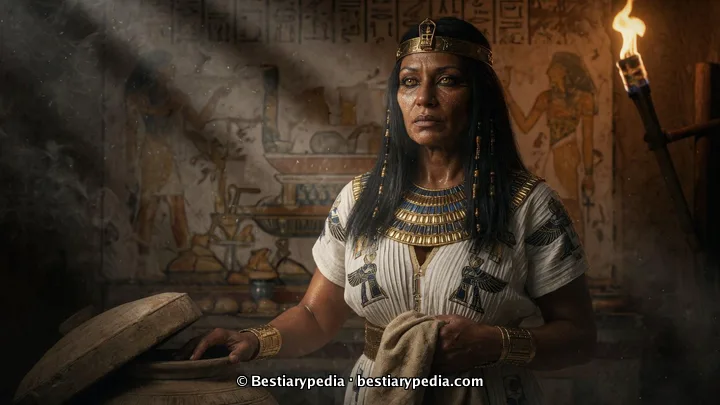
Nephthys
Nephthys, Egyptian funerary goddess, sister of Isis, wife of Set and mother of Anubis
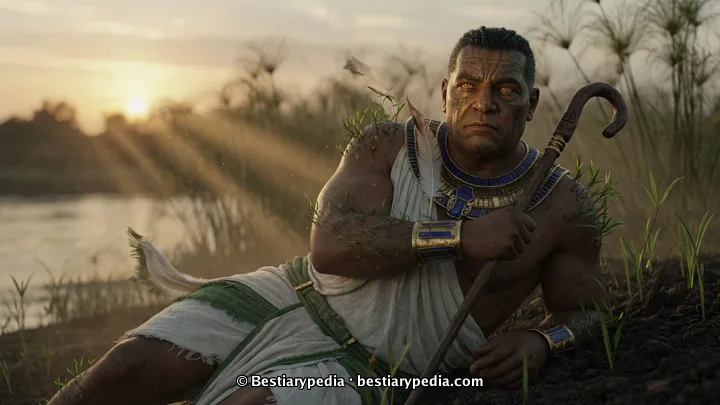
Geb
Geb, Egyptian god of the Earth, son of Shu and Tefnut
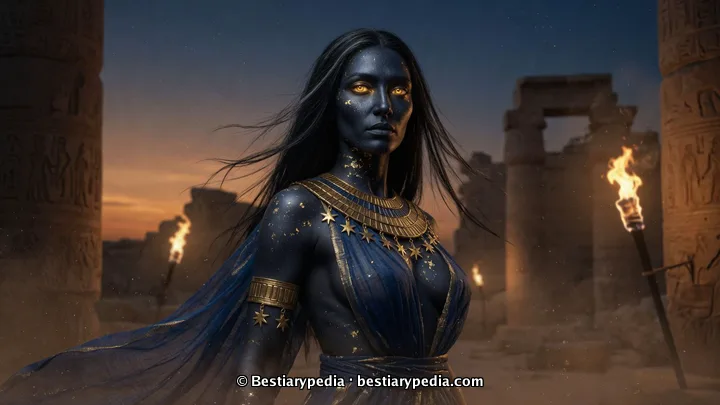
Nut
Nut, Egyptian goddess of the sky who arches over the Earth
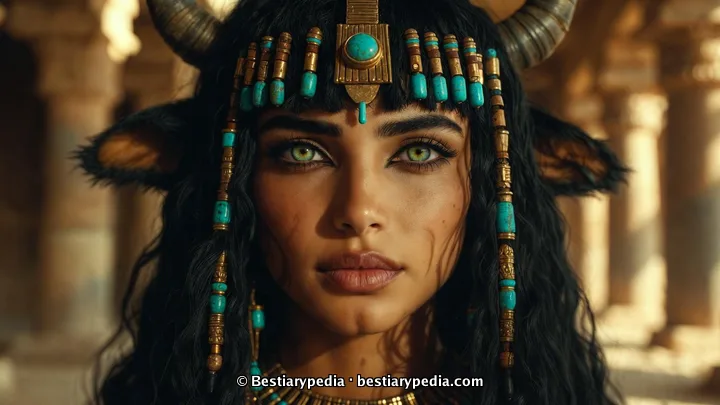
Hathor
Hathor, goddess of love, beauty, music and motherhood in Egyptian mythology
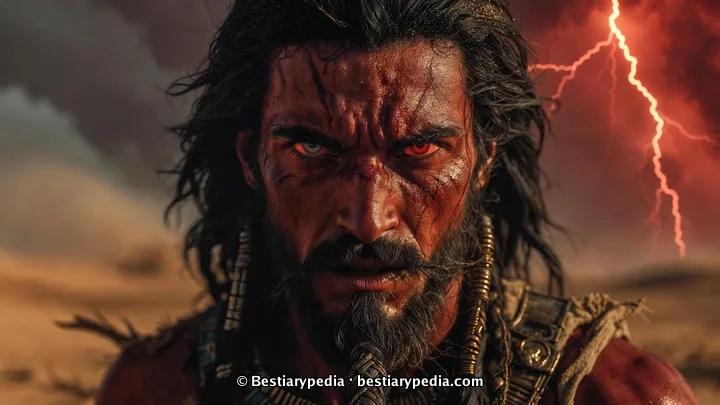
Set
Set, god of chaos, storm and violence in Egyptian mythology
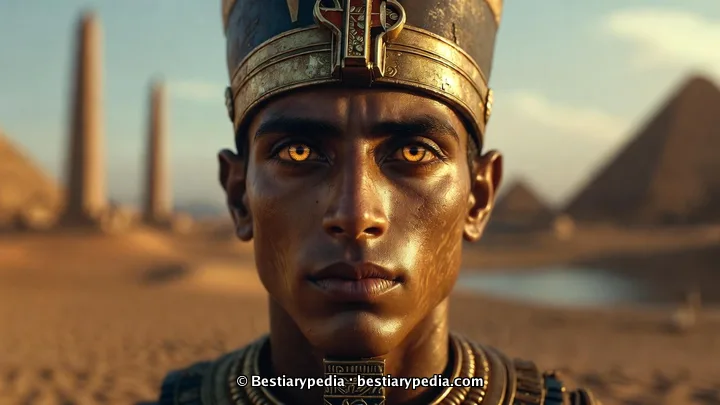
Ra
Ra, Egyptian god of the sun, creator of the world and father of the gods
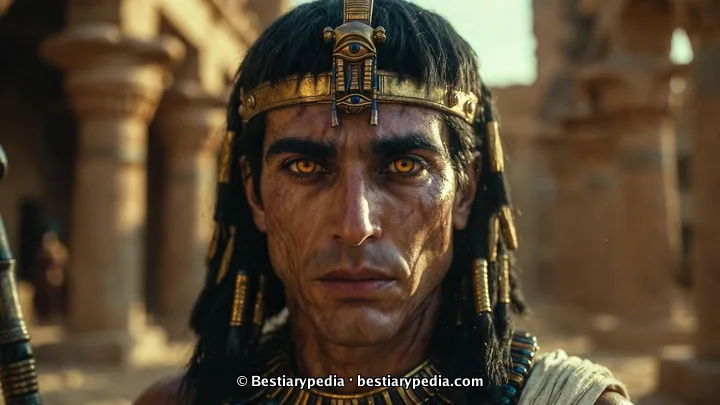
Horus
Horus, god of the sky, kingship and war in Egyptian mythology
Isis
Isis, Egyptian goddess of motherhood, magic and resurrection