Taira no Masakado
Aristocratic goryō of the Heian period, rebel warrior who leads a rebellion and causes disasters after his death
Curated byBestiarypediaCreated on
 Japan(Japan)
Origins of Taira no Masakado
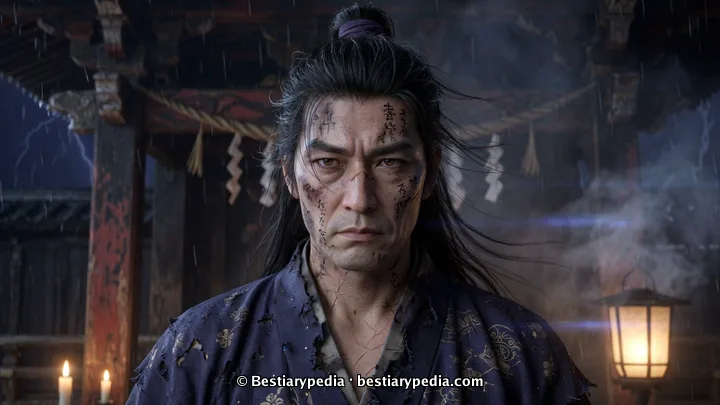
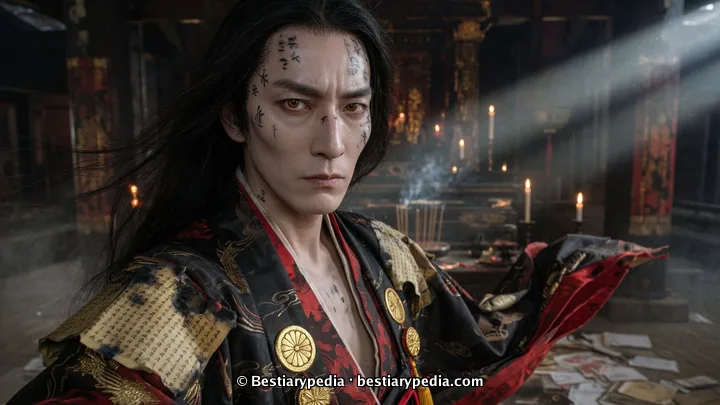
Taira no Masakado was a warrior aristocrat of the Heian period, from a branch of the Taira clan settled in the Kantō plain, in eastern Japan. In the tenth century, after getting entangled in land and blood disputes among relatives, he was accumulating military power until openly confronting the central government of Kyoto. Between 939 and 940 he took eight eastern provinces and took the step that no warrior had dared to take: he proclaimed himself Shinnō, New Emperor, planting a parallel throne in front of the court. That rebellion, the first that challenged imperial authority so directly, lasted little. In 940 he was defeated and killed by Taira no Sadamori and Fujiwara no Hidesato, and his severed head was sent to Kyoto and publicly exposed as that of a traitor. His military failure, however, was not the end of his story, but the beginning of the legend.
The head that flew looking for its body
The attribute that defines Masakado is his severed head, which tradition denies to let die. Exposed in Kioto entire months, it is said that it did not corrupt, that it maintained the eyes open and the gesture of rage, and that it gnashed the teeth claiming its body. One night, according to the legend, the head detached from the scaffold and flew through the airs towards the east, seeking the trunk that they had torn from it, until falling in Shibasaki, a fishing village of the Kantō that with time would be Edo and then Tokio. There it remained buried, and over it the kubizuka was raised, the mound of the head. Masakado is not, then, a spirit of diffuse powers, but the will concentrated in that head that does not rest: a defeated rebel whose resentment transformed him, after death, into a force that no one in the Kantō has dared to provoke.
The curse of the kubizuka in the heart of Tokyo
The tumulus of Masakado remains standing in Ōtemachi, the financial district of Tokyo, a few steps from the Imperial Palace and on one of the most expensive soils on the planet, intact among skyscrapers. Its fame as cursed comes from concrete and documented facts. After the great Kantō earthquake of 1923, which devastated the area, the Ministry of Finance erected provisional offices on the cleared land of the tumulus; in less than two years the minister and more than a dozen officials fell ill and died, and accidents multiplied, all attributed to Masakado. In 1940, exactly one thousand years after his death, a lightning bolt set fire to the ministry buildings. An attempt by the occupation forces to raze the mound with excavators ended in a fatal accident. Since then the companies in the surroundings care for the place and render ceremonies to it. Venerated also as one of the three deities of the Kanda Myōjin shrine, protector of Tokyo, Masakado is feared and honored at the same time, and figures among the three great onryō of Japan.
Also known as
Relics
🏺 Severed Head
Symbology
Element
Earth
Number
1
Color
Red
Animals
Oni Spirit
Sigils:
🏷️ Traits
Powers
Weaknesses
Behavioral
Resistances
🗺️In the Atlas
Travel the beings’ world of origin and the cosmos of their dimensions.
📜 Mythologies
Japanese folklore encompasses oral traditions, myths, legends and supernatural creatures like yōkai and kami, compiled in Edo-period illustrated texts by Toriyama Sekien in works like Gazu Hyakki Yagyō and Konjaku Hyakki Shūi, reflecting Shinto animist beliefs, ecological fears of floods and droughts, and respect for nature in rivers, lakes and rice fields of regions like Shiga, Osaka and Kyoto.
Sources
Engi (foundation legend) of Kanda Myōjin Shrine
Sanctuary Tradition · Edo period
Chronicle of Masakado
Anonymous · 940
Japanese chronicle (10th century) recounting the rebellion of Taira no Masakado against the Heian court. After his death, Masakado was venerated as a powerful vengeful spirit (onryō), a source of the folklore of Japanese yōkai and ghosts.
Taiheiki (Chronicle of Great Peace)
Anonymous · 14th century
Frequently asked questions
Why did Taira no Masakado rebel?
It started from local land disputes between relatives in the Kantō, which was escalating until becoming an open challenge to Kioto. It arrived to take eight provinces of the east and to proclaim itself New Emperor, something that no warrior had done, before falling defeated in 940.
What does the legend say about his severed head?
That exposed in Kioto did not rot and kept its eyes open with rage, until one night it flew towards the east seeking its body and fell in what today is Tokyo. There it was buried and the kubizuka was erected, the mound of the head that is still preserved.
Why does no one dare to move his tumulus in Tokyo?
Because those who tried it suffered misfortunes: after using the plot in 1923 the minister of Finance and more than a dozen officials died, and an attempt to raze it with excavators ended in death. Today the companies in the surroundings preserve it and make ceremonies for it.
🔖Cite this entry▾
If you cite this article in an academic, journalistic or editorial publication, use any of these formats:
Bestiarypedia. (2026, July 24). Taira no Masakado. Bestiarypedia. https://bestiarypedia.com/en/beings/taira-no-masakado
Free citation with attribution and canonical link for editorial, academic or journalistic use. Full commercial reuse or creation of derivative products requires prior agreement.