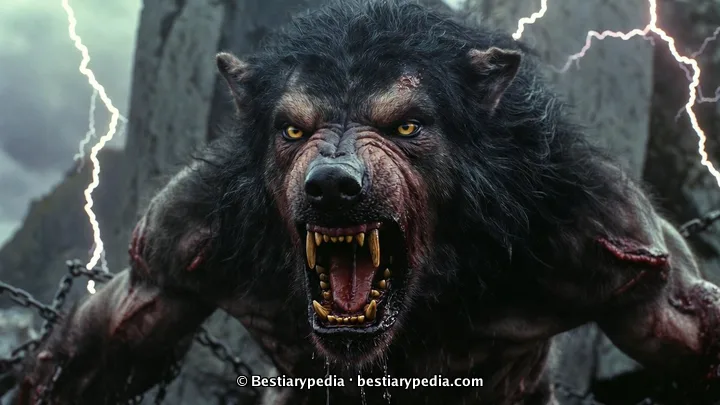
Jörmungandr
Jörmungandr, the World Serpent that encircles the Earth in Norse mythology
Curated byBestiarypediaCreated onUpdated on


 Scandinavia(Denmark, Norway, Sweden)
Family Tree

Origins and Genealogy of Jörmungandr
Jörmungandr, also called Miðgarðsormr (the Midgard Serpent), was born from the union between the god Loki and the giantess Angrboða, as recounted by the Poetic Edda and Snorri Sturluson's Gylfaginning. He was the second of three monstrous children: his siblings are the wolf Fenrir and Hel, lady of the underworld. Warned by prophecies of the harm this offspring would cause, the gods removed them from Asgard. Odin cast the serpent into the deep ocean that surrounds Midgard, the world of men. There, far from perishing, the creature grew without measure until it girdled the whole Earth and bit its own tail.
The World Serpent
In the waters encircling Midgard, Jörmungandr reached a colossal size: he grew so long that he spans the entire world and holds his tail between his jaws, image of the ouroboros that closes the circle of the ocean. For this the skalds name him the World Serpent. His colossal body and his deadly venom make him one of the most fearsome forces of the Norse cosmos. While he keeps his tail clenched between his teeth, the order of the world endures; the day he releases it will herald the end of times.
Enmity with Thor: Hymir's Fishing Trip
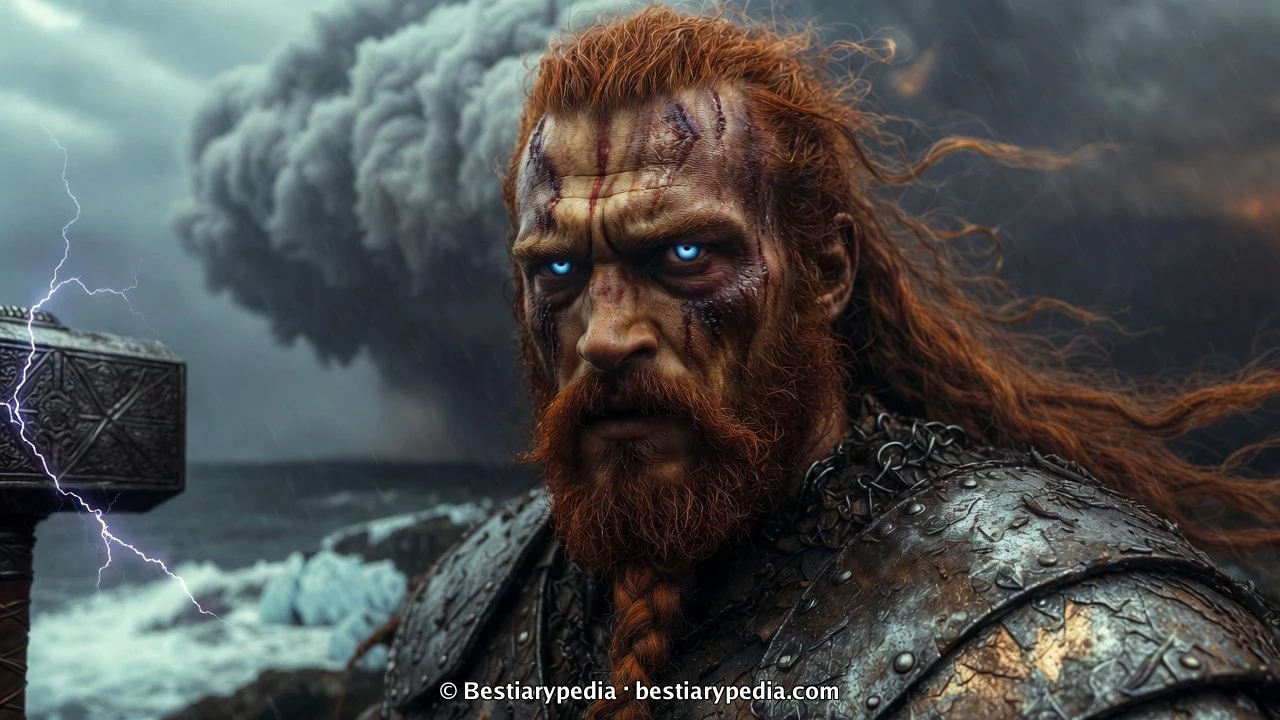
The thunder god Thor and the serpent are sworn enemies. The Gylfaginning tells the famous episode of the fishing trip with the giant Hymir: Thor puts out to the open sea and baits his hook with an ox head. Jörmungandr takes the bait, and the god, bracing his feet against the bottom of the boat, almost manages to haul him up; the two face one another while Thor grips the hammer Mjölnir. Before he can strike the mortal blow, the terrified Hymir cuts the line and the serpent sinks again beneath the waves, thus postponing the outcome until the end of the world.
Jörmungandr at Ragnarök
Jörmungandr's fate is fulfilled at Ragnarök, the twilight of the gods. When that day comes, the serpent at last releases his tail and rises from the sea, whose waters overflow and flood the land, while he poisons the air and the sky with his venomous breath. In the final battle he meets Thor for the last time. The god manages to kill him with his hammer, but, having walked barely nine steps, he falls dead, overcome by the venom the creature has breathed upon him. Thus serpent and god perish together, sealing the end of an age from which, according to the prophecy, a new world will arise.
Also known as
Relics
🏺 Colossal Body
Its immense body encircles Midgard, source of its infinite power.
Symbology
Element
Water and Poison
Number
Eight
Color
Dark Oceanic Green
Animals
Sea Serpent
Sigils:
🏷️ Traits
Powers
Weaknesses
Behavioral
Resistances
🔗 Relations with other beings
🗺️In the Atlas
Travel the beings’ world of origin and the cosmos of their dimensions.
📜 Mythologies
Norse mythology developed among the Germanic peoples of northern Europe, especially in Scandinavia, from the late Iron Age until the progressive Christianization between the 8th and 11th centuries. Its stories are preserved mainly in medieval Icelandic sources such as the Poetic Edda and the Prose Edda of Snorri Sturluson, which collect earlier oral traditions. The universe is conceived as a set of nine worlds connected by the cosmic tree Yggdrasil, in which gods, giants, humans and other beings coexist, and where the destiny of all is ruled by the Norns. The main gods are divided into two groups: the æsir, among whom Odin, Thor and Tyr stand out, and the vanir, represented by Njörðr, Freyr and Freyja, although both groups eventually integrated after a mythical war. Odin, associated with wisdom, war and poetry, occupies a central place, while Thor, god of thunder, protects humans from the giants. The end of the world, known as Ragnarök, involves a catastrophic battle in which most of the gods perish, although a later rebirth is foreseen. This tradition has exerted a lasting influence on literature, art and popular culture in Europe and America, from medieval sagas to modern representations in operas, novels and audiovisual media. Elements such as Valhalla or the valkyries have become part of the Western collective imagination, although often reinterpreted outside their original context.
Sources
Gylfaginning
Snorri Sturluson · 1220
First mythological part of Snorri Sturluson’s Prose Edda (c. 1220). Through King Gylfi, who questions the Æsir, it expounds the creation of the world, the Nine Realms and the fate of the gods at Ragnarök, key to Norse mythology.
Poetic Edda on Jörmungandr
Anonymous (oral tradition) · c. 1000-1200
Passages from the Poetic Edda (c. 1000-1200) about Jörmungandr, the Midgard Serpent and child of Loki. The Völuspá and Hymiskviða recount its enmity with Thor and its role at Ragnarök, when the two slay each other.
Frequently asked questions
From what forbidden union was Jörmungandr born according to Norse mythology?
Jörmungandr was born from the forbidden union between Loki and the giantess Angrboda. The gods feared its growing power and ordered Odin to cast it into the primordial ocean. There it grew to encircle Midgard biting its own tail in an eternal cycle.
What physical attributes and powers characterize Jörmungandr in Norse mythology?
Its size is unimaginable and its venom lethal enough to kill gods. Its gaze inspires absolute terror. Jörmungandr embodies the primordial chaos of the ocean uniting the nine worlds with its immense body and representing the destructive forces that maintain cosmic balance.
What role does Jörmungandr play during Ragnarök in Norse cosmology?
During Ragnarök Jörmungandr will release its tail poison the sky and battle Thor in a mortal duel. Both will perish marking the end of the gods and the rebirth of the world in Norse cosmology.
What relationship does Jörmungandr maintain with Thor in Norse mythology?
Jörmungandr and Thor are mortal enemies fated to kill each other at Ragnarök. The serpent poisons the sky and faces the thunder god in a lethal duel. Both will perish marking the end of the gods and the rebirth of the world.
🔖Cite this entry▾
If you cite this article in an academic, journalistic or editorial publication, use any of these formats:
Bestiarypedia. (2026, July 14). Jörmungandr. Bestiarypedia. https://bestiarypedia.com/en/beings/jormungandr
Free citation with attribution and canonical link for editorial, academic or journalistic use. Full commercial reuse or creation of derivative products requires prior agreement.