Hel
Hel, Norse goddess of the underworld and ruler of the dead who did not fall in battle
Curated byBestiarypediaCreated onUpdated on


 Scandinavia(Denmark, Norway, Sweden)
Family Tree




Mythical Origins of Hel
Hel is the daughter of the god Loki and the giantess Angrboða, and sister of the wolf Fenrir and the serpent Jörmungandr. According to Snorri Sturluson in the Gylfaginning, when the gods learned that these three offspring were growing up in Jotunheim and knew the prophecies of misfortune that hung over them, Odin had them brought before him. The father of the gods cast Hel into Niflheim and granted her authority over nine worlds, charging her to give lodging to all who were sent to her: those who die of sickness or old age, for the fallen in battle are reserved for Valhalla. Her lineage of giants binds her to the primordial and chaotic forces of Norse cosmology, where she embodies the inescapable fate of natural death.
Appearance and Attributes of Hel
The Prose Edda describes her with a body divided in two: one half flesh-coloured and the other livid and blackened, as if she were partly alive and partly dead. Grim and fierce of countenance, she presides over her realm with a stern demeanour. This duality makes her a figure of the threshold between life and death, and her body an emblem of the corruption that awaits all mortal flesh.
The Realm of Helheim
Helheim, set in cold and misty Niflheim, is the vast dwelling of the dead who did not fall in battle. There Hel rules from the hall called Éljúðnir; her dish is named Hungr («hunger») and her knife Sultr («starvation»), her threshold is Fallanda Forað («falling peril») and her bed is Kör («sick-bed»). She is served by two slow-moving servants, Ganglati and Ganglöt. Everything around her evokes privation, sickness and slowness, so that her realm reflects the very causes by which its guests come to it.
The Myth of Baldr
Hel's most famous episode belongs to the myth of Baldr's death. When the radiant son of Odin dies through Loki's ruse, his spirit descends to Helheim. The gods send Hermóðr, who rides Sleipnir along the road to Hel to plead for his return. Hel replies that she will release Baldr only if all things in the world, living and dead, weep for him. Almost everything that exists weeps for him, but the giantess Þökk (Loki in disguise) refuses and declares that Hel keep what she has. Thus Baldr remains in the realm of the dead until after Ragnarök.
Also known as
Relics
🏺 Keys of Helheim
Symbology
Element
Ice and fog
Number
Nine
Color
Pale blue and black
Animals
Hound Garmr
Sigils:
🏷️ Traits
Powers
Weaknesses
Behavioral
Resistances
🔗 Relations with other beings
🗺️In the Atlas
Travel the beings’ world of origin and the cosmos of their dimensions.
📜 Mythologies
Norse mythology developed among the Germanic peoples of northern Europe, especially in Scandinavia, from the late Iron Age until the progressive Christianization between the 8th and 11th centuries. Its stories are preserved mainly in medieval Icelandic sources such as the Poetic Edda and the Prose Edda of Snorri Sturluson, which collect earlier oral traditions. The universe is conceived as a set of nine worlds connected by the cosmic tree Yggdrasil, in which gods, giants, humans and other beings coexist, and where the destiny of all is ruled by the Norns. The main gods are divided into two groups: the æsir, among whom Odin, Thor and Tyr stand out, and the vanir, represented by Njörðr, Freyr and Freyja, although both groups eventually integrated after a mythical war. Odin, associated with wisdom, war and poetry, occupies a central place, while Thor, god of thunder, protects humans from the giants. The end of the world, known as Ragnarök, involves a catastrophic battle in which most of the gods perish, although a later rebirth is foreseen. This tradition has exerted a lasting influence on literature, art and popular culture in Europe and America, from medieval sagas to modern representations in operas, novels and audiovisual media. Elements such as Valhalla or the valkyries have become part of the Western collective imagination, although often reinterpreted outside their original context.
Sources
Poetic Edda
Anonymous · 1200
Collection of ancient poems including Grímnismál with allusions to the wolves pursuing the Sun and Moon.
Prose Edda
Snorri Sturluson · 1220
Snorri Sturluson's 13th-century handbook of poetics, compiling and organising Norse mythology from the origin of the world to Ragnarök. Together with the Poetic Edda, the main source for the Scandinavian pantheon.
Frequently asked questions
What is the mythological origin of Hel according to the Eddas?
Hel is the daughter of Loki and Angrboda, born in Jotunheim. Exiled by Odin to Niflheim, she rules Helheim receiving those who die of sickness or old age. Her giant lineage connects her to primordial chaotic forces.
What physical attributes characterize Hel in Norse mythology?
Hel possesses a face and body divided into two contrasting halves: one beautiful and alive, the other a putrid corpse. She wears dark robes and is guarded by the infernal hound Garmr. This duality symbolizes the boundary between life and death.
What role does Hel play in the cosmic balance of Norse mythology?
Helheim is a vast cold foggy realm in the north where peaceful dead reside in dim halls. Hel remains impartial denying exit even to Baldr until Ragnarok. Her rule maintains cosmic balance between the realms of the living and the deceased.
🔖Cite this entry▾
If you cite this article in an academic, journalistic or editorial publication, use any of these formats:
Bestiarypedia. (2026, July 16). Hel. Bestiarypedia. https://bestiarypedia.com/en/beings/hel-norse
Free citation with attribution and canonical link for editorial, academic or journalistic use. Full commercial reuse or creation of derivative products requires prior agreement.
Similar beings
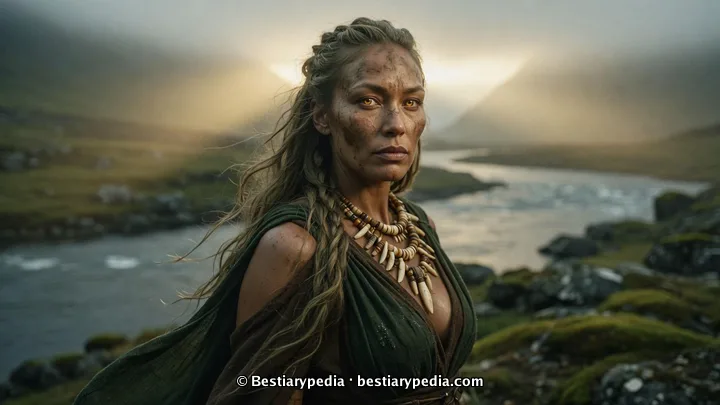
Jörð
Jörð, goddess-giant personification of the Earth in Norse mythology
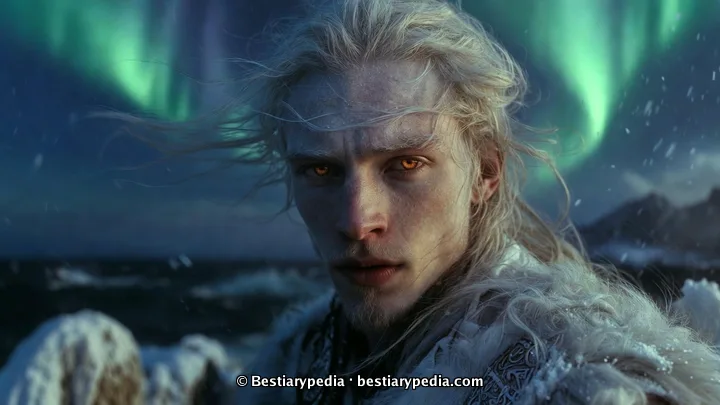
Baldr
Baldr, the Norse god of light, purity, and innocence
Freyja
Freyja, Norse goddess of fertility, love, beauty and war
Loki
Loki, Norse god of cunning, deception and transformation
Thor
Thor, Norse god of thunder, strength and protection

Odin
Odin, chief god of the Norse pantheon and lord of wisdom, war and runic magic