Freyja
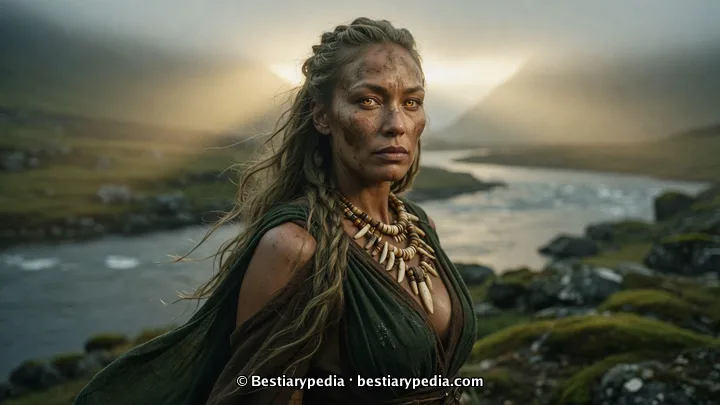
Freyja, Norse goddess of fertility, love, beauty and war
Curated byBestiarypediaCreated onUpdated on
 Europe

 Scandinavia(Denmark, Norway, Sweden)
Origin
Freyja belongs to the Vanir, the lineage of gods of fertility and prosperity, and is the daughter of Njörð, the god of the sea and wealth. After the war between the Aesir and the Vanir, which ended in a truce and exchange of hostages, Freyja arrived in Asgard together with her father and her twin brother Freyr, integrating into the main pantheon. Snorri Sturluson presents her in his Edda as the most glorious of the goddesses (ásynjur), owner of the mansion Fólkvangr and the hall Sessrúmnir. Her name simply means «lady» and is related to the Germanic title Frau. She is often confused with Frigg, Odin's wife, due to shared traits and functions, to the point that both are associated with the origin of the name of Friday; modern criticism debates whether in remote times they were a single divinity.
Domains and powers
Freyja rules love, desire, beauty, fertility and also war and death. According to the Grímnismál, each day she shares with Odin the fallen in combat: half march to her dwelling of Fólkvangr and the other half to Valhalla. She is, above all, the great teacher of seiðr, the prophetic and shamanic magic of the Vanir; and it is the sources that specify the direction of that teaching: Snorri's Ynglinga saga affirms that it was Freyja who introduced seiðr among the Aesir and taught it to Odin, not the other way around. She travels in a chariot pulled by two large cats and possesses a mantle of hawk feathers that allows flying between the worlds, a garment that in several myths she lends to Loki. Her weeping for the absence of her husband Óðr turns into tears of red gold, an image that also links her with wealth.
Main myths
The most famous object of Freyja is the Brísingamen, a collar of gold of dazzling beauty. The late tale of the Sörla þáttr recounts that she did not forge it, but four dwarves, and that Freyja obtained it by spending one night with each of them; later Loki steals it by order of Odin. In another myth, when a giant builder demands Freyja as payment for walling Asgard, the gods again resort to Loki's tricks to avoid delivering her. Her hawk mantle reappears in the recovery of Thor's hammer and in the rescue of Idun. These tales show a goddess at once desired and powerful, whose body, magic and treasures become objects of dispute between gods and giants, without her ever losing her sovereign rank.
Legacy
Freyja embodies like few divinities the union of apparently opposite forces: love and war, life and death, pleasure and magic. Her figure survived with strength in Scandinavian folklore long after Christianization, associated with the fertility of the fields and livestock, and in modern times she has become a central divinity of neopaganism and contemporary witchcraft currents (Wicca, Ásatrú). Studied as one of the clearest examples of the complex goddess of the Germanic world, Freyja endures as a symbol of feminine power that integrates seduction, sovereignty and dominion of the sacred.
Also known as
Relics
Symbology
Element
Gold
Number
Nine
Color
Gold and red
Animals
Cats, Falcon
Sigils:
Traits
Powers
Weaknesses
Behavioral
Resistances
Relations with other beings


In the Atlas
Travel the beings’ world of origin and the cosmos of their dimensions.
Mythologies
Norse mythology developed among the Germanic peoples of northern Europe, especially in Scandinavia, from the late Iron Age until the progressive Christianization between the 8th and 11th centuries. Its stories are preserved mainly in medieval Icelandic sources such as the Poetic Edda and the Prose Edda of Snorri Sturluson, which collect earlier oral traditions. The universe is conceived as a set of nine worlds connected by the cosmic tree Yggdrasil, in which gods, giants, humans and other beings coexist, and where the destiny of all is ruled by the Norns. The main gods are divided into two groups: the æsir, among whom Odin, Thor and Tyr stand out, and the vanir, represented by Njörðr, Freyr and Freyja, although both groups eventually integrated after a mythical war. Odin, associated with wisdom, war and poetry, occupies a central place, while Thor, god of thunder, protects humans from the giants. The end of the world, known as Ragnarök, involves a catastrophic battle in which most of the gods perish, although a later rebirth is foreseen. This tradition has exerted a lasting influence on literature, art and popular culture in Europe and America, from medieval sagas to modern representations in operas, novels and audiovisual media. Elements such as Valhalla or the valkyries have become part of the Western collective imagination, although often reinterpreted outside their original context.
Sources
Poetic Edda
Anonymous · 1200
Collection of ancient poems including Grímnismál with allusions to the wolves pursuing the Sun and Moon.
Prose Edda
Snorri Sturluson · 1220
Snorri Sturluson's 13th-century handbook of poetics, compiling and organising Norse mythology from the origin of the world to Ragnarök. Together with the Poetic Edda, the main source for the Scandinavian pantheon.
Gylfaginning
Snorri Sturluson · 1220
First mythological part of Snorri Sturluson’s Prose Edda (c. 1220). Through King Gylfi, who questions the Æsir, it expounds the creation of the world, the Nine Realms and the fate of the gods at Ragnarök, key to Norse mythology.
Ynglinga Saga
Snorri Sturluson · c. 1225
Ynglinga saga (c. 1225), the opening saga of Snorri Sturluson's Heimskringla. Through euhemerization it presents Odin, Njörðr and Freyr as priest-kings of the Æsir and Vanir who migrated to Scandinavia, founding the Swedish and Norwegian royal dynasty.
Frequently asked questions
How did Freyja integrate into the Aesir pantheon after the Aesir-Vanir war?
Freyja was sent as a hostage to Asgard with Njörd and Freyr. This integration reflects the balance between fertility and war forces.
What role does Freyja play in choosing the slain and her relation to the valkyries?
Freyja claims half the slain for Folkvangr and leads the valkyries there. This highlights her role in war and magic.
How does Freyja's legacy symbolize feminine duality in Norse traditions?
Freyja embodies love and war together. Her influence endures in folklore and modern magic, inspiring contemporary rituals.
🔖Cite this entry▾
If you cite this article in an academic, journalistic or editorial publication, use any of these formats:
Bestiarypedia. (2026, August 2). Freyja. Bestiarypedia. https://bestiarypedia.com/en/beings/freyja
Free citation with attribution and canonical link for editorial, academic or journalistic use. Full commercial reuse or creation of derivative products requires prior agreement.
Similar beings
Jörð
Jörð, goddess-giant personification of the Earth in Norse mythology

Loki
Loki, Norse god of cunning, deception and transformation

Thor
Thor, Norse god of thunder and strength

Hel
Hel, Norse goddess of the underworld and ruler of the dead who did not fall in battle

Odin
Odin, Norse lord of wisdom and war

Baldr
Baldr, the Norse god of light, purity, and innocence