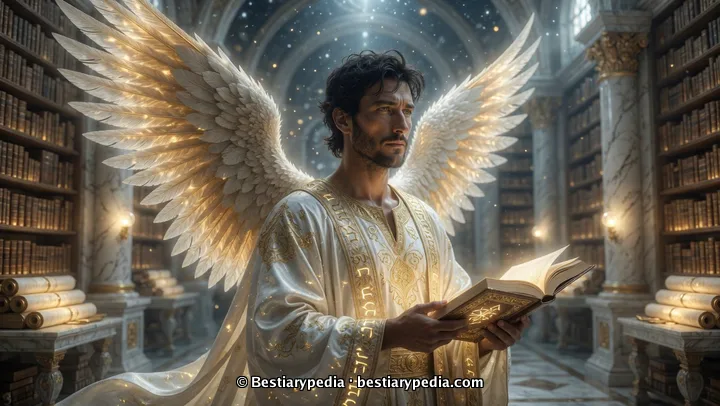
Helel Ben Shahar
The Morning Star
Curated byBestiarypediaCreated onUpdated on
 Israel(Israel)
🔄 Transformation line (Phase 1 of 2)


Origins of Helel ben Shahar
Helel ben Shahar, whose Hebrew name means «the resplendent one, son of the Dawn», designates the morning star, that is, the planet Venus shining on the horizon before dawn. The expression comes from a famous passage of the prophet Isaiah (14:12), a burlesque song against the king of Babylon to whom he is compared with the morning star fallen from the sky because of his pride: «How you have fallen from heaven, O Lucifer, son of the Dawn!». The image gathers a previous Canaanite mythological motif, that of the divine star Shahar (the Dawn) and his son, who aspires to be enthroned on the summit of the mountain of the gods and is cast down. In its origin, therefore, Helel is not a demon, but an astral figure linked to light, beauty and excessive pride that precedes the fall.
The fall and its transformation into Lucifer
The passage from Isaiah puts in the mouth of the fallen star a declaration of pride: «I will ascend to heaven, on high, next to the stars of God I will raise my throne... I will be like the Most High». For that excess (hybris) he is thrown into Sheol, the kingdom of the dead. When Saint Jerome translated the passage into Latin in the Vulgate, he rendered «Helel» as Lucifer («light-bearer», the Latin name of the morning Venus), and the Church Fathers, reading the text in light of other passages (Luke 10:18, Ezekiel 28), identified that fallen star with the rebel angel who becomes Satan. Thus, a metaphor about a Babylonian king gave rise, through Christian tradition, to the myth of Lucifer: the most beautiful angel whose light is perverted by wanting to equal God.
Cultural Legacy
The figure of Helel ben Shahar, transformed into Lucifer, has had an enormous influence on Western culture. John Milton immortalized it in Paradise Lost as the fallen angel of tragic grandeur who prefers «to reign in Hell rather than serve in Heaven». Romanticism, with William Blake and others, reinterpreted Lucifer as a symbol of creative rebellion and freedom against authority. Various esoteric and Luciferian currents have associated him with Prometheus, the titan who steals fire to give it to men, seeing in him a bearer of knowledge rather than an incarnation of evil. As an archetype, Helel/Lucifer condenses the human aspiration to transcendence, the price of pride and the beauty of glorious failure, and continues to be one of the most cited images in literature and art.
Also known as
Relics
🏺 Morning Star
Symbology
Element
Stellar Fire
Number
11
Color
Crimson Gold
Animals
Serpent, Fallen Eagle
Sigils:
🏷️ Traits
Powers
Weaknesses
Behavioral
Resistances
🗺️In the Atlas
Travel the beings’ world of origin and the cosmos of their dimensions.
📜 Mythologies
Esoteric and Kabbalistic traditions within Judaism, encompassing Merkabah mysticism from the Talmudic era, 13th-century Zoharic Kabbalah, 16th-century Lurianic Kabbalah, the 18th-century Hasidic movement, and various meditative, contemplative, and visionary practices aimed at ascending through spiritual worlds, invoking divine names, and achieving mystical union with the divine while unraveling the secrets of the creative universe.
Sources
Ugaritic Texts
Various (scribes of Ugarit) · c. 1300 BC
Corpus of inscriptions and tablets documenting the mythology, rituals and theology of the Canaanite pantheon in Ugarit.
Book of Ezekiel
Ezekiel ben Buzi (attributed) · c. 593-571 BCE
The Book of Ezekiel is one of the Major Prophets in the Old Testament, recounting the visions and prophecies of the prophet Ezekiel during the Babylonian exile, including the divine chariot, valley of dry bones, and future temple.
Book of Isaiah
Isaiah (traditionally attributed) · 8th cent. BC
The Book of Isaiah in the Old Testament contains Isaiah's prophecies circa 700-680 BCE covering judgment, salvation, and messianism.
Frequently asked questions
Which ancient traditions identify Helel Ben Shahar as son of the Dawn and heir to celestial glow?
Ancient Canaanite and Hebrew traditions present him as a primordial being of resplendent light. His name evokes Venus shining before dawn. This foundational narrative establishes him as a catalyst for cosmic cycles.
What cosmic transformation does Helel Ben Shahar undergo after his fall into Sheol according to medieval grimoires?
His light transmutes into burning darkness, birthing the figure of Lucifer. Grimoires invoke him as lord of infernal legions. Gnostic accounts rehabilitate him as a liberating demiurge of forbidden knowledge.
With which mythological figures does Helel Ben Shahar merge in occult syncretism according to his cultural legacy?
He merges with Prometheus, Enki and Quetzalcoatl as bearer of intellectual fire. He represents human aspiration for transcendence and the price of autonomy. His legacy permeates literature, art and music as a primordial rebel.
🔖Cite this entry▾
If you cite this article in an academic, journalistic or editorial publication, use any of these formats:
Bestiarypedia. (2026, July 26). Helel Ben Shahar. Bestiarypedia. https://bestiarypedia.com/en/beings/helel-ben-shahar
Free citation with attribution and canonical link for editorial, academic or journalistic use. Full commercial reuse or creation of derivative products requires prior agreement.