Kitsune Tenkō
Tenkō Celestial Elder Kitsune
Curated byBestiarypediaCreated onUpdated on
 Japan(Japan)
🔄 Transformation line (Phase 2 of 2)



Origins of the Celestial Fox
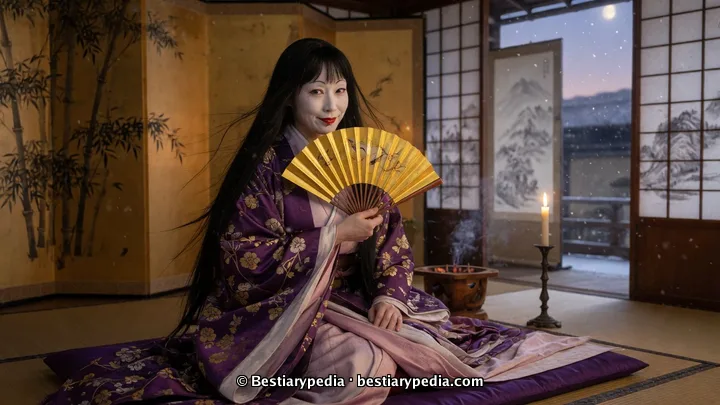
The tenko (天狐, «celestial fox») is, in the Japanese tradition, the most elevated form of the kitsune, the fox that reaches a thousand years of life and accumulates nine tails. Unlike the myōbu, linked to the service of Inari, the tenko reaches its condition by its own spiritual cultivation, withdrawing for centuries to the mountains to practice Buddhist discipline, Taoism and Shinto purification. Japanese folklore, influenced by the Chinese cosmology of the celestial foxes (tianhu), thus distinguishes between the servile forms and the independent and ascetic forms of the archetype; the tenko embodies the latter, that of the wise fox that transcends both predation and service to become an almost divine being, close to the immortals.
Nature and powers
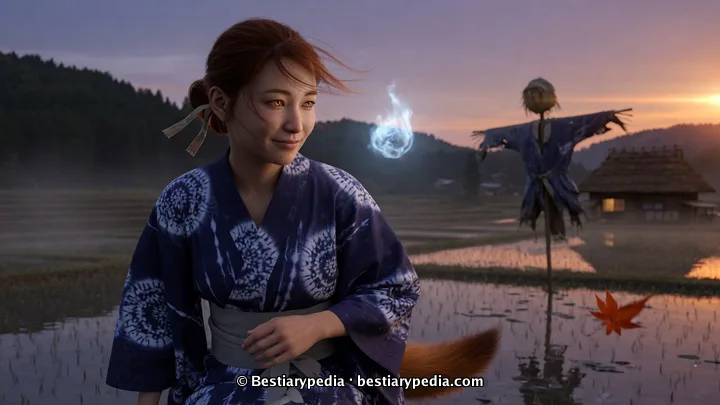
The tenko is attributed the maximum powers of the kitsune: flight, mastery of illusion and perfect transformation, clairvoyance and limited prophecy, healing and a minor alchemy of longevity elixirs. Having cultivated for a millennium, it has refined its pearl or jewel (hōju), seat of its spiritual power, and is placed above common foxes and Inari's messengers. Its nature is that of the wise master rather than that of the predator: it does not drain human energy, but guides and advises. Tradition links it to the number nine of its tails, symbol of the fullness achieved, and presents it as a serene and distant creature, rarely involved in the affairs of mortals except to instruct the virtuous.
Tradition and variants
The tenko is the Japanese counterpart of the Chinese celestial fox (the immortal huli-jing, tianhu) and the Korean celestial gumiho, with which it shares the motif of the millennial fox ascended by cultivation, although with its own syncretism that combines Buddhism, Taoism and Shintoism. It is distinguished from the myōbu by its independence from Inari and from the yako by having overcome predation. As a master, it is represented instructing monks and scholars in mountain caves and delivering its knowledge to meritorious disciples. Within the nine-tailed fox family, the tenko represents the pinnacle of the contemplative path: that of the fox that, through inner discipline alone, attains wisdom and quasi-divinity.
Relics
🏺 Hōju personal
🏺 Handwritten Lotus Sutra
🏺 White feather fan
Symbology
Element
Yin air
Number
9
Color
Silver-white
Animals
Nine-tailed white kitsune, Japanese white crane, Japanese macaque
Sigils:
🏷️ Traits
Powers
Weaknesses
Behavioral
Resistances
🗺️In the Atlas
Travel the beings’ world of origin and the cosmos of their dimensions.
📜 Mythologies
Japanese folklore encompasses oral traditions, myths, legends and supernatural creatures like yōkai and kami, compiled in Edo-period illustrated texts by Toriyama Sekien in works like Gazu Hyakki Yagyō and Konjaku Hyakki Shūi, reflecting Shinto animist beliefs, ecological fears of floods and droughts, and respect for nature in rivers, lakes and rice fields of regions like Shiga, Osaka and Kyoto.
Sources
Konjaku Monogatarishū
Unknown compiler · 12th century
Vast Japanese collection of more than a thousand tales (setsuwa) from the late Heian period (c. 12th century). It gathers Buddhist, secular and supernatural stories from India, China and Japan, and is an essential source for yōkai, oni and spirits of Japanese folklore.
Gazu Hyakki Yagyō
Toriyama Sekien · 1776
Illustrated bestiary by Toriyama Sekien, part of his influential series of yokai catalogues (1776-1784) that defined the classic image of Japanese folklore creatures.
Kwaidan: Stories and Studies of Strange Things
Lafcadio Hearn · 1904
Lafcadio Hearn's 1904 collection, gathering and translating Japanese supernatural legends from oral tradition and introducing them to the West. A classic reference for ghost and yokai folklore.
Frequently asked questions
What is the origin of the Kitsune Tenkō's ascent to celestial status?
A yako kitsune withdraws to remote caves to cultivate Zen, Taoism and Shinto for a thousand years until accumulating nine tails and ascending free from Inari.
What characteristic powers does the Kitsune Tenkō possess?
Free flight across the archipelago, mastery of Zen-Taoism-Shinto, advanced healing, limited prophecy and alchemy of longevity elixirs for virtuous humans.
How does the Tenkō relate to other celestial foxes of East Asia?
It is a variant of the Chinese immortal huli-jing and the Korean ancient gumiho, sharing the ascended millennial archetype but with its own Japanese Zen-Taoist-Shinto syncretism.
🔖Cite this entry▾
If you cite this article in an academic, journalistic or editorial publication, use any of these formats:
Bestiarypedia. (2026, July 26). Kitsune Tenkō. Bestiarypedia. https://bestiarypedia.com/en/beings/kitsune-tenko-celestial-elder
Free citation with attribution and canonical link for editorial, academic or journalistic use. Full commercial reuse or creation of derivative products requires prior agreement.