Jupiter
Jupiter, supreme god of the Roman pantheon, lord of the sky, thunder, and divine justice
Curated byBestiarypediaUpdated on
 Ancient Rome(Italy)
⇄ Cultural variants (1)
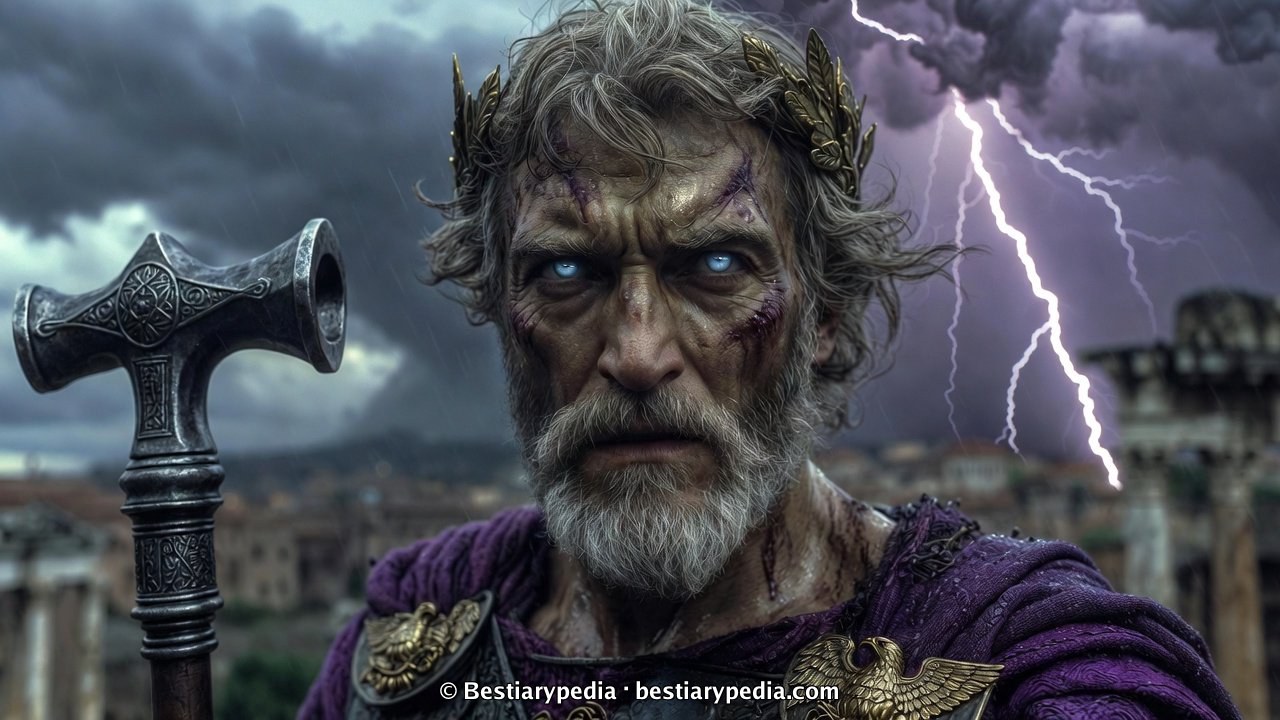

Mythical Origins of Jupiter
Jupiter, son of Saturn and Ops, overthrew his father to become king of the Roman gods. His birth in Crete and secret upbringing to avoid being devoured mark the start of his supreme rise to power. He is linked to the Greek Zeus and maintains his role as protector of divine justice and the Roman state from the mythical beginnings.
Domains and Symbols
Lord of sky and thunder, Jupiter wields the thunderbolt as supreme weapon. Protector of justice, oaths, and the Roman state, symbolized by the eagle and oak. He maintains close relations with Juno his wife and Minerva and Mars his children, strengthening his imperial authority and aligning with Zeus in Greek myths.
Myths and Legacy
In Virgil's Aeneid Jupiter guides Aeneas's fate toward Rome's foundation. He punishes Titans and giants affirming his eternal dominion. Jupiter Optimus Maximus embodies Roman imperial power and his cult endures in Western traditions with strong ties to Juno Minerva and Mars.
Also known as
Relics
🏺 Thunderbolt of Jupiter
Divine weapon forged by Vulcan, symbol of his destructive power and sovereignty.
Symbology
Element
Thunderbolt and Sky
Number
Six
Color
Electric Blue
Animals
Eagle
Sigils:
🏷️ Traits
Powers
Weaknesses
Behavioral
Resistances
🔗 Relations with other beings
Cultural variant of
The Greek deity Zeus is identified with the Roman deity Jupiter by the classical Hellenistic-Roman tradition. Syncretism documented in the interpretatio romana from the 3rd century BCE to the 2nd century CE.
🗺️In the Atlas
Travel the beings’ world of origin and the cosmos of their dimensions.
📜 Mythologies
Jupiter, Venus, and gods adopted from Greece.
Sources
Virgil's Aeneid
Virgil · -19
Latin epic by Virgil (1st century BCE) recounting the journey of the Trojan hero Aeneas from the fall of Troy to Italy. Amid gods, omens and a descent to the underworld, it gathers many divinities, nymphs and monsters of Greco-Roman mythology.
Fasti
Ovid · 8
Poem in elegiac couplets by Ovid (1st century) that runs month by month through the first six months of the Roman calendar. It explains the origin of festivals, rites and legends, and is a valuable source on gods, nymphs and beings of Roman folklore.
🔖Cite this entry▾
If you cite this article in an academic, journalistic or editorial publication, use any of these formats:
Bestiarypedia. (2026). Jupiter. Bestiarypedia. https://bestiarypedia.com/en/beings/jupiter
Free citation with attribution and canonical link for editorial, academic or journalistic use. Full commercial reuse or creation of derivative products requires prior agreement.