Langsuir
Langsuir, the winged vampire mother of rural Malay folklore
Curated byBestiarypediaCreated on
 Malaysia(Malaysia)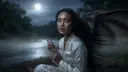
Origin of the Langsuir, the mother turned into a vampire
The Langsuir is the vampire of Malay folklore that is born from the most feared death in the rural world: that of the woman who dies during childbirth or in the forty days after, or that whose child is born dead. Her soul, broken by a truncated motherhood, returns to the world turned into a winged being that feeds precisely on the children of others. Tradition considers it the most ancient and primordial form of the Pontianak archetype, linked to the pre-Islamic animist substratum of the Malay peninsula. Walter Skeat, in Malay Magic (1900), collects the rites with which they tried to prevent a deceased woman from rising as Langsuir: her mouth was filled with glass beads so that she could not launch her scream, chicken eggs were placed under her armpits and needles in the palms of her hands so that she could not open her arms and fly. That there existed an entire funeral protocol to contain her reveals to what extent the fear of the Langsuir structured the mourning for dead mothers.
Appearance, powers and the domesticated Langsuir
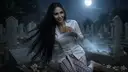
In its diurnal form the Langsuir is a woman of great beauty, dressed in a green suit, with black hair so long that it reaches her ankles and some sharp and extremely long nails. That hair is not only a trait of beauty: it hides the hole she has in the nape, through which she feeds by sucking the blood of the children. At night she unfolds her winged nature and flies emitting a hypnotic and seductive voice with which she attracts her victims. A singular motive of her legend is that the Langsuir can be domesticated: if one manages to trap her and cut her nails and put her long hair in the hole in the nape, she becomes tame, adopts human form and can come to live years as a normal woman, marry and have children. But the spell is fragile: it is enough that at a party she sets to dance and to spin until losing control so that she recovers her primeval form, rises through the airs and disappears in the jungle forever.
Geography and kinship with the Pontianak
The territory of the Langsuir is the rural world of peninsular Malaysia, with its rice fields and its villages of houses on stilts: it is located above all in the northern states, Kedah, Kelantan and Terengganu, and also in ancient Singapore, northern Sumatra and the Malay communities of southern Thailand. Its defining feature within the Malay pantheon is antiquity: it is understood as the archaic and peasant version from which the Pontianak derives, the best-known and urban postpartum vampire of modern tradition; in fact, it already appears mentioned in the Hikayat Hang Tuah, the Malay chronicle of the 15th century. It shares with figures from other cultures the same core, the dead mother who returns turned into a threat to the living, although with an opposite polarity to that of the Japanese kosodate-yūrei, who returns out of love for her child while the Langsuir returns out of thirst for blood. It is, in short, the mythical memory of the enormous danger that childbirth was for centuries.
Relics
🏺 Nails and hair locks
Symbology
Element
air-night, blood of childbirth
Number
40
Color
white baju kurung, black hair, dark wings
Animals
giant fruit bat, Moluccan owl
Sigils:
🏷️ Traits
Powers
Weaknesses
Behavioral
Resistances
🗺️In the Atlas
Travel the beings’ world of origin and the cosmos of their dimensions.
📜 Mythologies
Malay folklore encompasses a set of beliefs, stories and practices transmitted orally among the populations of the Malay Peninsula and the Indonesian archipelago, with roots dating back to prehistoric periods and incorporating influences from indigenous, Hindu, Buddhist and Islamic traditions over the centuries. Its origins are linked to the Austronesian communities that populated the region since ancient times, integrating animist elements with conceptions of the natural and supernatural world that reflect the interaction between humans, spirits and cosmic forces. In this tradition, the universe is conceived as a space inhabited by spiritual entities that influence daily life, including spirits of nature, ancestors and supernatural beings such as the pontianak or the orang minyak, along with figures derived from epic tales like the Ramayana adapted locally. Ritual and narrative practices seek to maintain balance between these planes, although variants differ according to regions and ethnic groups. The cultural legacy of Malay folklore persists in classical literature, shadow theatre, traditional dances and contemporary festivities of Malaysia and Indonesia, where stories and beliefs continue to influence collective identity and modern artistic expressions.
Sources
Hikayat Hang Tuah
Anonymous · 1400
Classical Malay epic from the fifteenth to seventeenth centuries containing langsuir appearances in ancestral rural context.
Malay Magic
Walter William Skeat · 1900
1900 work documenting langsuir domestication rituals in detail in Malay folklore.
Pagan Races of the Malay Peninsula, by Skeat and Blagden
Walter Skeat y Charles Blagden · 1906
Frequently asked questions
In what postpartum period does the woman transform into a langsuir according to Malay folklore?
The transformation occurs exactly forty days after childbirth or after a failed delivery. This liminal period allows the incomplete soul to return as a winged vampire.
What physical trait distinguishes the langsuir from the pontianak in its diurnal form?
The extraordinarily long hair reaching the feet, which hides the suction hole in the nape, marks the ancestral rural version of the langsuir versus the modern pontianak.
How does the langsuir relate to the Japanese kosodate yurei in Asian tradition?
Both entities represent cultural variants of the deceased-in-childbirth mother archetype, although the langsuir adopts a vengeful vampiric polarity while the kosodate yurei shows a loving tragic version.
🔖Cite this entry▾
If you cite this article in an academic, journalistic or editorial publication, use any of these formats:
Bestiarypedia. (2026, July 25). Langsuir. Bestiarypedia. https://bestiarypedia.com/en/beings/langsuir-flying-vampire-mother
Free citation with attribution and canonical link for editorial, academic or journalistic use. Full commercial reuse or creation of derivative products requires prior agreement.