Manananggal
Manananggal Segmented Flying Torso
Curated byBestiarypediaCreated on
 Philippines(Philippines)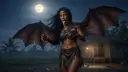
Origin of the segmentation ritual
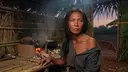
La Manananggal is one of the most celebrated creatures of Filipino folklore, especially of the Visayas, and its name comes from the Tagalog tanggal, «separar», because its defining trait is to split the body in two. It is considered a specific variety of the aswang, the umbrella term with which in the Philippines witches, vampires and devourers of the night are designated; the accounts of these creatures already appear in the testimonies of the Spanish chroniclers of the colonial era, collected centuries later in compilations like The Philippine Islands by Blair and Robertson. Tradition says that the ability to segment is inherited through the female line or received by pact from another elderly Manananggal, who transfers her condition before dying; the knowledge is kept secret and only transmitted from woman to woman. To split, the practitioner anoints the navel with a ritual oil, often described as crocodile liver oil or an inherited oil, at nightfall, and then the body opens at the waist and the upper half takes flight.
Characteristic powers and weaknesses
Separated by the waist, the upper half of the Manananggal unfolds large bat wings and rises in the night, while the lower half, the legs, remains planted and inert on the floor of the hut. Its weapon is a long and thin tongue, like a trunk, that it introduces through the cracks of the palm roof to suck from above the blood and, above all, the fetus of pregnant women, whom it locates by a superhuman sense of smell. It prefers the pregnant and the newborns, and for that reason in the countryside pregnant women were surrounded by protections. Its weak point is as famous as its form: the abandoned lower half. If someone finds it during the night and throws over it salt, crushed garlic, vinegar or, above all, ash, the creature can no longer reunite its two halves and dies at the break of day. Salt, garlic and the leaves of certain plants hung on doors and windows also repel it.
Diurnal form and segmented form
By day the Manananggal presents herself as an ordinary and discreet human woman, often beautiful, who lives without raising suspicions in the rural villages of the Visayas, Bicol and Mindanao; the belief warned that she could be the neighbor, the midwife or the single woman of the town. At night, already segmented, the upper torso shows the large dark wings, the intestines hanging slightly from the cut at the waist, hands turned into claws, the long disheveled mane, the eyes shining between yellow and red and the characteristic proboscis tongue. The lower half remains upright and empty on the ground, waiting. This duality, a being that is at the same time two halves and whose vulnerability is in the part that it abandons, is what distinguishes it from the flying heads of the continent, like the Malay Penanggalan or the Thai Krasue, which separate at the neck and do not preserve the torso. The Manananggal is, within the aswang family, the incarnation of the terror of nocturnal flight over the roofs.
Relics
🏺 Ritual segmentation oil
Symbology
Element
Nocturnal air and earth
Number
2
Color
Blood dark red and black
Animals
Giant fruit bat, Dark owl
Sigils:
🏷️ Traits
Powers
Weaknesses
Behavioral
Resistances
🗺️In the Atlas
Travel the beings’ world of origin and the cosmos of their dimensions.
📜 Mythologies
Body of supernatural beliefs and narratives of the Philippine archipelago: syncretism among native Austronesian traditions, pre-colonial Sino-Malay influences, Hispanic Catholicism (1565-1898) and American modernity. Vampiric (aswang, manananggal, tiyanak), shapeshifters (tikbalang), tree giants (kapre) and nature spirits (engkanto, duwende).
Sources
Mythological Dictionary of the Philippines, by Blumentritt
Ferdinand Blumentritt · 1895
The Philippine Islands, 1493-1898
Emma H. Blair y James A. Robertson (eds.) · 1903-1909
Vast 55-volume documentary collection on the history, peoples and beliefs of the Philippine Islands between 1493 and 1898, edited by Emma H. Blair and James A. Robertson.
Filipino Popular Tales
Dean S. Fansler · 1921
Extensive scholarly compilation of Filipino folk tales gathered by Dean S. Fansler in the early twentieth century, a classic source for the narrative folklore of the Philippines.
Frequently asked questions
How is the manananggal segmentation ritual transmitted?
It is transmitted through matrilineal inheritance or pact with an older manananggal, exclusively woman to woman in secret.
What weakness causes the definitive death of the manananggal?
Throwing ash, salt or garlic on the lower stump before dawn prevents the halves from reuniting and causes death by sun.
What iconographic relationship does the number two maintain with the manananggal?
The number two represents the duality of the separated halves, key to its appearance and vulnerability.
🔖Cite this entry▾
If you cite this article in an academic, journalistic or editorial publication, use any of these formats:
Bestiarypedia. (2026, July 25). Manananggal. Bestiarypedia. https://bestiarypedia.com/en/beings/manananggal-self-segmenter
Free citation with attribution and canonical link for editorial, academic or journalistic use. Full commercial reuse or creation of derivative products requires prior agreement.