Oiwa
Oiwa, vengeful Japanese spirit from the Yotsuya Kaidan folklore
Curated byBestiarypediaCreated on
 Japan(Japan)
Origin of Oiwa in the Yotsuya Kaidan
Oiwa is the most celebrated spirit of Japanese ghost theater, fixed by the playwright Tsuruya Nanboku IV in the kabuki work Tōkaidō Yotsuya Kaidan, premiered in Edo in 1825. In the story, Oiwa is married to Tamiya Iemon, a masterless samurai, impoverished and unscrupulous. Iemon aspires to marry Oume, the granddaughter of a rich neighbor, the Itō family, and to get rid of his wife poison comes into play. The Itō send Oiwa a facial cream that is presented as a restorative medicine but that in reality is a disfiguring poison. Oiwa, weak after giving birth, applies it trustingly. Her face deforms without remedy: the left eyelid falls swollen over the cheek, the skin ulcerates and, when she combs her hair, it comes off in bloody clumps. Upon discovering her face in the mirror she suddenly understands the betrayal. She dies in agony, some versions by the poison itself, others by cutting her neck with a sword in her desperation, launching with her last breath a curse against Iemon.
The vengeful form and the revenge on Iemon
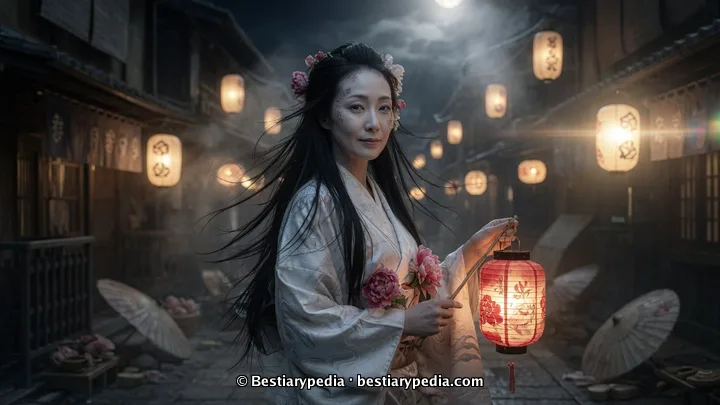
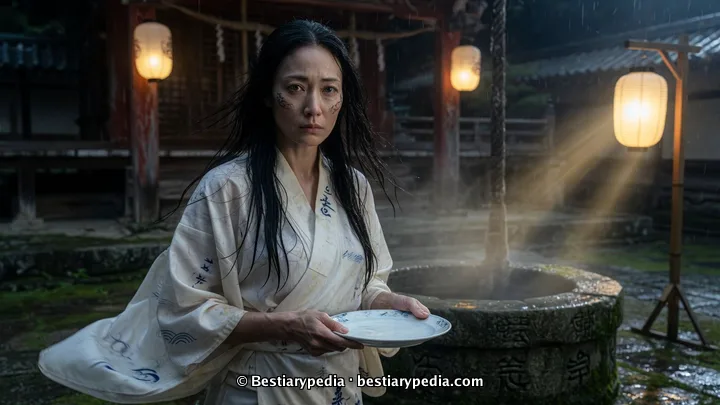
Converted into onryō, Oiwa forever keeps the face that the poison left her: the left eye fallen and swollen, half face deformed, the long sparse hair hanging and the white kimono for shrouding. Her most famous image is the chōchin-Oiwa, the face that emerges from the paper of a lit lantern, engraved by Hokusai and repeated in countless prints. Iemon, to hide the corpses, nails the body of Oiwa and that of the servant Kohei, falsely accused of adultery with her, on the two sides of a wooden shutter and throws it into the Onbō canal. But the affront does not go unpunished. The disfigured face of Oiwa pursues Iemon everywhere: he sees it in the face of his new wife Oume, whom he beheads on the same wedding night believing he is killing the specter, and in that of his father-in-law, whom he also kills. The apparition multiplies in the lanterns, in the smoke, in the water, until dragging Iemon to madness and ruin, and with him all those who participated in the deception.
The living curse of Oiwa
What distinguishes Oiwa from other ghosts of fiction is that her cult is still alive and has a postal address. She is venerated in the Oiwa Inari Tamiya sanctuary, in Yotsuya (Tokyo), and a tomb is attributed to her in the Myōgyō-ji temple of Sugamo. From there arises the best documented custom of Japanese theater: actors, directors and film crews who are going to represent the Yotsuya Kaidan visit the sanctuary beforehand to pay homage to Oiwa and ask her permission, because it is believed that the productions that do not do so suffer accidents, illnesses and misfortunes. Over more than a century injuries and even deaths in productions and films have been attributed to her anger, and the superstition is respected today with all seriousness in the guild. Oiwa is, by far, the Japanese ghost most represented in theater and cinema, and the archetype of the aggrieved and disfigured woman who returns from the tomb, mold from which the avengers of contemporary Japanese horror drink.
Also known as
Relics
🏺 Paper Lantern
Symbology
Element
Vengeance
Number
1
Color
White
Animals
Deformed Yūrei
Sigils:
🏷️ Traits
Powers
Weaknesses
Behavioral
Resistances
🗺️In the Atlas
Travel the beings’ world of origin and the cosmos of their dimensions.
📜 Mythologies
Japanese folklore encompasses oral traditions, myths, legends and supernatural creatures like yōkai and kami, compiled in Edo-period illustrated texts by Toriyama Sekien in works like Gazu Hyakki Yagyō and Konjaku Hyakki Shūi, reflecting Shinto animist beliefs, ecological fears of floods and droughts, and respect for nature in rivers, lakes and rice fields of regions like Shiga, Osaka and Kyoto.
Sources
Yotsuya Kaidan by Tsuruya Nanboku
Tsuruya Nanboku IV · 1825
Tōkaidō Yotsuya Kaidan, a kabuki play by Tsuruya Nanboku IV premiered in 1825 in Edo. It dramatizes the revenge of the spectre of Oiwa, disfigured and killed by her husband Iemon, fixing the classic image of the Japanese onryō and her ravaged face.
Hyaku Monogatari (One Hundred Ghost Tales) by Hokusai
Katsushika Hokusai · 1831
New Forms of Thirty-Six Ghosts, by Yoshitoshi
Tsukioka Yoshitoshi · 1889
Frequently asked questions
Why does Oiwa's face become disfigured?
For a poison disguised as medicinal cream that the Itō make reach him so that Iemon remains free and can marry the granddaughter of that family. The poison sinks his left eye and makes his hair fall in clumps, and that deformed face is the one he already conserves as spirit.
What is the chōchin-Oiwa of the prints?
It is her most iconic appearance: the deformed face of Oiwa emerging from the paper of a lit lantern. Hokusai engraved it like this and since then the lantern is her emblem, to the point that that image suffices to evoke the whole story.
Why do actors visit their grave before representing it?
Because there exists the belief, still alive in the guild, that staging the Yotsuya Kaidan without asking permission from Oiwa brings accidents and misfortunes. Theater and film crews go to the Oiwa Inari Tamiya shrine of Yotsuya to pay her respect before embodying her.
🔖Cite this entry▾
If you cite this article in an academic, journalistic or editorial publication, use any of these formats:
Bestiarypedia. (2026, July 24). Oiwa. Bestiarypedia. https://bestiarypedia.com/en/beings/oiwa
Free citation with attribution and canonical link for editorial, academic or journalistic use. Full commercial reuse or creation of derivative products requires prior agreement.