Okiku
Okiku, samurai maid in Himeji who returns as vengeful yūrei after being killed by her master
Curated byBestiarypediaCreated on
 Japan(Japan)
Mythical Origins of Okiku in Himeji
Okiku emerges in Japanese folklore as a maid in service to a samurai at Himeji Castle during the Edo period. After being falsely accused of stealing a valuable plate and brutally murdered by her master who throws her into a deep well, her spirit returns transformed into an onryo driven by revenge and obsession. Local chronicles recount how her unjust death generates a persistent spiritual energy that manifests near the castle well. This transformation reflects classic themes of feudal injustice and the power of unresolved grudges in the Japanese yūrei tradition. Her story became popular in kabuki theaters and oral tales passed down through generations in the Banshū region.
Attributes and Manifestation of Okiku as Onryo
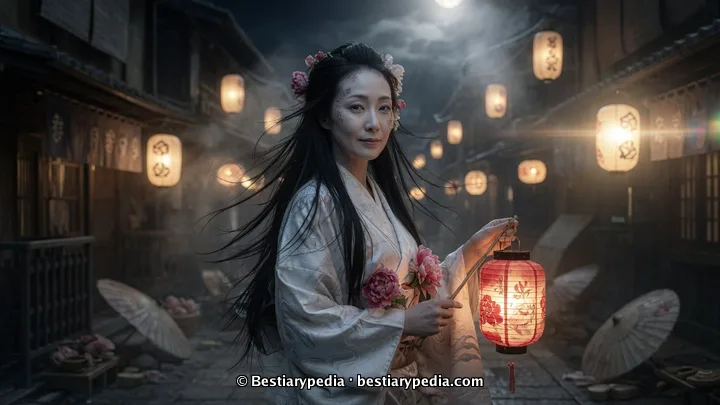
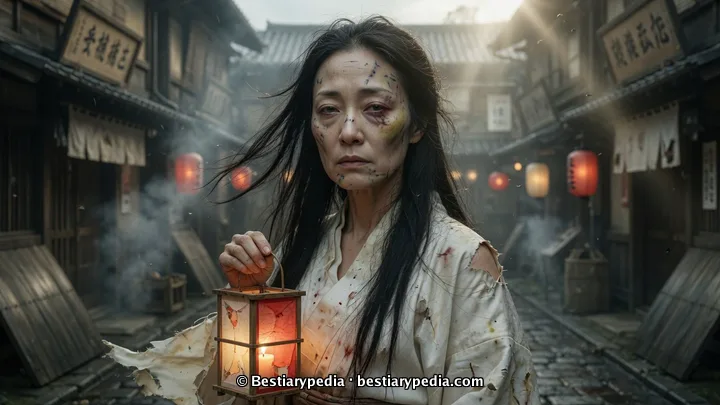
Okiku manifests wearing a traditional white kimono stained by well water with long disheveled hair covering her pale face. Her most distinctive trait is the compulsion to count plates one by one up to the number nine and then eternally repeat the count without reaching the tenth. This obsessive repetition symbolizes both the crime imputed to her and her unfulfilled desire for justice. Her presence generates an atmosphere of intense cold and sounds of clinking plates near the well of Himeji Castle. The high persistence of her spirit allows her to remain active for centuries without dissipating unless a specific exorcism ritual is performed.
Symbology and Persistent Legacy of Okiku
The well represents the site of her death and the threshold between the world of the living and the dead while the white kimono evokes purity sullied by betrayal. The repetitive act of counting nine plates embodies incompleteness and the infinite cycle of resentment that prevents spiritual rest. In the Himeji region her legend serves as a moral warning about the abuse of power and the importance of justice for servants. Her high persistence makes her an archetype of the Japanese onryo that influences modern narratives of vengeful ghosts in film and literature. Local rituals include offerings of complete sets of plates to appease her spirit and restore cosmic balance.
Also known as
Relics
🏺 Himeji Well
Symbology
Element
Water
Number
9
Color
White
Animals
Fox
Sigils:
🏷️ Traits
Powers
Weaknesses
Behavioral
Resistances
🗺️In the Atlas
Travel the beings’ world of origin and the cosmos of their dimensions.
📜 Mythologies
Japanese folklore encompasses oral traditions, myths, legends and supernatural creatures like yōkai and kami, compiled in Edo-period illustrated texts by Toriyama Sekien in works like Gazu Hyakki Yagyō and Konjaku Hyakki Shūi, reflecting Shinto animist beliefs, ecological fears of floods and droughts, and respect for nature in rivers, lakes and rice fields of regions like Shiga, Osaka and Kyoto.
Sources
Hyaku Monogatari (One Hundred Ghost Tales) by Hokusai
Katsushika Hokusai · 1831
New Forms of Thirty-Six Ghosts, by Yoshitoshi
Tsukioka Yoshitoshi · 1889
Tales of Banchō Sarayashiki
Traditional oral sources · Edo period
Banchō Sarayashiki ("The Dish Mansion"), a famous Japanese ghost story (kaidan) from the Edo period. It tells of the vengeful spirit (yūrei) of the servant Okiku, thrown into a well, who counts dishes each night and terrifies her murderer.
Frequently asked questions
What is the origin of Okiku's transformation into an onryo?
Okiku was a maid unjustly killed by her samurai master in Himeji and thrown into a well. Her death generates a vengeful spirit that returns obsessed with counting plates.
What obsessive behavior defines Okiku's powers?
Okiku counts plates up to nine and endlessly repeats the process. This repetition generates intense cold and supernatural sounds that manifest her persistent vengeful energy.
What symbolic elements surround Okiku in her legend?
The well and white kimono symbolize the threshold of death and violated purity. The incomplete count represents eternal resentment and denied justice in Himeji folklore.
🔖Cite this entry▾
If you cite this article in an academic, journalistic or editorial publication, use any of these formats:
Bestiarypedia. (2026, July 24). Okiku. Bestiarypedia. https://bestiarypedia.com/en/beings/okiku
Free citation with attribution and canonical link for editorial, academic or journalistic use. Full commercial reuse or creation of derivative products requires prior agreement.