Pazuzu
Pazuzu, Mesopotamian demon of desert winds and protector against evil spirits
Curated byBestiarypediaCreated onUpdated on
 Mesopotamia(Iraq)
Mythical Origins of Pazuzu
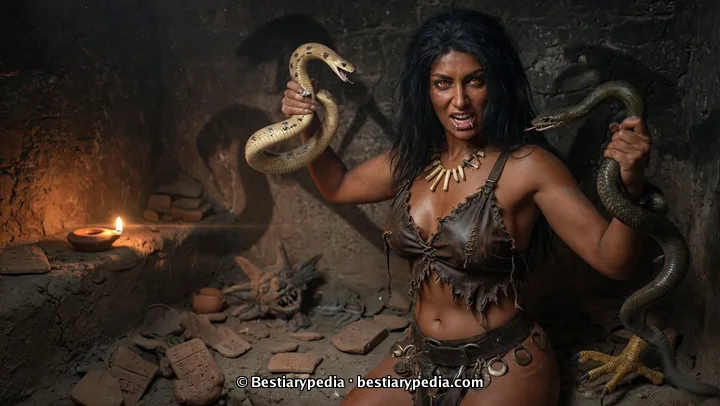
Pazuzu is the king of the wind demons in Mesopotamian mythology of the first millennium BC, son of the god Hanbi (or Hanpa), sovereign of the evil spirits. He is represented with a humanoid body of monstrous features: canine or leonine face, bulging eyes, body covered with scales, raptor claws on hands and feet, two pairs of wings and a scorpion tail. As lord of the winds, in his destructive facet he embodied the southwest wind, bearer of droughts, storms and locust plagues that ruined the crops. His figure thus gathered the fearsome power of the atmospheric forces of the Mesopotamian desert.
Ambivalent Nature and Powers
Although a demon, Pazuzu had a markedly protective (apotropaic) function, which distinguishes him from other evil beings. Precisely because of his ferocity he was invoked to combat other demons, especially Lamashtu, the devourer of children: it was believed that Pazuzu could force her to return to the underworld. Therefore, pregnant women and mothers wore amulets with his effigy or with his head alone, and these were hung in houses to repel evil and the diseases brought by the winds. Pazuzu thus fought evil with evil, dominating the forces of the pestilent air and turning them against the threats that lurked in the home and the most vulnerable.
Cultural Legacy
Numerous statuettes, bronze heads and amulets of Pazuzu have been preserved since the Neo-Assyrian and Babylonian period, testimony to the spread of his protective cult throughout the Near East. Many included a ring for hanging them and an inscription that identified him as son of Hanbi and king of the wind spirits. In contemporary popular culture, Pazuzu achieved worldwide fame as the demon that possesses the girl in the novel and film The Exorcist (1971 and 1973), a modern association foreign to his original role: in ancient Mesopotamia he was not a demon of possession, but a fierce guardian invoked to protect, not to harm. His iconography remains one of the most recognizable in Mesopotamian demonic art.
Also known as
Relics
🏺 Exorcism Tablets
Symbology
Element
Desert Winds
Number
1
Color
Dark Red
Animals
Scorpion
Sigils:
🏷️ Traits
Powers
Weaknesses
Behavioral
Resistances
🔗 Relations with other beings
🗺️In the Atlas
Travel the beings’ world of origin and the cosmos of their dimensions.
📜 Mythologies
Mesopotamian mythology developed in the region situated between the Tigris and Euphrates rivers, in the territory that today corresponds to Iraq and bordering areas, and spans an extensive period that begins with Sumerian civilization around the fourth millennium BCE and continues through the Akkadian, Babylonian and Assyrian cultures until the Hellenistic era. Its tales were transmitted on clay tablets written in Sumerian and Akkadian, and reflect a worldview in which the gods controlled the forces of nature and human destiny, while kings acted as intermediaries between the divine world and society.
Sources
Assyrian Incantation Texts
Several Assyrian scribes · 1000 BCE
Collection of cuneiform tablets from the first millennium BCE documenting invocations to Pazuzu for protection against wind demons.
Mesopotamian Pazuzu Amulets
Leonard W. King · 1896
Bronze and clay artifacts used in maternal protection rituals and against respiratory diseases in ancient Assyria and Babylonia.
Frequently asked questions
In what Assyrian mythological context does Pazuzu emerge as the son of Hanbu?
Pazuzu emerges in Assyrian mythology around the first millennium BCE as the son of Hanbu. Cuneiform texts describe him as a hybrid being born from the primordial chaos of the Mesopotamian deserts. His appearance coincides with the rise of the Assyrian Empire, where he is invoked in exorcism tablets.
What physical traits characterize the iconography of Pazuzu in bronze amulets?
Pazuzu is depicted with a canine body, raptor bird head, membranous wings, sharp talons and scorpion tail. These traits symbolize dominion over arid winds, deadly venom and prophetic vision. Bronze amulets found in Nineveh show his figure holding lightning bolts and serpents.
How does Pazuzu's duality manifest in his relationship with Lilitu and Lilith?
Although feared for sending devastating winds, Pazuzu acts as guardian against demons like Lilitu and Lilith. Amulets placed on birthing beds invoke his fury to repel evil spirits. This duality makes him an ambivalent figure: destroyer of crops yet savior of infants.
🔖Cite this entry▾
If you cite this article in an academic, journalistic or editorial publication, use any of these formats:
Bestiarypedia. (2026, July 26). Pazuzu. Bestiarypedia. https://bestiarypedia.com/en/beings/pazuzu
Free citation with attribution and canonical link for editorial, academic or journalistic use. Full commercial reuse or creation of derivative products requires prior agreement.