Lamashtu
Lamashtu, Mesopotamian demoness daughter of Anu and ancestor of Lilith
Curated byBestiarypediaCreated onUpdated on
 Mesopotamia(Iraq)
⇄ Cultural variants (3)



4 beings in the lineage
Mythical Origins of Lamashtu
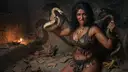
Lamashtu (in Sumerian Dimme) is a fearsome demoness of ancient Mesopotamia, daughter of the celestial god Anu. Unlike most Mesopotamian demons, who acted on the orders of the gods, Lamashtu acted according to her own malevolent will, which made her an especially terrifying force. Akkadian and Babylonian texts describe her with a lion's head, donkey's teeth, hairy body, long fingers and nails, and hands stained with blood. She is often depicted kneeling on a donkey or a boat, nursing a dog and a pig, and holding snakes in both hands. She was known by seven names and embodied the danger that lurked for women and newborns.
Nature and Powers
Lamashtu's terror preyed mainly on pregnant women and infants. She was believed to slip into houses to touch the belly of the pregnant woman, cause miscarriage or steal the child from its mother's breast to drink its blood and devour its flesh. She was also blamed for illnesses, nightmares, sudden death of the infant and sterility. As a force of chaos, she spread fevers and contagions, withered vegetation and poisoned waters and rivers. Her autonomous character, not subject to any god, placed her among the most dangerous threats of the demonic pantheon, for she could not be appeased through offerings to a higher divinity.
Protection and Legacy
Against Lamashtu, the Mesopotamians resorted to apotropaic magic. Pregnant women and mothers wore amulets, and it was customary to invoke the wind demon Pazuzu, her great rival, whose image was hung or placed facing her to drive her away. The famous plaques against Lamashtu show her being expelled to the underworld through the waters, while Pazuzu watches her from above. Spells were recited that listed her seven names to dominate her and gifts (combs, spindles, brooches) were offered to her so that she would leave appeased. Lamashtu endured for millennia as the personification of the ancestral fear of perinatal death, and her iconography influenced later representations of female child-devouring demons in the Near East.
Relics
🏺 Ritually broken bronze comb
🏺 Two living serpents
Symbology
Element
Yin night and puerperal darkness
Number
7
Color
Red-black
Animals
Lioness, Serpents, Nocturnal owl
Sigils:
🏷️ Traits
Powers
Weaknesses
Behavioral
Resistances
🔗 Relations with other beings

🗺️In the Atlas
Travel the beings’ world of origin and the cosmos of their dimensions.
📜 Mythologies
Mesopotamian mythology developed in the region situated between the Tigris and Euphrates rivers, in the territory that today corresponds to Iraq and bordering areas, and spans an extensive period that begins with Sumerian civilization around the fourth millennium BCE and continues through the Akkadian, Babylonian and Assyrian cultures until the Hellenistic era. Its tales were transmitted on clay tablets written in Sumerian and Akkadian, and reflect a worldview in which the gods controlled the forces of nature and human destiny, while kings acted as intermediaries between the divine world and society.
Sources
The Devils and Evil Spirits of Babylonia
R. Campbell Thompson · 1903-1904
Edition and study of the cuneiform magical texts of Babylonia and Assyria concerning demons and evil spirits (among them Lamashtu and the utukku), a pioneering Assyriological work by R. Campbell Thompson.
Maqlû Series
Ancient Babylonian scribes · c. 700 BCE
The Maqlû series is a collection of ancient Babylonian incantations (c. 700 BCE) against demons like Lilitu, preserved on clay tablets, detailing her attacks on sleepers and pregnant women.
Frequently asked questions
What relationship is there between Lamashtu and Lilith?
Lamashtu is the direct antecedent of Lilith in the post-exilic Jewish tradition. Unlike other Mesopotamian demons, she obeys no one: she acts of her own will after her exile from the pantheon of Anu.
What weakens Lamashtu in Mesopotamian cosmology?
Pazuzu amulets and ritually broken bronze combs neutralize her. No dialogue is possible, only defensive rituals in homes with pregnant women.
What number of plagues does Lamashtu inflict according to the texts?
She inflicts seven pairs of plagues. Her associated number is seven, linked to neonatal attacks, fevers and animal control in Mesopotamian iconography.
🔖Cite this entry▾
If you cite this article in an academic, journalistic or editorial publication, use any of these formats:
Bestiarypedia. (2026, July 22). Lamashtu. Bestiarypedia. https://bestiarypedia.com/en/beings/lamashtu
Free citation with attribution and canonical link for editorial, academic or journalistic use. Full commercial reuse or creation of derivative products requires prior agreement.