Qarinah
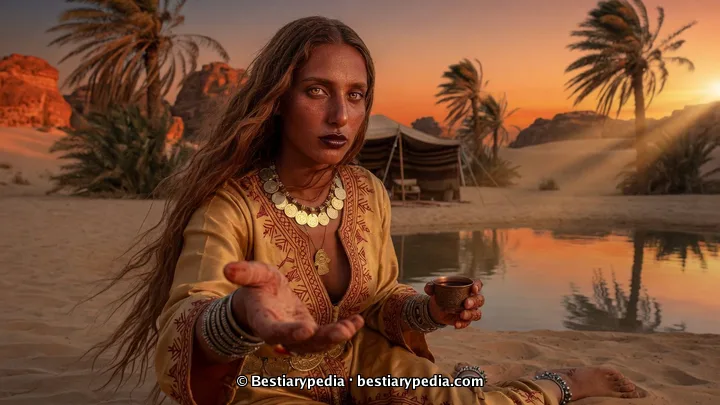
Qarinah, soul companion linked to the human man in pre-Islamic Arabian folklore
Curated byBestiarypediaCreated onUpdated on
 Arabian Peninsula(Saudi Arabia)
⇄ Cultural variants (4)



5 beings in the lineage
Mythical Origins of the Qarinah
The Qarinah arises as a female jinn spirit created simultaneously with the human man to whom she bonds from birth, parallel to the male qarīn. Pre-Islamic Arabian lore presents her as an invisible cosmic shadow-wife always present beside the man. The later Islamic tradition kept her as a real entity framed under the general jinn legion. In rural Egyptian lore she persists alive until the twentieth century with amuletic protection cults using silver and Quranic calligraphy in the Delta and Upper Egypt, plus zar rites in Sudan and rural Yemen.
Powers and Appearance of the Qarinah
The Qarinah possesses cosmic bonding with a specific man from his birth, intervenes in dreams causing marital failures and psychological infertility, provokes spontaneous jealousy and attacks newborns according to popular lore. She can henge between a beautiful human form with livid-lunar pale skin, long loose black hair, subtle vertical-pupil green-selenite eyes and floating translucent white kaftan, or a translucent shadow form. Her longevity is tied to the bonded human's life. She is perceived at the corner of the eye near mortal wives and reveals herself in dreams or zar sessions.
Symbology and Relations of the Qarinah
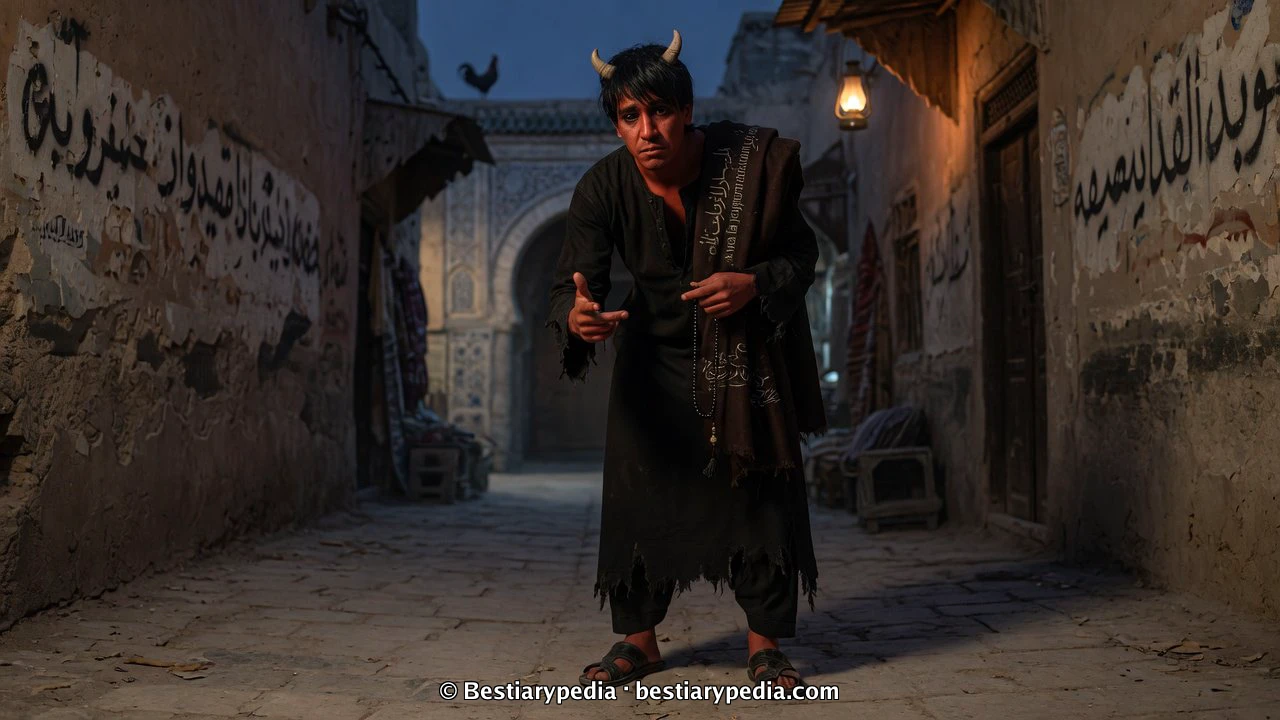
Its symbology includes livid-lunar pale skin, long loose black hair, green-selenite eyes with vertical pupil, floating translucent white kaftan, silver amulet collar and pale bare feet. She bonds with jealous love to a single human man and shows hostility toward all mortal women in his life, causing psychological infertility and nocturnal attacks. She is warded by Quranic amulets, zar rituals and Āyat al-Kursī. She is a direct cultural variant of Lilith and operates in parallel to the male shaitan-tempter.
Relics
🏺 Khamsa Amulet of the linked human
Symbology
Element
Yin Air
Number
7
Color
Livid Lunar
Animals
Black cat, Night owl, Moon moth
Sigils:
🏷️ Traits
Powers
Weaknesses
Behavioral
Resistances
🔗 Relations with other beings
🗺️In the Atlas
Travel the beings’ world of origin and the cosmos of their dimensions.
📜 Mythologies
Arabian folklore encompasses oral traditions, tales from One Thousand and One Nights, and supernatural beings like djinn, ifrit and marid, spirits created from smokeless fire according to the Quran (Surah 55:15), originating in pre-Islamic myths of the Arabian Peninsula, reflecting Bedouin animism, fears of desert spirits, sandstorms and oases, compiled in medieval literature like the works of Al-Jahiz and transmitted in regions like Hijaz, Yemen and the Maghreb.
Sources
Kharidat al-Aja'ib
Ibn al-Wardi · 1450
"Kharidat al-Aja’ib" (The Pearl of Wonders), an Arabic cosmography attributed to Siraj al-Din ibn al-Wardi (15th century). It describes the geography of the known world, its peoples and the wondrous creatures—jinn, demons and beasts—that tradition placed at its edges.
One Thousand and One Nights
Anonymous (traditional compilation) · VIII-XIV
Anonymous compilation of medieval Arab folk tales (8th-14th centuries), where ifrits appear in stories like 'The Fisherman and the Ifrit', illustrating their power, vengeance and submission to magical seals.
Kitāb al-Ḥayawān (Book of Animals)
Al-Jāḥiẓ (Abū ʿUthmān ʿAmr ibn Baḥr al-Kinānī) · c. 776-868
Zoological and theological encyclopedia in 7 volumes by Basran polymath Al-Jāḥiẓ (776-868 CE), foundational reference on jinn, ifrit, ghul and other Arabic creatures from both naturalist and cultural-religious perspectives. Includes theological debates on jinn ontology and catalogs of mafáhim on supernatural desert behavior.
Frequently asked questions
What is the origin of the Qarinah?
The Qarinah is born at the same time as the person to whom it remains linked, and accompanies it from that instant as a shadow-wife of the opposite sex. The belief is pre-Islamic; the later Islamic tradition integrated it among the jinn, assigning a qarin to each human being.
How does the Qarinah intervene in human dreams and relationships?
She provokes dreams of marital failure and psychological infertility, generates spontaneous jealousy between spouses and attacks newborns. Her power is psychic and subtle, operating from her individual cosmic bond.
What relation does the Qarinah have with Lilith and the male shaitan?
She is a direct cultural variant of Lilith as a nocturnal figure hostile to mortal wives. She operates in parallel to the male shaitan-tempter, one tempting and the other affectively bonding with cosmic jealousy.
🔖Cite this entry▾
If you cite this article in an academic, journalistic or editorial publication, use any of these formats:
Bestiarypedia. (2026, July 22). Qarinah. Bestiarypedia. https://bestiarypedia.com/en/beings/qarinah-bonded-spirit
Free citation with attribution and canonical link for editorial, academic or journalistic use. Full commercial reuse or creation of derivative products requires prior agreement.