Astarte
Astarte, Canaanite goddess of love, fertility, war and sexuality
Curated byBestiarypediaCreated onUpdated on
 Holy Land(Israel)
 +2Levant(Israel, Jordan, Lebanon, Syria, Palestine)
Family Tree



Identity, Domains and Origins of Astarte
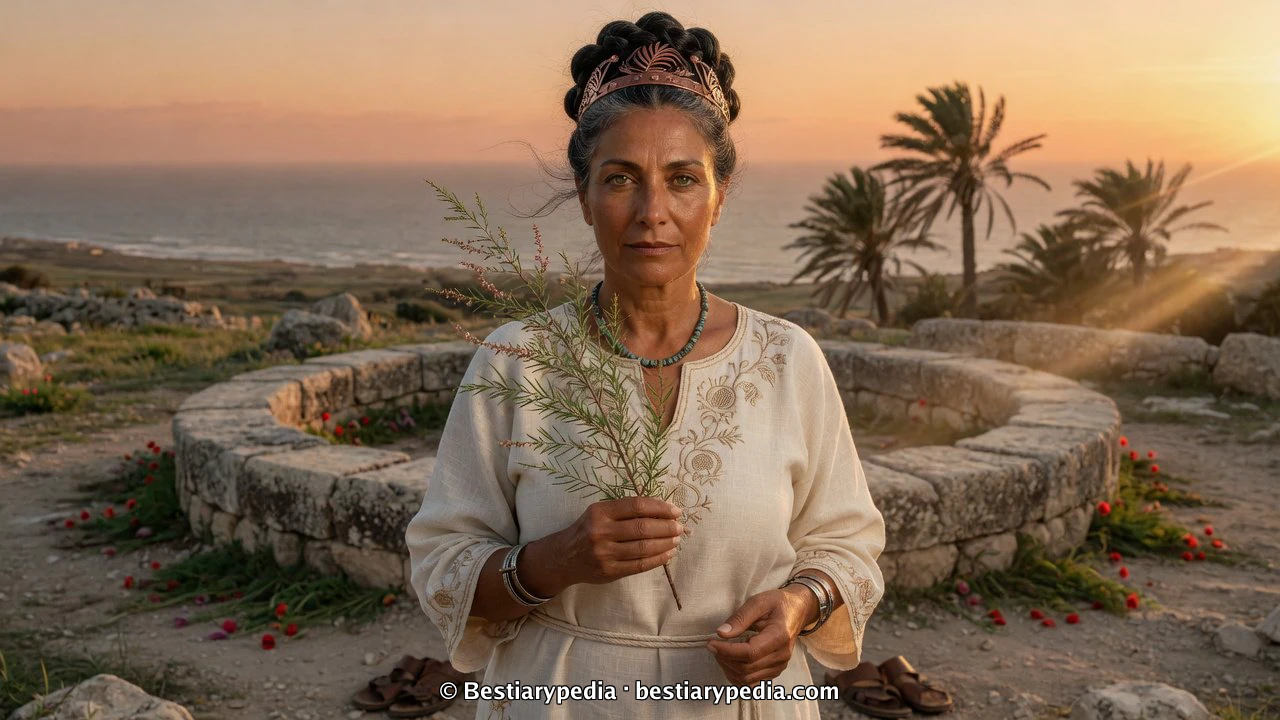
Astarte (in Northwest Semitic ʿAshtart, and in the biblical sources Ashtoreth) is the great goddess of the ancient Levant, attested in the texts of Ugarit from the fourteenth century BCE. Goddess of love, sexuality, fertility, war and sovereign power, she was also associated with the stars and, in particular, with the planet Venus, the evening star. In the Canaanite pantheon she appears linked to El and is often presented as consort of Baal Hadad, the storm god. Her name and functions connect with the Mesopotamian Inanna-Ishtar, of whom she constitutes the West Semitic variant. Astarte embodies a twofold nature (that of the love which engenders life and that of the warlike fury which reaps it), a trait she shares with other great goddesses of the ancient Near East.
Cult, Rites and Iconography of Astarte
The cult of Astarte radiated from Phoenicia towards its great cities (Tyre, Sidon and Byblos) and its Mediterranean colonies, with Carthage at the head; she was also received in Ramesside Egypt. Philo of Byblos, transmitted by Eusebius, calls her “the greatest goddess” and relates that she placed upon her head the head of a bull as an emblem of royalty and that she consecrated in Tyre a star fallen from the sky. Hence her characteristic iconography: the nudity associated with fecundity, the horns, the lion that symbolizes warlike strength, the dove of sacred love and the astral star. Her sanctuaries received offerings, music and dances; later classical authors also attributed to her rites of sacred prostitution, today disputed by modern scholarship.
Syncretisms, Bible and Survival of Astarte
For the Greeks, Astarte was identified with Aphrodite (the Phoenicians “say that Astarte is Aphrodite”, according to Philo), and thence with the Roman Venus; Lucian of Samosata, in “On the Syrian Goddess”, linked her also with the Moon. The Hebrew Bible condemns her under the name of Ashtoreth, “abomination of the Sidonians”, reproaching Solomon for her cult and celebrating its destruction in the reform of Josiah (1 Kings 11 and 2 Kings 23); the Masoretic vocalization seems to deform her name with the vowels of “bosheth” (shame). It is fitting to distinguish the goddess from her late demonization as Astaroth, the masculine demon of the medieval and Renaissance grimoires: they are the same root, but Astarte is the historical deity of love and war, not that infernal figure.
Also known as
Relics
🏺 Fertility Scepter
Symbology
Element
Moon and Love
Number
7
Color
Red
Animals
Dove and Lion
Sigils:
🏷️ Traits
Powers
Weaknesses
Behavioral
Resistances
🔗 Relations with other beings
🗺️In the Atlas
Travel the beings’ world of origin and the cosmos of their dimensions.
📜 Mythologies
Canaanite mythology developed among the Semitic peoples who inhabited the region of Canaan, located in the eastern Mediterranean Levant, from the late third millennium BCE until the first half of the first millennium BCE. The main sources for its knowledge come from the texts discovered at Ugarit, as well as references in Egyptian, Hittite and Hebrew documents. This tradition formed part of a broader set of religions of the ancient Near East and shared elements with Mesopotamian and Egyptian mythologies, although it retained distinctive features linked to the coastal and agricultural environment of the area. In the Canaanite pantheon, the divinities associated with fertility, storms and the sea occupied a prominent place. Baal, god of rain and vegetation, played a central role in the myths of combat against the forces of chaos, while Asherah, associated with motherhood and sacred trees, figured as the consort of the supreme god El. Other relevant figures included Astarte, Dagan and Mot, who embodied aspects of war, grain and death respectively. Worship was practiced in local shrines and temples, with rituals that sought to ensure agricultural prosperity and the protection of the city-states. The influence of Canaanite mythology is perceived in later traditions of the Levant, especially in the religion of ancient Israel, where certain elements were reinterpreted or rejected. Epigraphic and archaeological remains found in Phoenicia and Palestine attest to the continuity of some cults until the Hellenistic period, at which time a progressive fusion with Greek and Roman divinities took place.
Sources
Three Books of Occult Philosophy
Heinrich Cornelius Agrippa · 1533
Renaissance encyclopedia of magic by Heinrich Cornelius Agrippa detailing planetary and angelic correspondences.
Phoenician History
Filón de Biblos (trad. E. H. Gifford, en Eusebio, PE I) · 1903
Work by Philo of Byblos (1st-2nd c.), preserved by Eusebius in the Praeparatio Evangelica, a source on Phoenician mythology and gods.
Ugaritic Texts
Various (scribes of Ugarit) · c. 1300 BC
Corpus of inscriptions and tablets documenting the mythology, rituals and theology of the Canaanite pantheon in Ugarit.
On the Syrian Goddess
Luciano de Samósata · c. 160
Treatise attributed to Lucian of Samosata (2nd c.) on the cult of the Syrian goddess at Hierapolis, a source on Atargatis and Astarte.
Frequently asked questions
In which ancient texts does Astarte appear as daughter of El or consort of Baal Hadad?
Astarte emerges in Ugaritic texts around 1400 BCE as daughter of El or consort of Baal Hadad. She represents sexual love, war and the lunar cycle in Canaanite mythology.
What symbols and attributes characterize Astarte in Canaanite mythology?
Astarte grants fertility, courage in battle and divine seduction. She rules the moon and stars while associated with the dove as symbol of sacred love and the lion as emblem of warrior strength.
How did the cult of Astarte transform with the expansion of Abrahamic religions?
With the expansion of Abrahamic religions Astarte was demonized as Ashtoreth in the Bible. Her cult syncretized with Mesopotamian Ishtar, Greek Aphrodite and Roman Venus.
🔖Cite this entry▾
If you cite this article in an academic, journalistic or editorial publication, use any of these formats:
Bestiarypedia. (2026, July 14). Astarte. Bestiarypedia. https://bestiarypedia.com/en/beings/astarte
Free citation with attribution and canonical link for editorial, academic or journalistic use. Full commercial reuse or creation of derivative products requires prior agreement.
Similar beings
Dagon
Dagon, Canaanite god of the sea, fertility, and agriculture
Milcom
Milcom, national Ammonite deity associated with child sacrifice
Asherah
Asherah, consort of El and mother of the seventy gods in the Canaanite pantheon
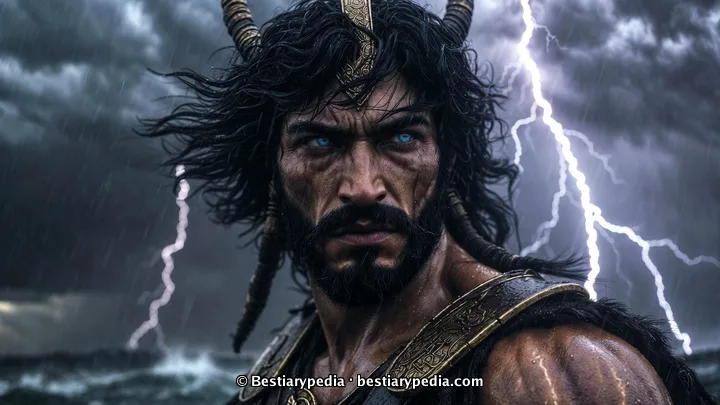
Baal-Hadad
Baal-Hadad, Canaanite god of storm, rain and fertility