Astaroth
Astaroth, grand duke of hell in Goetic demonology
Curated byBestiarypediaCreated onUpdated on


Origins and Demonization of Astaroth
Astaroth is the demonization, within the Judeo-Christian and grimoiric imagination, of the Canaanite and Phoenician deity Astarte (Ashtoreth), goddess of love, fertility and war worshipped in the ancient Levant. In condemning pagan cults, Christian theology transformed the female deity into a male demon: the Hebrew plural «Ashtaroth», which designated the idols of Astarte, became fixed as the proper name of an infernal spirit. It is fitting to clearly distinguish the goddess from the demon, for this is not a literal mythical metamorphosis but a cultural reinterpretation (a variant) by which an ancient numen of fertility was reassigned to the pantheon of evil. As such he figures in Renaissance demonology, and not as a biblical character bearing that name.
Goetic Rank and Powers
In the Ars Goetia, the first part of the Lemegeton or Lesser Key of Solomon, Astaroth is the twenty-ninth spirit, a grand duke of hell who governs forty legions of demons; in Johann Weyer's Pseudomonarchia Daemonum he appears as the twenty-eighth, with the title of duke. Questioned by the operator, he answers truthfully about things past, present and future, discovers secrets and hidden treasures, and teaches masterfully all the liberal sciences (the arts of the trivium and the quadrivium). A singular trait of his tradition is that he willingly answers whoever asks him how the rebel spirits fell and what was the reason for his own fall, a matter on which other demons rarely elaborate.
Iconography and Invocation
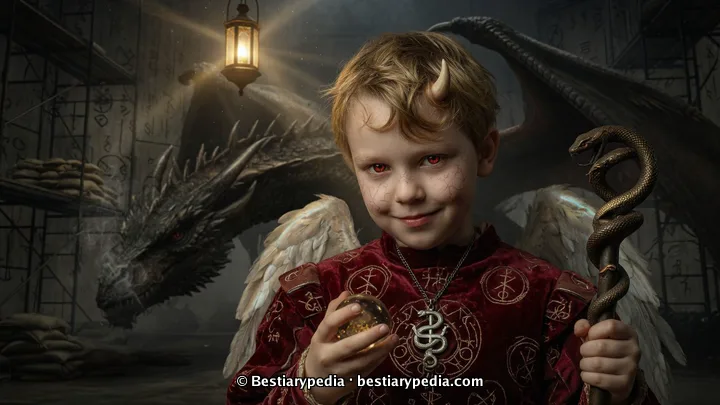
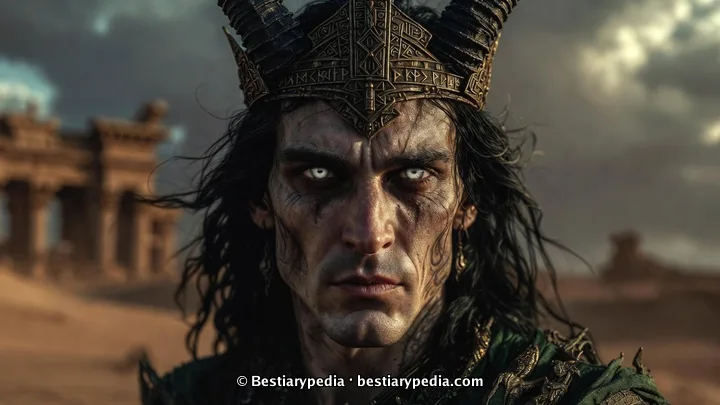
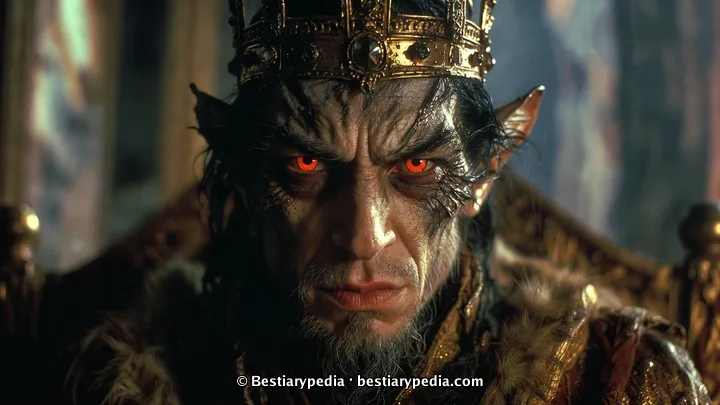
The grimoires describe him as a hurtful or «ugly» angel who rides an infernal beast resembling a dragon (or a wolf) and holds a viper in his hand. Collin de Plancy, in the Dictionnaire Infernal, portrays him as a repugnant and crowned angel. His breath is foul and pestilential, so the exorcist must not let him approach too closely: he must hold the magical ring near his face to protect himself from the stench. Tradition also requires bearing his seal or sigil before invoking him, for otherwise the spirit will not obey. Medieval demonology likewise associated him with sloth and counted him among the princes of hell.
Also known as
Relics
🏺 Scepter of Forbidden Knowledge
Symbology
Element
Fire and Seduction
Number
40
Color
Infernal Red
Animals
Dragon, Serpent
Sigils:
🏷️ Traits
Powers
Weaknesses
Behavioral
Resistances
🗺️In the Atlas
Travel the beings’ world of origin and the cosmos of their dimensions.
📜 Mythologies
The Abrahamic religions comprise Judaism, Christianity and Islam, three monotheistic traditions that share a common origin in the figure of Abraham, regarded as patriarch in all three. Originating in the ancient Near East, Judaism developed among the Hebrews during the second millennium BCE, Christianity arose in the 1st century CE in the context of Second Temple Judaism and Islam appeared in the 7th century on the Arabian Peninsula. Each is based on divine revelations transmitted through prophets and sacred scriptures, such as the Torah, the Bible and the Qur'an, and upholds the belief in a single creator and judge God.
Sources
Pseudomonarchia Daemonum
Johann Weyer · 1577
Catalogue of sixty-nine demons included by Johann Weyer in his work "De praestigiis daemonum" (1577). It describes the infernal hierarchy, its ranks and offices, and is the direct precedent of the Ars Goetia and later Western demonology.
Three Books of Occult Philosophy
Heinrich Cornelius Agrippa · 1533
Renaissance encyclopedia of magic by Heinrich Cornelius Agrippa detailing planetary and angelic correspondences.
Ars Goetia
Anonymous · 1650
First section of the Lemegeton or Lesser Key of Solomon enumerating seventy-two demons.
The Lesser Key of Solomon
Anonymous · 17th century
Anonymous 17th-century grimoire, also called the Lemegeton, composed of five books (Ars Goetia, Theurgia-Goetia, Ars Paulina, Ars Almadel and Ars Notoria). It catalogues celestial and infernal spirits with their hierarchies, seals and rituals of invocation.
Dictionnaire Infernal
Collin de Plancy · 1818
Demonological dictionary by Collin de Plancy (1818), famous for the illustrations by Louis Le Breton in its 1863 edition. It catalogues demons, superstitions and infernal beings, and popularized the visual image of many entities of goetia.
Frequently asked questions
What is the mythological origin of Astaroth according to Abrahamic traditions?
Astaroth represents the final demonic form of the goddess Astarte after her transformation in Abrahamic and Western traditions. His origin is linked to the conversion of Canaanite deities into infernal entities as punishment for pagan worship. He appears in Goetic texts as a grand duke who knows the past and future.
What characteristic powers does Astaroth possess in Goetic demonology?
Astaroth grants knowledge of the past and future and commands demonic love and war. He teaches the liberal arts and reveals hidden treasures. He commands forty legions of demons according to Goetic texts.
What relationship does Astaroth maintain with the goddess Astarte?
Astaroth represents the final demonic form of the goddess Astarte after her transformation in Abrahamic and Western traditions. He is linked to Astarte as a transformation of the Canaanite goddess. This relationship appears in grimoires as a powerful prince of Hell.
How is the iconography and symbology of Astaroth described?
Astaroth is typically depicted as a fallen angel with dragon wings and a serpent in his left hand. He rides a dragon and carries a scepter symbolizing his authority over forbidden knowledge. His appearance merges celestial beauty with infernal corruption.
🔖Cite this entry▾
If you cite this article in an academic, journalistic or editorial publication, use any of these formats:
Bestiarypedia. (2026, July 14). Astaroth. Bestiarypedia. https://bestiarypedia.com/en/beings/astaroth
Free citation with attribution and canonical link for editorial, academic or journalistic use. Full commercial reuse or creation of derivative products requires prior agreement.