Baal-Hadad
Baal-Hadad, Canaanite god of storm, rain and fertility
Curated byBestiarypediaCreated onUpdated on
 Israel(Israel)Holy Land(Israel)
Family Tree






Mythical origins of Baal Hadad
Hadad is the Canaanite and northwestern Semitic god of the storm, rain and fertility, known above all by his title Baal, which means «lord» or «master». In the Ugaritic texts (14th century B.C.) he appears as the son of Dagán (Dagon), the grain god, although he is sometimes also linked to the supreme god El. Lord of the clouds, he is called «the one who rides upon the clouds» and wields the lightning as a spear and the thunder as a voice. As the giver of seasonal rain, on which the harvests of Syria and Canaan depended, Hadad was one of the most important divinities in his pantheon, guarantor of the fertility of the land and of the agricultural cycle.
The Baal Cycle
The great tale of Hadad is the Baal Cycle, preserved in the tablets of Ugarit. In it, Baal confronts Yam, the god of the sea and primordial chaos, and defeats him with two magical maces forged by the artisan god Kothar-wa-Khasis, thereby winning kingship among the gods. After his victory, with the help of his sister and consort Anat and the goddess Asherah, he obtains permission to build his own palace, a symbol of his sovereignty. Later he descends to the underworld defeated by Mot, the god of death and aridity, and his disappearance dries the earth; but Anat destroys Mot and Baal is resurrected, restoring the rain and life. This myth of death and return personifies the cycle of the seasons and the alternation between drought and fertility.
Cult and legacy
The cult of Baal spread throughout Syria-Palestine and was a rival of Israelite Yahwism, which is why the Hebrew Bible repeatedly condemns him as the idol par excellence (the confrontation of the prophet Elijah with the prophets of Baal on Mount Carmel is its most famous episode). Under the name of Hadad or Adad he was also venerated in Mesopotamia and Aram, and in Hellenistic times he was identified with Zeus and Jupiter in his advocation as Jupiter Dolichenus. His iconography (the god with raised arm brandishing the lightning, standing on mountains or bulls) influenced the representation of other storm divinities of the eastern Mediterranean, and his figure remains central to understanding Canaanite religion.
Also known as
Relics
🏺 Bolt of Baal
Symbology
Element
Storm
Number
1
Color
Gold
Animals
Bull of Baal
Sigils:
🏷️ Traits
Powers
Weaknesses
Behavioral
Resistances
🗺️In the Atlas
Travel the beings’ world of origin and the cosmos of their dimensions.
📜 Mythologies
Canaanite mythology developed among the Semitic peoples who inhabited the region of Canaan, located in the eastern Mediterranean Levant, from the late third millennium BCE until the first half of the first millennium BCE. The main sources for its knowledge come from the texts discovered at Ugarit, as well as references in Egyptian, Hittite and Hebrew documents. This tradition formed part of a broader set of religions of the ancient Near East and shared elements with Mesopotamian and Egyptian mythologies, although it retained distinctive features linked to the coastal and agricultural environment of the area. In the Canaanite pantheon, the divinities associated with fertility, storms and the sea occupied a prominent place. Baal, god of rain and vegetation, played a central role in the myths of combat against the forces of chaos, while Asherah, associated with motherhood and sacred trees, figured as the consort of the supreme god El. Other relevant figures included Astarte, Dagan and Mot, who embodied aspects of war, grain and death respectively. Worship was practiced in local shrines and temples, with rituals that sought to ensure agricultural prosperity and the protection of the city-states. The influence of Canaanite mythology is perceived in later traditions of the Levant, especially in the religion of ancient Israel, where certain elements were reinterpreted or rejected. Epigraphic and archaeological remains found in Phoenicia and Palestine attest to the continuity of some cults until the Hellenistic period, at which time a progressive fusion with Greek and Roman divinities took place.
Sources
Second Book of Kings
Anonymous · 600 BCE
Historical book of the Old Testament recounting the end of the monarchies of Israel and Judah. Amid prophets such as Elisha, miracles and divine judgements, it mentions destroying angels and idolatrous practices—a source for the supernatural imagery of the ancient Levant.
Ugaritic Texts
Various (scribes of Ugarit) · c. 1300 BC
Corpus of inscriptions and tablets documenting the mythology, rituals and theology of the Canaanite pantheon in Ugarit.
Frequently asked questions
How does Baal-Hadad emerge in the 14th-century BCE Ugaritic texts?
Baal-Hadad emerges in Ugaritic texts as son of El and successor after defeating the sea god Yam. His rise symbolizes the triumph of cosmic order over primordial chaos. The Ras Shamra tablets describe rituals invoking his power to renew the land each year.
What attributes and symbols characterize Baal-Hadad according to Ugaritic myths?
Baal-Hadad rules storms, thunder and rain that fertilize fields. He is depicted holding lightning in one hand and a scepter in the other. Myths associate him with the bull as a symbol of virile strength and with Mount Saphon as his divine abode.
What relationship does Baal-Hadad maintain with Yam and Lotan in Canaanite cosmology?
Baal-Hadad defeats Yam, the sea god, and the dragon Lotan in cosmic battles. These victories restore order against marine chaos. His triumph establishes his dominion over storms and fertilizing rains.
How did the figure of Baal-Hadad influence the biblical Leviathan and the cultural legacy of the Levant?
With the spread of Abrahamic religions Baal-Hadad was demonized and his figure influenced the biblical image of Leviathan as a defeated chaotic force. His cult persists in fertility rituals and the veneration of local saints in the Levant. Modern studies highlight his role as archetype of the storm god who overcomes chaos.
🔖Cite this entry▾
If you cite this article in an academic, journalistic or editorial publication, use any of these formats:
Bestiarypedia. (2026, July 15). Baal-Hadad. Bestiarypedia. https://bestiarypedia.com/en/beings/baal-hadad
Free citation with attribution and canonical link for editorial, academic or journalistic use. Full commercial reuse or creation of derivative products requires prior agreement.
Similar beings
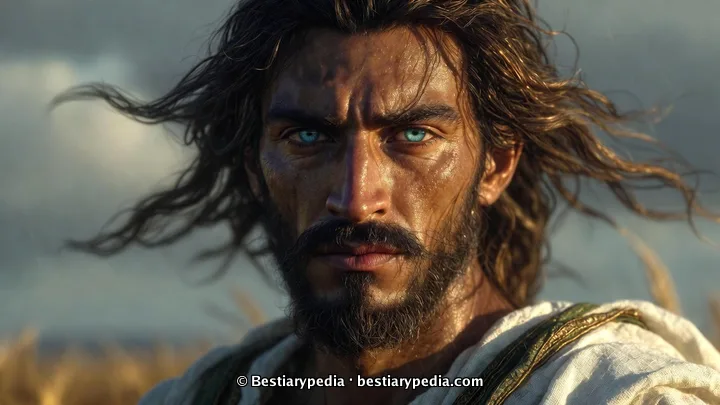
Dagon
Dagon, Canaanite god of the sea, fertility, and agriculture
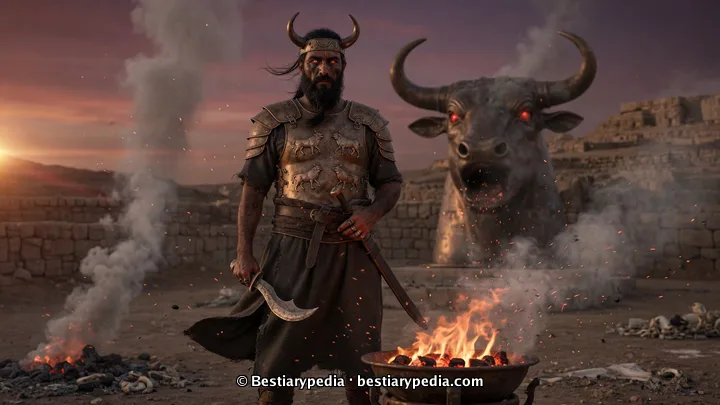
Milcom
Milcom, national Ammonite deity associated with child sacrifice
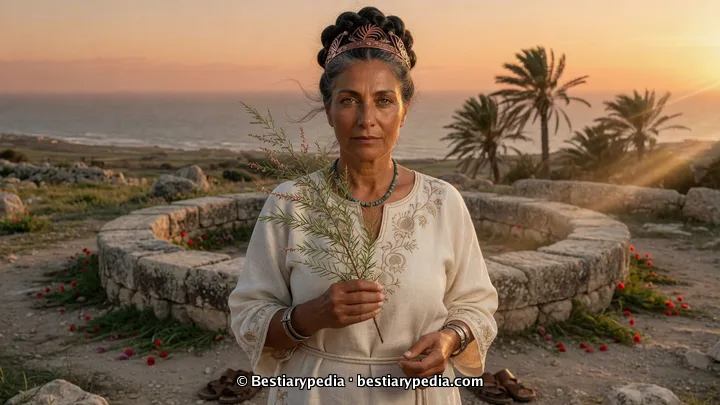
Asherah
Asherah, consort of El and mother of the seventy gods in the Canaanite pantheon

Astarte
Astarte, Canaanite goddess of love, fertility, war and sexuality