Baal
Baal, demonic prince of storm, fertility, and war in Canaanite and biblical traditions
Curated byBestiarypediaCreated onUpdated on
 Israel(Israel)Holy Land(Israel)

Origins of Baal
Baal, identified primarily with the storm god Hadad, is one of the central divinities of the Canaanite and Ugaritic pantheon of the second millennium B.C. His name means «Lord» or «Owner», and often functions as a title applicable to various local divinities. In the clay texts of Ugarit he is presented as son of Dagan and linked to the supreme god El, and he is called «the one who rides on the clouds», lord of rain and fertility. The great Baal Cycle narrates his cosmic battles: first he defeats Yam, the god of the sea and chaos, to secure his reign and build his palace on Mount Zaphon; then he succumbs to Mot, the god of death and aridity, and descends to the underworld, until his sister and consort Anat destroys Mot and Baal resurrects, personifying the annual agricultural cycle of drought and renewal.
Appearance and symbols
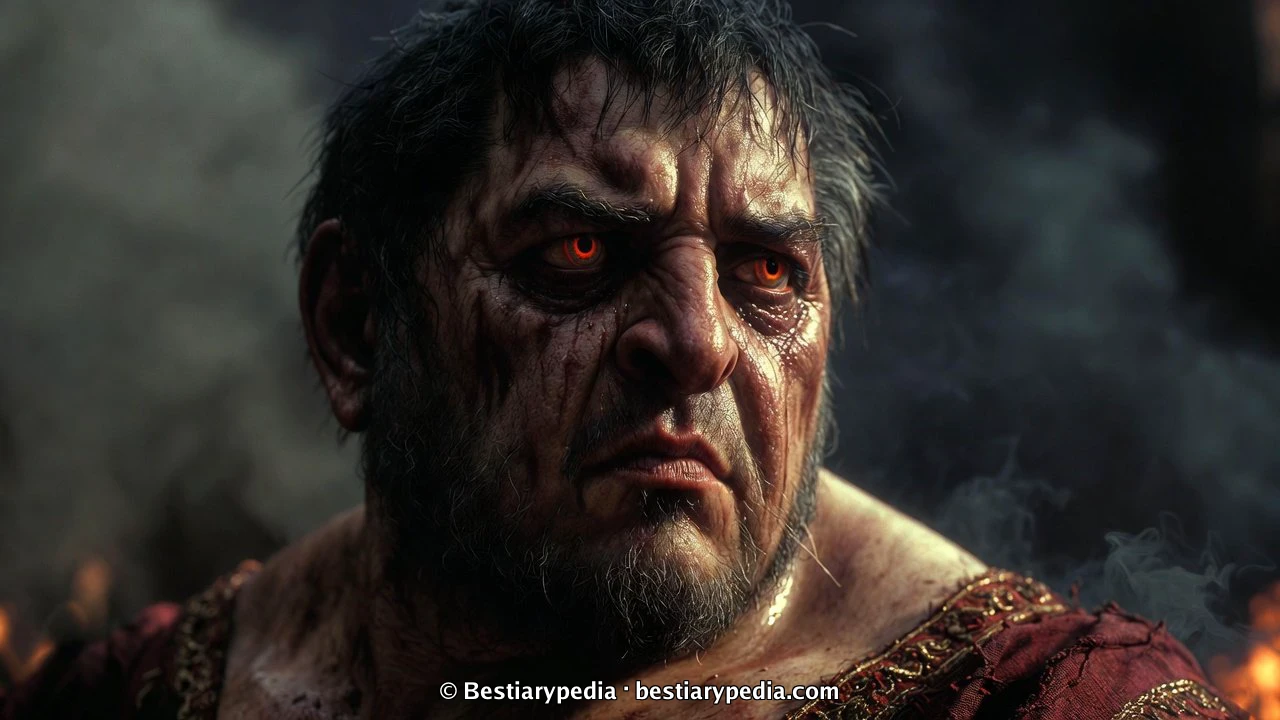
Baal is represented in stelae and Canaanite images as a vigorous warrior wearing a helmet with bull horns, symbol of strength and fertility. In his raised hand he wields a mace or a lightning bolt, and in the other he often holds a spear whose lower part ends in the shape of a plant or a lightning bolt, emblem of the storm that fertilizes the earth. The bull is his sacred animal par excellence, image of potency and fecundity, and sometimes he is shown standing on mountains, on a bull or on a pedestal, with his seat on Mount Safón. His attributes (the bifurcated lightning, the rain clouds and the peaks) reflect his role as organizer of the climate against drought and marine chaos.
Cult and biblical controversy
The cult of Baal was very widespread throughout the Levant and Phoenicia, with sanctuaries on the tops of the mountains and large temples such as those of Ugarit or Baalbek. The rites sought to ensure rain and harvests through animal sacrifices, especially bulls, and fertility offerings. Biblical sources, written by their adversaries, attribute to these cults practices of sacred prostitution and child sacrifices, although today research considers both accusations disputed and probably exaggerated, understood in part as religious polemic of Yahwism against neighboring cults. The Hebrew Bible presents Baal as the great rival of Yahweh and the idol that seduces Israel, and the most famous episode is the challenge of the prophet Elijah to the prophets of Baal on Mount Carmel, where the fire of Yahweh triumphs over the Canaanite god.
Legacy and Demonization
With the rise of the Abrahamic religions, the great Canaanite Baal was reduced to a demonic figure. His epithet Baal-Zebub («Lord of the Flies»), name of a Philistine advocacy of Ekron mentioned in 2 Kings, derived into the demon Beelzebub of Christian demonology, and under the name of Bael he heads the catalog of the Ars Goetia. The prophets (Hosea, Jeremiah) condemn him as a false god who turns Israel away from its covenant. In the academic field, on the other hand, Baal is studied as one of the first and most influential examples of the myth of the storm god who dies and resurrects, a pattern that illuminates the understanding of the religions of the ancient Near East and their fertility cycles.
Also known as
Relics
🏺 Spear of Baal
🏺 Forked Lightning
Symbology
Element
Storm
Number
1
Color
Gray
Animals
Young Bull
Sigils:
🏷️ Traits
Powers
Weaknesses
Behavioral
Resistances
🔗 Relations with other beings
🗺️In the Atlas
Travel the beings’ world of origin and the cosmos of their dimensions.
📜 Mythologies
The Abrahamic religions comprise Judaism, Christianity and Islam, three monotheistic traditions that share a common origin in the figure of Abraham, regarded as patriarch in all three. Originating in the ancient Near East, Judaism developed among the Hebrews during the second millennium BCE, Christianity arose in the 1st century CE in the context of Second Temple Judaism and Islam appeared in the 7th century on the Arabian Peninsula. Each is based on divine revelations transmitted through prophets and sacred scriptures, such as the Torah, the Bible and the Qur'an, and upholds the belief in a single creator and judge God.
Sources
Ars Goetia
Anonymous · 1650
First section of the Lemegeton or Lesser Key of Solomon enumerating seventy-two demons.
Second Book of Kings
Anonymous · 600 BCE
Historical book of the Old Testament recounting the end of the monarchies of Israel and Judah. Amid prophets such as Elisha, miracles and divine judgements, it mentions destroying angels and idolatrous practices—a source for the supernatural imagery of the ancient Levant.
Ugaritic Texts
Various (scribes of Ugarit) · c. 1300 BC
Corpus of inscriptions and tablets documenting the mythology, rituals and theology of the Canaanite pantheon in Ugarit.
Frequently asked questions
How is the mythical origin of Baal described in the Ugaritic texts?
Baal, known as Baal Hadad, emerges as chief god of storms and fertility in Canaanite and Ugaritic traditions from the 14th century BCE. In clay texts from Ugarit he is portrayed as son of Dagan or High El. His name means 'Lord' and he is titled Rider of the Clouds.
What attributes and symbols characterize the iconography of Baal?
Baal is depicted as a majestic warrior wearing a helmet with young bull horns. He grasps a spear or forked lightning and stands upon a lion or sea dragon. His main symbols are forked lightning, rain-bearing clouds, and Mount Zaphon.
What mythical relations does Baal maintain with other Canaanite gods?
Baal is son of Dagan or High El. His sister and consort is fierce Anat, and his lover Astarte. Among his sons are Baal-Berith and Baal-Hammon. In the mythical cycle he confronts Yam and Mot, gods of the sea and death.
What place does Baal occupy in the demonic hierarchy according to Ars Goetia?
In Ars Goetia Baal appears as prince of demons known as Baal-Zebub. He rules sixty-six legions of demons. His transformation into a demonic figure reflects the shift from Canaanite god to adversary of Yahweh in Abrahamic traditions.
🔖Cite this entry▾
If you cite this article in an academic, journalistic or editorial publication, use any of these formats:
Bestiarypedia. (2026, July 26). Baal. Bestiarypedia. https://bestiarypedia.com/en/beings/baal
Free citation with attribution and canonical link for editorial, academic or journalistic use. Full commercial reuse or creation of derivative products requires prior agreement.